Objects
When Service Selection Becomes a Matter of Order
A 2015 invention for finding broadcast channels keeps resurfacing just as NextGen TV becomes a licensing problem.

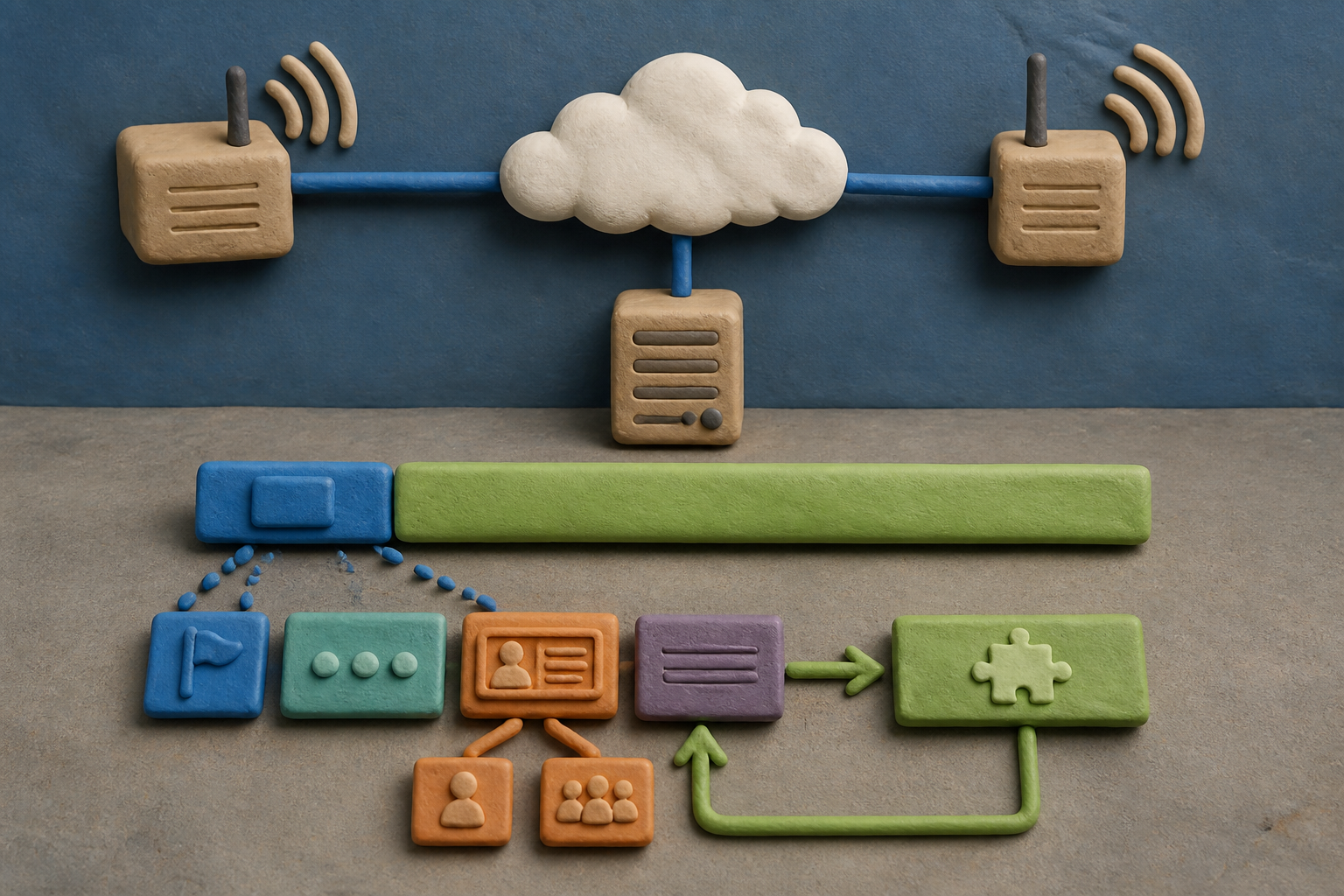
What changes in this design
Without more detail, a reader might expect a receiver to get channel-selection instructions and use them with incoming service data. The record does not say how that is ordinarily handled.
Here, the receiver also receives information showing the order in which the channel-selection instructions were sent. Once it has those instructions, it uses them to control its processing of other data that contains part of the service.
The important point is that the receiver gets information about sending order as well as channel-selection information. The record connects those instructions to later processing of other service-related data, but does not state the practical outcome.
The $6.75 television
In 2024, LG halted production of ATSC 3.0-compatible televisions after a jury set a $6.75-per-unit royalty on a different cluster of broadcast patents. That price was more than double the $2.75 to $3.00 per-receiver rate advertised by the industry's large collective licensing pools. The number that stopped me was not the damages total but the per-set charge: it turns an invisible part of television reception into a line item that can change a product decision.
That dispute is not this patent family. I found no material here tying US20260254764A1, or its listed assignee Saturn Licensing LLC, to the case against LG. But it establishes the commercial condition surrounding the new filing: a receiver feature can be technically ordinary, deeply embedded in a broadcast standard, and still become expensive when rights are licensed one portfolio at a time.
One shared transmission band
That is the context for a filing with the grandly generic title Transmission Device, Transmission Method, Reception Device, And Reception Method. Its core concern is less grand. A receiver obtains one stream of data with the instructions needed to choose a service, plus information about the order in which those instructions are transmitted. It then uses those instructions to process a second stream that carries a component of that service.
The earlier family application explains why order matters. In an ATSC broadcast, several service providers can share a transmission band, so a receiver cannot assume that a single provider's fast-update tool will organize everything it sees. The 2016 document puts low-layer signaling, service-layer signaling, and the ROUTE protocol to work sorting urgent and non-urgent control information. The technical point I take from it is simple: before a television can show the right thing, it has to know which small instructions arrived first and which can wait.
Eleven years of continuations
The priority date is February 10, 2015. A Sony team filed the first published U.S. application in 2016; the chain later produced a patent granted in 2022, another granted in 2024, and the current 2026 publication. Ownership was reassigned from Sony to Saturn Licensing LLC in 2020, and the 2024 patent record identifies a further continuation filed in February that year.
I read that trail less as a late technical breakthrough than as a determined effort to keep a particular receiver operation in play while the market catches up to it. A related application from the same inventor team, with a 2014 priority date, dealt with hybrid broadcast-and-internet delivery and metadata flags for basic and hybrid services. Together, the records place this filing inside a longer effort to define the handoff from traditional transport streams to IP-based broadcasting.
Seventy-six percent of homes
The standard is no longer a laboratory project. Its deployment page reports that NextGen TV reaches more than 76% of U.S. households, while deployments have also advanced in South Korea, Jamaica, and Trinidad and Tobago. The federal communications regulator, meanwhile, adopted a proposal in October 2025 to end the mandatory older-standard simulcast requirement, then scheduled to sunset on July 17, 2027, without setting a replacement deadline.
Those two facts pull in opposite directions for this kind of right. Wider receiver deployment means more devices potentially using the signaling behavior. A more voluntary transition could make the timing of that demand less predictable. For my purposes, the important point is not that US20260254764A1 will decide the transition. It is that a claim about choosing services gains commercial weight only when broadcasters, set makers, and viewers move together.
Where the risk actually sits
Public licensor lists create the unresolved part of the story. One pool's 2024 list of 17 licensors names neither Sony nor Saturn Licensing LLC. A second pool lists Sony but not Saturn Licensing LLC and says it represents more than 80% of declared essential patents. Neither omission proves that this family sits outside a pool. I cannot tell from the lists alone whether a manufacturer receives coverage for this exact line through another arrangement.
That uncertainty matters more than the filing's tidy data sequence. In April 2026, a federal appeals court ruled the other case's optimization claims patent-ineligible as abstract ideas, while narrower constellation-configuration claims survived. The risk, in my view, lies neither in the fact that receivers need control data nor in the idea that a 2015 invention has been kept alive. It lies in the gap between a standard that is spreading, rights whose coverage is not plainly visible, and a product market already shown to react to a per-unit royalty.
Sources
Reporting for this piece drew on the published filing and the references below.
- US20260254764A1 - Transmission Device, Transmission Method, Reception Device, And Reception Method
- LG halts production of ATSC 3.0-compatible TVs over patent concerns
- Constellation Designs, LLC v. LG Electronics Inc.
- ATSC 3.0 - Via Licensing Alliance
- Avanci Broadcast
- A Simulcast Sunset on the Horizon as FCC Adopts NextGen TV NPRM
- Deployments - ATSC: NextGen TV
The record, briefly. US20260254764A1, “Transmission Device, Transmission Method, Reception Device, And Reception Method” The reception device receives first data containing control information needed for channel selection of a service, plus transmission sequence information indicating the order in which that control information is sent, and uses the acquired control information to control processing on second data holding a component of the service.
Identity details. The saved title-page transcription needs review, so names are not repeated here. Check the official published title page.
More angles on this
- When a Queue Waits for Its CueAnother reading from the same H04L classification family, transmission of digital information, e.g. telegraphic communication.
- The Reply Arrow's Quiet HandoffAnother reading from the same H04L classification family, transmission of digital information, e.g. telegraphic communication.
- CPC H04L: Transmission of digital information, e.g. telegraphic communicationThe official classification family this record was filed into, published in the USPTO Cooperative Patent Classification scheme.
- CPC H04H: Broadcast communicationThe official classification family this record was filed into, published in the USPTO Cooperative Patent Classification scheme.
- Tracking Wireless Monitoring With Reduced Data Loss Questions the Default ArrangementAnother reading from the neighbouring H04W classification family, wireless communication networks.
Read around this one:Public patent recordUSPTO published figure