Objects
Connecting Device And System Marks a Pause Worth Noticing
To shed bulky air hoses from millions of industrial arms, a new robot tool changer relies entirely on the twisting motion of the wrist itself.

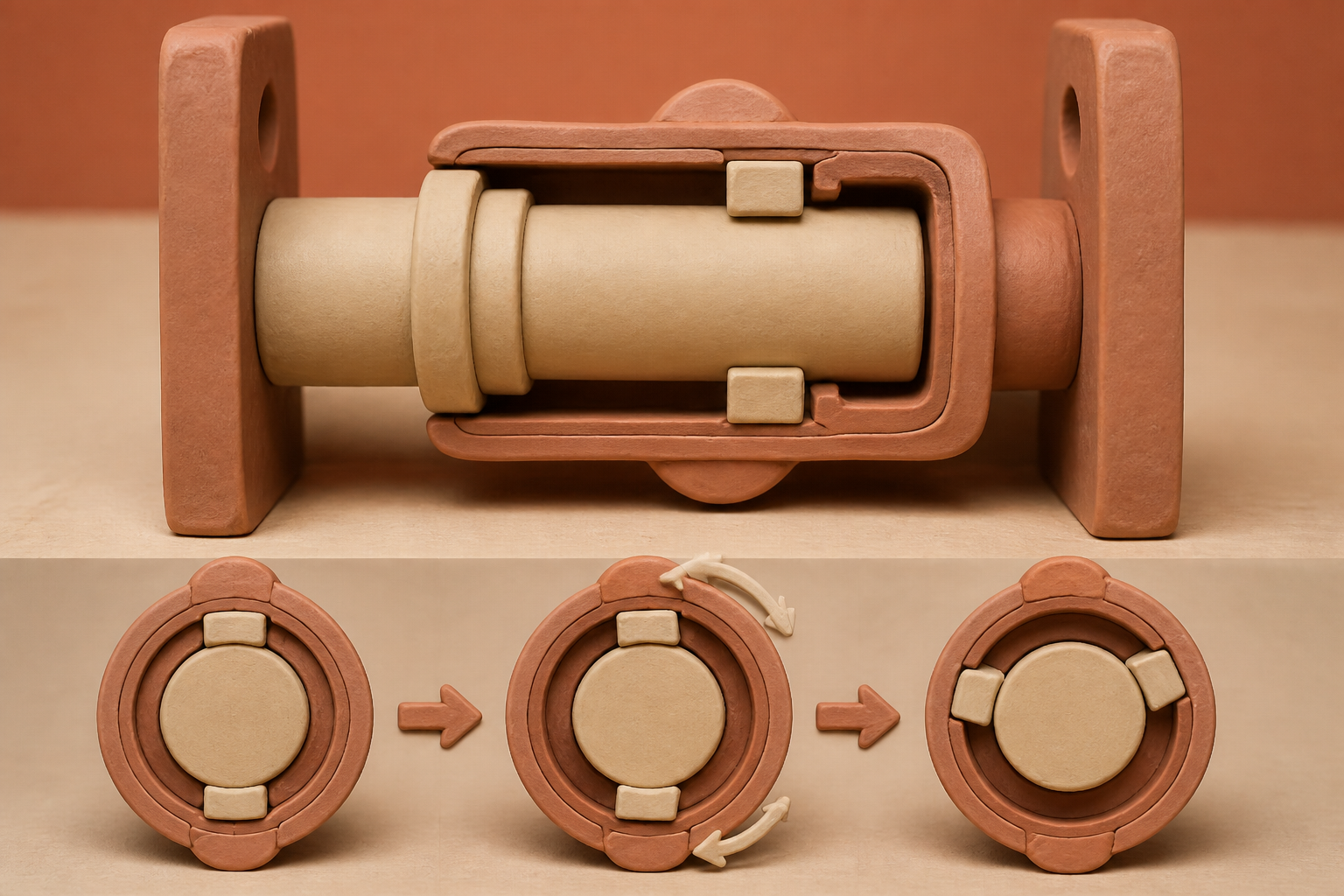
What changes in this design
When two objects must latch together, people often expect a mechanism that requires pulling a lever, pressing a release button, or battling stiff friction clips.
In this design, the connection relies on paired coupling pieces that disengage through rotation. Twisting the parts around the same central axis used for plugging them together shifts the internal locking elements directly into an open position, freeing the pieces.
Understanding this mechanical approach shows how everyday fastening can work reliably without requiring extra external release buttons. A single alignment line accommodates both pushing the joint closed and twisting it apart.
The weight on the factory wrist
Across the world's factory floors, there are now 4,664,000 industrial robots at work. The International Federation of Robotics counted 542,000 new installations in 2024 alone, pushing factory density to 267 robots for every 10,000 manufacturing workers in Western Europe and 204 in North America. Those machines do everything from spot welding car chassis to packing medicine boxes. Yet despite decades of refinement, the very tip of the mechanical arm remains an awkward bottleneck.
Every time an arm switches tasks, it must swap its end effector. That might mean trading an impactive mechanical gripper for ingressive needle grippers or an astrictive vacuum cup. Watching an industrial arm swap tools on a line, you quickly realize how much dead weight we still force these machines to carry. Most automated couplers depend on dedicated air lines or supplementary electric actuators just to latch onto a new tool. That extra hardware adds bulk, increases maintenance, and eats into payload capacity.
Augsburg's mechanical detour
The challenge is acute for KUKA Deutschland GmbH. Founded in Augsburg in 1898, the German machinery builder spent over a century expanding into a global automation powerhouse with roughly 14,000 employees. After China's Midea Group completed a full takeover, squeezed out minority shareholders at €80.77 per share, and delisted the firm in November 2022, its engineering focus has pushed hard toward flexible, modular systems.
In modern plants, modular arms paired with KR C5 controllers and mobile platforms like the KMR series cannot afford messy external support lines. Traditional automatic tool changers, borrowed from machining centres where drum magazines hold fewer than 30 tools or chain racks use 180-degree swiveling arms, rely heavily on pneumatic pistons. Running pressurized air hoses along an articulated arm creates drag, limits rotational freedom, and introduces leak points. If a mobile robot is roaming an aisle, hauling a dedicated compressor setup is the last thing anyone wants.
Twisting to unlock
That brings us to a recent patent application, published under US20260258823A1 with the straightforward title "Connecting Device And System". What caught my eye in the published record was the complete absence of secondary motors, hydraulic lines, or pneumatic valves in the coupling interface.
Instead, the filing describes a purely mechanical latching system driven by the robot's own articulation. The device connects a first object to a second object along a plugging direction. To detach, an unlocking mechanism on the counter-coupling responds to a relative rotation between the coupling parts around an axis parallel to that insertion path. As the robot wrist rotates, it moves internal locking elements into an unlocking position where they disengage, freeing the tool. The robot simply pushes in, twists its wrist to release or latch, and pulls away.
The problem with rigid metal
I spent an afternoon looking through recent robotics research to see why this approach is not already universal. The concept seems clean on paper, but physical docking in an unconstrained environment is notoriously unforgiving. Roboticists studying tool changers have analyzed how motorized cams rotating from 0 to 60 degrees convert rotational motion into linear locking pin engagement, while warning that rigid mechanical couplings frequently fail when docking autonomously.
Without compliant alignment, even minute rotational or lateral misalignments cause jamming. Studies show that passive geometric lead-ins must absorb errors of up to 7 millimeters to achieve 90 to 100 percent docking reliability without relying on expensive multi-axis force and torque sensors. When rigid metal meets rigid metal, forced rotation can chew up locking pins or place severe stress on the wrist gearbox. In collaborative workspaces, excessive docking resistance can also violate the strict contact and torque thresholds set by safety standards like ISO 10218 and ISO/TS 15066.
Where this leaves things
To my mind, the trade-off is much sharper than the filing suggests. I am not convinced that factory floors will readily gamble their wrist gearboxes on an interface with zero compliance. If an arm docks slightly off-axis, a stubborn mechanical interlock can trigger an emergency stop or strip a gear before the counter-coupling ever rotates into its release slot.
Yet our appetite for lighter, untethered mobile robots might force the issue anyway. Stripping away pneumatic hoses and auxiliary motors makes every arm leaner, faster, and cheaper to run on battery power. If KUKA can pair this wrist-rotated mechanism with compliant lead-in geometry, the design could solve one of the messiest plumbing problems in modern robotics. Until then, getting rid of the air hose remains a delicate balancing act between mechanical simplicity and positioning precision.
Sources
Reporting for this piece drew on the published filing and the references below.
- US Patent 20260258823: Connecting Device And System
- KUKA - Wikipedia
- About KUKA | KUKA Global
- New IFR Position Paper: The Impact of Robots - International Federation of Robotics
- Designing and Validating a Self-Aligning Tool Changer for Modular Reconfigurable Manipulation Robots
- Automatic tool changer - Wikipedia
- Robot end effector - Wikipedia
- Cobot - Wikipedia
The record, briefly. US20260258823A1, “Connecting Device And System” A connecting device mechanically interlocks a first object to a second object. An unlocking means on a counter-coupling means responds to relative rotation between coupling and counter-coupling means about an axis parallel to the plugging direction, moving locking elements into an unlocking position where they disengage to allow separation.
More angles on this
- CPC F16B: Devices for fastening or securing constructional elements or machine parts togetherThe official classification family this record was filed into, published in the USPTO Cooperative Patent Classification scheme.
- A Sleeve's Context HandoffAnother reading from the neighbouring F16L classification family, pipes.
- Inside systemAnother reading from the wider F26B classification family, drying solid materials or objects by removing liquid therefrom.
- Measurement Method, Observation Device, And Program Makes the Next Move Easier to SeeAnother reading in the same Objects category on this site.
Read around this one:Public patent recordUSPTO published figure