Machines
Cutting Tool, And Method For Manufacturing Machined Product Treats the Relationship as the Point
A new cutting-tool patent arrives after two decades of sensor promises, in an industry still struggling to trust the signals.

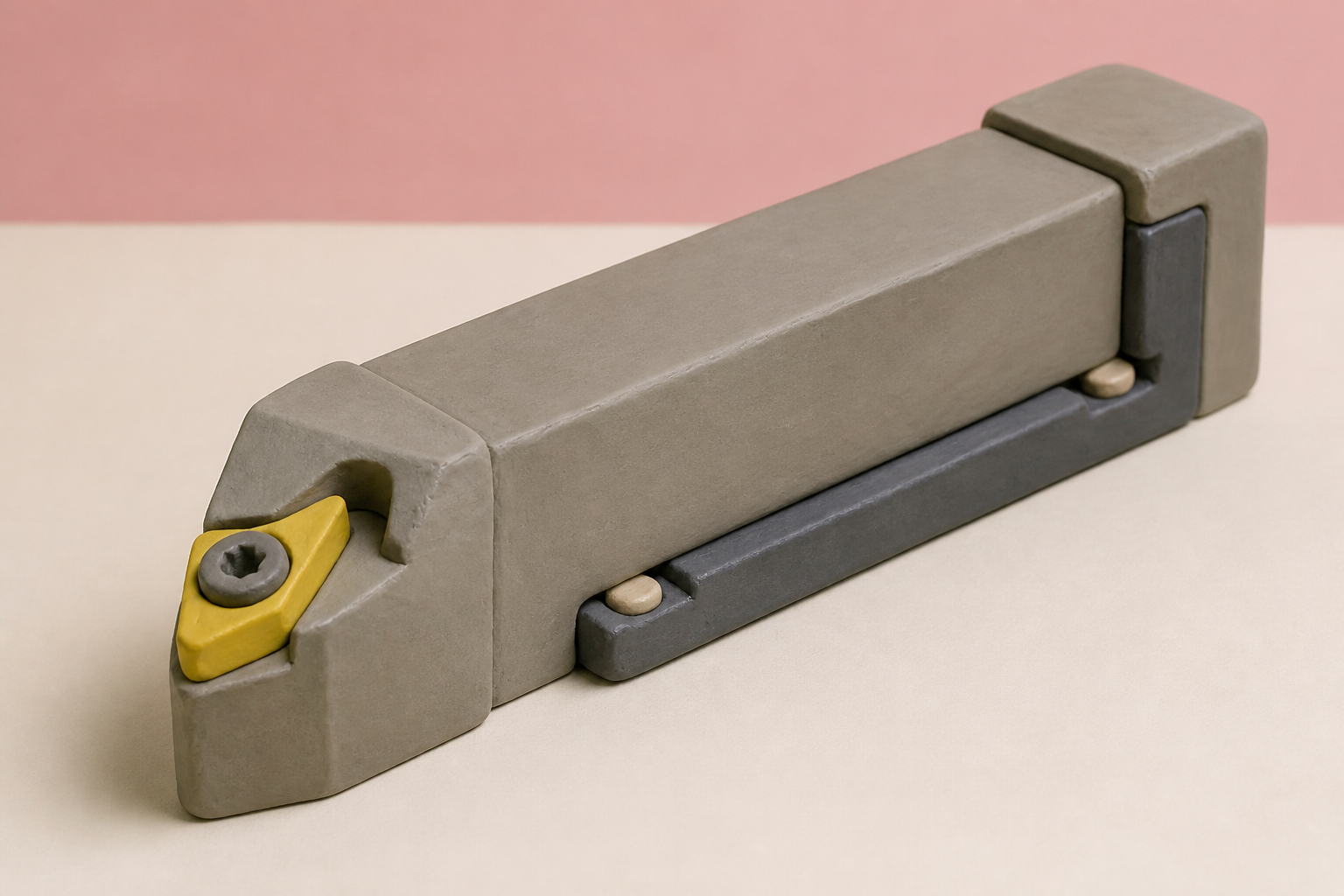
What changes in this design
When people picture a cutting tool, they often focus on the cutting piece and the holder that carries it.
Here, the holder has a pocket for the cutting insert and also carries a sensor unit. Its L-shaped supporting piece contacts the holder’s lower surface and its second side surface.
That placement makes the sensor unit’s physical relationship to the holder clear. What sensing role it has, and what manufacturing result follows, are not stated.
Fifteen percent more
In 2003, Kyocera sold a Sensor Tool System insert that could detect edge wear or damage and alert a machine controller immediately. It cost about 15 percent more than a standard silicon-nitride indexable insert. The sales case was not subtle: on brake-disc production lines, the company said, the system could cut process costs by as much as 40 percent.
That old device matters because it makes the current filing feel less like a sudden leap than another turn in a very long effort to make a cutting tool report on its own condition. Factories have wanted that report for obvious reasons. A worn edge can spoil a part, break a tool, interrupt a line, or leave an operator discovering the problem after material and time are already gone. The promise has always been early warning, delivered while there is still something useful to do with it.
Signals that will not settle
The hard part is not merely putting a sensor near the cut. A 2024 engineering paper described a wireless milling holder with strain gauges, a triaxial accelerometer, and a Pt1000 temperature sensor sampling at 10 kHz. It also reported losing roughly 20 Bluetooth packets each second and found its axial-force signal noisy. That is a serious reminder that a working prototype and a dependable production tool are different achievements.
A peer-reviewed review published in 2022 reached an even blunter conclusion: indirect readings such as force, vibration, and acoustic emission remain less accurate and heavily dependent on process parameters, and no “comprehensive, reliable and friendly solution” had emerged for real-time industrial use. The gap, I think, is where the interesting work still is. A sensor can be correct about motion and still be wrong about what that motion means for a particular insert, material, machine, speed, and cut.
An L-shaped base
That is the setting for US20260257282A1, published as “Cutting Tool, And Method For Manufacturing Machined Product.” Its holder has a pocket for the cutting insert. A sensor unit is placed in the holder with an L-shaped base contacting the lower surface and a second side surface. The arrangement sounds modest, but mounting is not an incidental problem when the object carrying the electronics is repeatedly exposed to force, heat, chips, coolant, and vibration.
Kyocera has been working through related arrangements for years. Its US12103088B2, filed in 2020 with a 2019 priority date, describes a holder pocket, a wireless sensor positioned nearer that pocket than its antenna, and an antenna encased in resin near the holder's rear end. That earlier design contemplated readings for temperature, vibration, acceleration, strain, internal stress, and wear. The naming and architecture give this new application a clear corporate lineage. I cannot tell from the published material whether this particular mounting detail will prove more durable or more useful in the field.
The route out of the machine
Even a perfectly placed sensor needs a route from the holder to somebody's decision. The data standards behind that route did not arrive overnight. MTConnect began in 2008, while its mobile-assets vocabulary for cutting tools, built on ISO 13399 tool data, was formally added in 2012. The physical tool, its digital identity, and the software watching a shop floor have had to learn how to meet each other.
Competitors have already made a commercial case for instrumented holders. Sandvik's Silent Tools Plus uses vibration and temperature sensing in a turning adaptor, while its Capto DTH Plus sends vibration, spindle-temperature, RPM, and rotation-direction data by Bluetooth so maintenance can follow actual need rather than a fixed schedule. That makes the new filing neither an isolated idea nor a guarantee of adoption. For my money, the question is not whether tools can produce data. They plainly can. It is whether that data remains trustworthy enough to change a decision before damage is done.
What the filing is really betting on
One market-research estimate puts the wider CNC machine condition-monitoring sensor market at $1.38 billion in 2025 and projects $3.41 billion by 2032. The estimate does not separate tool-wear sensors, so it should not be mistaken for a measure of demand for this exact kind of holder. Still, it describes the commercial pressure around the work: more machines are becoming measurable, and the value of avoiding an unplanned stop is easy to understand.
The company pursuing this patent also faces a less comfortable backdrop. A January 2025 report said Kyocera's group operating profit had fallen 54 percent from its FY2021 peak and that it planned about $1.27 billion in divestitures of non-core businesses with weak profit prospects by March 2026. No link between that report and this filing is established, and we should not invent one. But the coexistence is telling. The patent is betting that the old ambition survives its practical failures: put sensing close enough to the cut, protect it well enough to last, and turn a difficult signal into an action a factory will trust. The number I keep returning to is not the market forecast. It is the roughly 20 lost packets per second in the lab test.
Sources
Reporting for this piece drew on the published filing and the references below.
- US20260257282A1 - Cutting Tool, And Method For Manufacturing Machined Product
- Holder, cutting tool, method for manufacturing machined product, and method for collecting data
- Cutting tools from Kyocera - Focus on profitability
- Multi-Sensory Tool Holder for Process Force Monitoring and Chatter Detection in Milling
- Tool Condition Monitoring for High-Performance Machining Systems - A Review
- The ISO 13399 and MTConnect Connection
- Data at the cutting edge: tooling sensors for every application
- New connected driven tool holder solution maximizes machine utilization
- CNC Machine Condition Monitoring Sensors Market
- Kyocera to divest US$1.27 billion in non-core business amid 3-year profit decline
The record, briefly. US20260257282A1, “Cutting Tool, And Method For Manufacturing Machined Product” A cutting tool includes a holder, cutting insert, and sensor unit. The holder has a front end surface, upper and lower surfaces, side surfaces, and a pocket holding the insert. The sensor unit's L-shaped base contacts the lower and second side surfaces.
More angles on this
- CPC B23B: Turning; boringThe official classification family this record was filed into, published in the USPTO Cooperative Patent Classification scheme.
- Welding-Type Systems Using Fluid Sensors With Bond Resisting Substances Makes the Next Move Easier to SeeAnother reading from the neighbouring B23K classification family, soldering or unsoldering.
- The Moment a Remediation System Hands OffAnother reading from the wider B09C classification family, reclamation of contaminated soil.
- What a Steelmaking Sequence Leaves for JudgmentAnother reading in the same Machines category on this site.
Read around this one:Public patent recordUSPTO published figure