Machines
What a Steelmaking Sequence Leaves for Judgment
A new U.S. steelmaking filing joins the long attempt to replace protective coatings with alloys that defend themselves in the furnace.

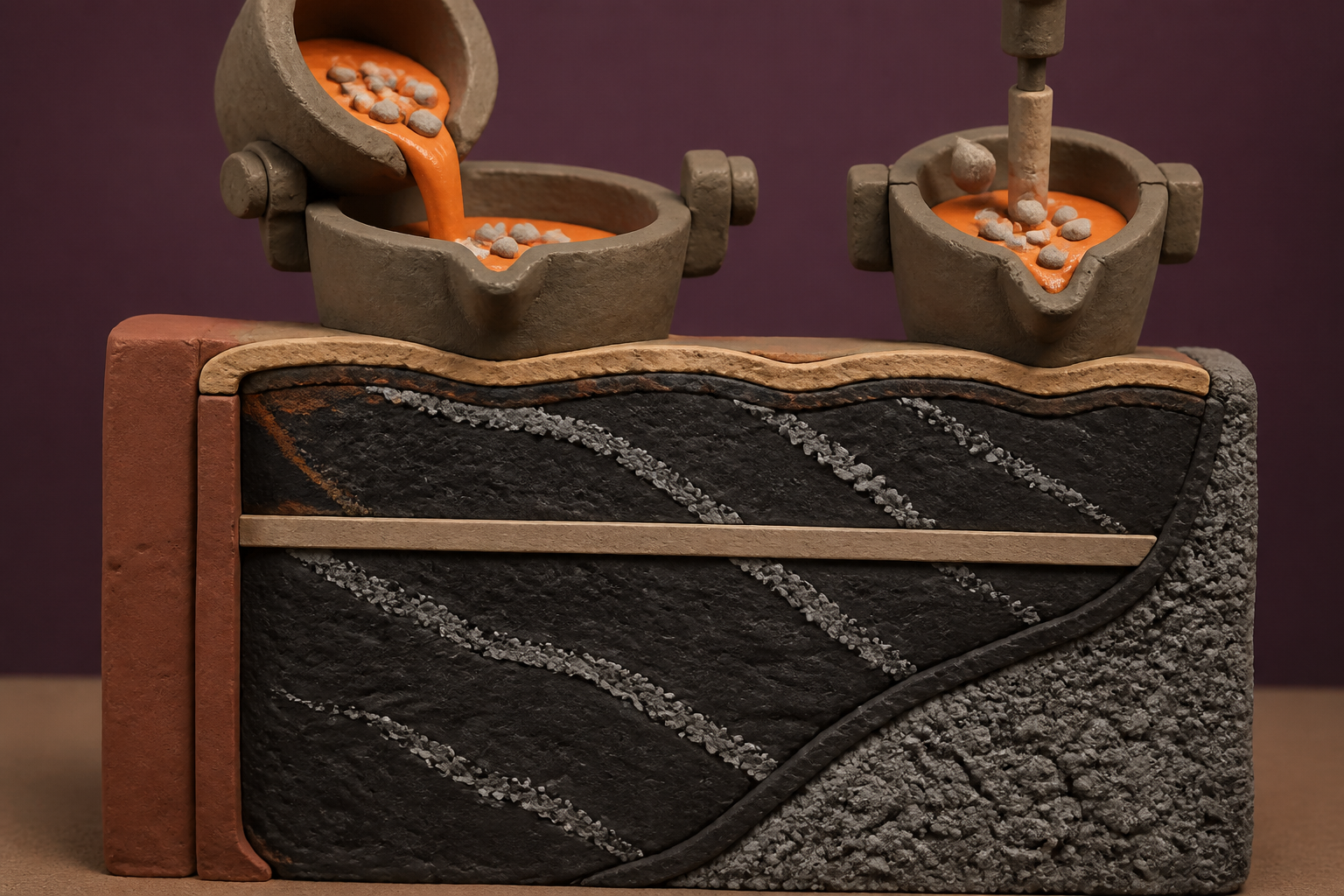
What changes in this design
A reader might imagine one preparation step followed by pouring. In this setting, the work includes preparing alloyed steel and casting it continuously, with a mold-side material involved in heat transfer and lubrication.
Alloy ingredients are added at the ladle stage and at LF refining. The casting step uses low-basicity mold fluxes, materials placed at the mold, for uniform heat transfer and lubrication.
It draws attention to both the timing of alloy additions and the mold material used during casting. That helps a reader see that the method covers more than the steel ingredients alone. What it measures, or what results it delivers, is not stated.
A door beam in 1984
The part was a door beam in the 1984 Saab 9000, and it marks where I start with this new steelmaking patent. Press hardening had been patented in Sweden in 1977, but the beam put a practical promise into a car: shape the part hot, harden it in the die, and make a thin piece shoulder crash loads. The idea moved from specialized protection to an ordinary way of building a safer body shell. By 2016, one review says, press-hardened steel could make up as much as 60% of some body-in-white structures. That is an extraordinary change for a process most drivers will never see. The sequence matters because it separates forming from final strength: the part can be shaped while hot and asked to do structural work after the die has hardened it. For me, that pairing is the industrial turning point, turning a metallurgical technique into a repeatable way to allocate crash performance across a production body.
Usibor's long shadow
Strength was only half of it. Steel heated for stamping also oxidizes, and the usual answer became an aluminium-silicon coating. A French steelmaker commercialized Al-Si-coated Usibor 1500 in 1998, making it possible to heat and form sheet without accepting a heavy oxide scale and a cleaning operation afterward. A 2005 Volkswagen Passat carried press-hardened steel at roughly 19% of its body-in-white weight, a marker of how firmly the coating-led approach entered carmaking.
The question I care about is not whether that coating was valuable. It was. The question is whether its success has made a different answer seem less urgent: make the steel resist oxidation through its own chemistry. It is a consequential division of labor: the coating carries the oxidation burden through heating and forming, while the press-hardening route delivers the shaped, strong part. That helps explain why a chemistry-first alternative must be measured against an established manufacturing system, not against an abstract coating.
The molten bottleneck
US20260257267A1 enters at a much less glamorous point in that effort. The filing covers a smelting and continuous-casting method for high Cr-Si alloyed hot-formed steel, with alloy additions at ladle and ladle-furnace refining stages. It also calls for a low-basicity mold flux intended to provide even heat transfer and lubrication as the steel is continuously cast.
That flux is not a footnote. In work on low-alloy peritectic steel, researchers identify the practical targets a mold flux must balance: a melting point below 1200 C, viscosity below 0.1 Pa s at 1300 C, and a crystallization cooling rate above 50 C/s. Basicity and sodium-oxide content are tools for managing the conflict between heat transfer and lubrication. Those measurements are not a specification for this Cr-Si alloy, but they show why I read the filing as a manufacturing claim, not simply an alloy recipe. Read together, the targets describe a narrow process window rather than independent material preferences. A flux that must meet melting, flow and crystallization goals simultaneously makes alloy chemistry, furnace practice and casting behavior part of one manufacturing problem.
Fifty times thinner
The alloy route was already being pursued beyond steelmakers. A 2020 General Motors research program described a 20MnCr press-hardened steel reaching 1.7 GPa with oxidation resistance intended to eliminate post-stamping shot blasting, alongside a 34MnBV grade near 2.0 GPa. This filing therefore joins an active technical contest rather than opening a new category.
A 2023 study gives that contest a startling number. Its coating-free Cr-Si-Mn steel formed an oxide scale about 0.13 micrometres thick after hot stamping, compared with 6.36 micrometres for conventional 22MnB5. The number that stopped me, I admit, is the nearly 50-fold difference. The same study reported 8-9% total elongation, against 6-7% for comparable Al-Si-coated grades.
Those results do not establish a commercial winner, and we should not treat a published comparison as proof that every stamped part will behave the same way. They do show that alloy-based oxidation resistance is capable of being more than a substitute for coating. It may improve a core failure mode. The scale comparison also gives the GM program's stated shot-blasting goal a technical rationale, without establishing that this patent achieves that outcome. A thinner scale matters because the comparison is not merely between two surface treatments; it concerns whether an oxidation-control strategy can remove work from the production route.
The harder half of the problem
Corrosion keeps the answer from becoming tidy. A 2024 comparison found that Al-Si-coated steel resists corrosion better than bare steel before stamping, yet after hot forming the coating developed microcracks and iron pickup and failed within nine hours of salt-spray testing. Uncoated cold-rolled and CSP hot-rolled steels posted comparable corrosion rates of 1.156 and 1.538 mm per year in that study.
I cannot find, in the published work gathered here, an answer to whether a coating-free Cr-Si steel gives up cathodic corrosion protection that coatings were also designed to provide. For my part, that gap is the central reason not to call the alloy route a settled replacement. The patent may improve the route from molten steel to a self-passivating stamped sheet, but the full vehicle-corrosion problem does not end at the casting mold. The reported comparison shifts the question rather than resolving it: the coating is an advantage before stamping, then its post-forming behavior becomes a separate failure mode. That is why oxidation resistance in the furnace and corrosion protection on the vehicle remain related, but not interchangeable, tests.
Sources
Reporting for this piece drew on the published filing and the references below.
- Smelting And Continuous Casting Method For High Cr-Si Alloyed Hot-Formed Steel
- PHS in Automotive Applications: An Abridged History
- Multi-Scale Microstructural Tailoring and Associated Properties of Press-Hardened Steels: A Review
- New Generation Press Hardened Steels Research by General Motors
- Investigation on Mechanical Properties and Oxidation Behavior of 1.2 and 1.7 GPa Grades Coating-Free Press-Hardened Steels
- Comparative Study of Anti-Corrosion Properties of Different Types of Press-Hardened Steels
- Physical Properties of Mold Flux and Mineralogical Characteristics of Flux Film for Low-alloy Peritectic Steel Continuous Casting
The record, briefly. US20260257267A1, “Smelting And Continuous Casting Method For High Cr-Si Alloyed Hot-Formed Steel” A smelting and continuous-casting method for high Cr-Si alloyed hot-formed steel uses alloy additions at ladle and LF refining stages and low-basicity mold fluxes with uniform heat transfer and lubrication during continuous casting.
More angles on this
- CPC B22D: Casting of metals; casting of other substances by the same processes or devicesThe official classification family this record was filed into, published in the USPTO Cooperative Patent Classification scheme.
- CPC C21C: Processing of pig-iron, e.g. refining, manufacture of wrought-iron or steel; treatment in molten state of ferrous alloysThe official classification family this record was filed into, published in the USPTO Cooperative Patent Classification scheme.
- Before the Chemical Spreads, the Drum DecidesAnother reading from the wider B09B classification family, disposal of solid waste not otherwise provided for.
- Apparatus, System And Method For Coordinated Fluid Dispersal Marks a Pause Worth NoticingAnother reading in the same Machines category on this site.
Read around this one:Public patent recordUSPTO published figure