Machines
Apparatus, System And Method For Coordinated Fluid Dispersal Marks a Pause Worth Noticing
As firestorms drain hydrants, an unassigned patent proposes a water network built to find a different source before it is too late.

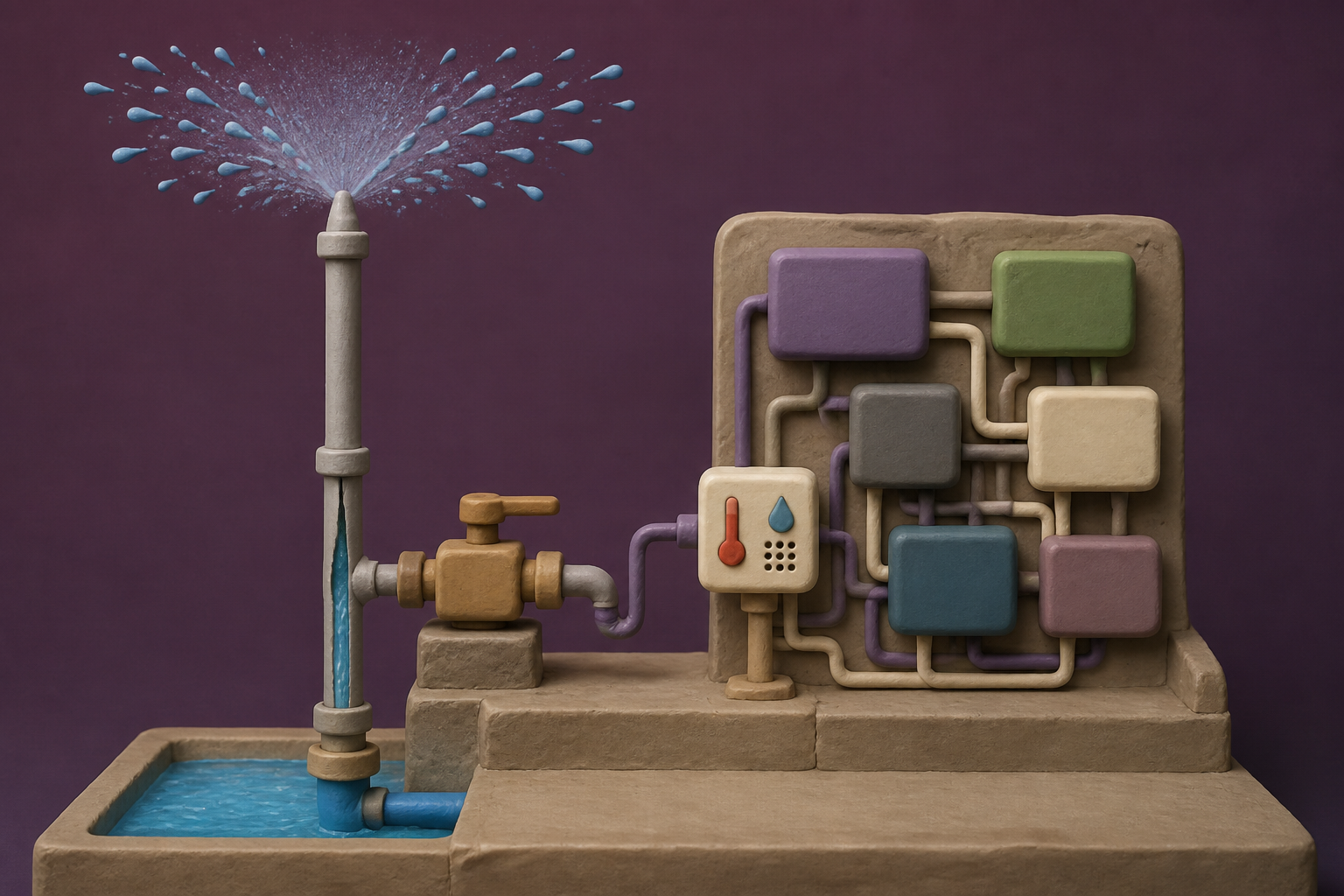
What changes in this design
A reader might otherwise picture fluid being released by one device in one place, with a person deciding when to use it.
This record brings together fixed and mobile fluid-dispersal units, drones, human monitoring, computer-based analysis, changing placement plans, and plans for handling faults. It also refers to hybrid fluid sourcing, without stating the actual sources.
It presents fluid dispersal as a coordinated operation that can be adjusted and managed across multiple units, rather than a one-device task. The stated conditions and practical setting remain unspecified.
Four times normal demand
During the January 2025 Palisades Fire, water systems faced the kind of demand they were never built to meet. A later UCLA Water Resources Group policy brief found that hydrant and pressure failure was the rule rather than the exception in that fire, and found a similar pattern in the Tubbs, Camp, Marshall, and Lahaina fires. Firestorms can push municipal demand to roughly four times normal levels for hours. Pipes, pumps, backup power, and stored pressure all become part of the emergency.
That matters because a sprinkler is only as useful as the water behind it. The number that stopped me was not the diameter of a spray nozzle or the speed of a drone. It was four. A neighborhood system that depends on hydrants may be most vulnerable at the moment every house needs it. California has since required backup power for some water pumps in fire-prone areas, but power is only one piece of a network strained far beyond daily use.
Ten provisional filings
Into that problem arrives US20260257235A1, published on September 3, 2026, under the broad title "Apparatus, System And Method For Coordinated Fluid Dispersal." The application describes a network meant to prevent or suppress wildfires while also fertilizing and protecting vegetation. Its proposed equipment ranges from fixed dispersal units to mobile units and drones, coordinated through remote monitoring, machine learning, placement models, and fault-management logic.
The public filing does not identify an assignee or inventor, though it names filing attorney John Basil. Its priority trail runs through ten provisional applications filed between August 20, 2024 and June 1, 2025. That is an unusually long sequence for a short period, and to me it suggests a concept assembled in stages as its builders kept adding pieces: the water source, the vehicles, the sensing, the control room, the response to a failed unit. I cannot tell from that history whether any single integrated system has been tested in a fire. A published application is a claim to an approach, not proof that the approach works.
Water from somewhere else
The patent's most revealing feature may be its refusal to rely on one water supply. It describes municipal infrastructure, natural sources, and atmospheric water generators as possible inputs to a hybrid system. Water can then be dispersed where models and operators think conditions are turning dangerous, while faults trigger rerouting or other responses.
That breadth is sensible, but it creates a severe operational question. Municipal water is already known to falter under firestorm demand; natural sources can be distant, seasonal, or inaccessible; and atmospheric generation must produce enough water quickly enough to matter. The application acknowledges the first problem by designing around it, even while still including fixed infrastructure in its plan. To me, hybrid sourcing reads less as a promise of unlimited supply than as an admission that no single supply can be trusted. The filing puts us in the harder conversation: who owns, maintains, powers, tests, and replenishes a distributed water system before an evacuation begins?
Fifteen million for no water
Several commercial paths are already competing for that answer. A Colorado home-defense system uses thermal cameras to trigger sprinklers that can spray about 35 gallons per minute per zone. A Canadian company sells towable rain-tower units intended to cover four to seven hectares, with deployment measured in tens of minutes. Another neighborhood product retrofits hydrants with sprinkler poles, betting that existing water infrastructure can be made more useful before a fire arrives.
Sonic Fire Tech has taken the opposite bet. The Cleveland company says its infrasound approach uses no water, chemicals, or PFAS, and its seed financing reached $15 million in August 2026. A separate granted U.S. patent covers remotely activated chemical coating for protecting homes from embers. These are not cosmetic differences. They are competing answers to the same failure point: if water cannot arrive reliably during a firestorm, should the system store it, generate it, move it, replace it with a coating, or avoid fluid altogether? I don't think the new filing can be understood without that contest around it.
The part worth watching
Wildfire demand is no longer confined to the places that have long expected it. About 77,850 U.S. wildfires burned in 2025, according to a year-end report, and the Eastern United States saw sharp increases in both fire counts and acres burned compared with its ten-year average. The financial pressure is just as direct: after the Palisades and Eaton fires, California's insurer of last resort received approval for a $1 billion assessment on admitted-market insurers.
That creates a market hungry for measurable protection, not merely compelling diagrams. What I would watch first is whether this application's hybrid-water idea becomes a tested operating system with defined capacity, backup power, maintenance rules, and a source of water that survives peak demand. We should be wary of treating coordination software as a substitute for physical supply. The strongest part of this patent is also its unresolved part: it sees that the hydrant may fail, then asks a network of machines to find water anyway.
Sources
Reporting for this piece drew on the published filing and the references below.
- US20260257235A1 - Apparatus, System And Method For Coordinated Fluid Dispersal
- The hydrants will run dry: Trump's LA fire claims missed the mark, study shows
- New mobile tech offers wildfire protection for communities at risk
- RainFire - Wildfire Protection Systems for Communities
- Wildfire defense spraying system - US12226661B2
- The O.H.I.O. Fund Announces Lead Investment in Sonic Fire Tech's Seed Round
- California Approves FAIR Plan Request to Assess Insurers $1B for Wildfire Claims
- US wildfires had mix of highs and lows nationwide in 2025, new report shows
The record, briefly. US20260257235A1, “Apparatus, System And Method For Coordinated Fluid Dispersal” Apparatuses, systems, and methods provide proactive prevention of adverse conditions and promotion of desirable conditions through dynamic adaptation, scalable deployment, human monitoring, advanced algorithms and machine learning, fluid dispersal units, mobile FDUs, drones, hybrid fluid sourcing, and models for placement and fault management.
More angles on this
- The Fan Blade Learns a Reversible TrickAnother reading from the same B05B classification family, spraying apparatus; atomising apparatus; nozzles.
- CPC B05B: Spraying apparatus; atomising apparatus; nozzlesThe official classification family this record was filed into, published in the USPTO Cooperative Patent Classification scheme.
- CPC B05D: Processes for applying fluent materials to surfaces, in generalThe official classification family this record was filed into, published in the USPTO Cooperative Patent Classification scheme.
- A Membrane, Two Outlets, and the Difference Between Setting and PromiseAnother reading from the wider B01D classification family, separation.
- Centrifugal Microfluidic Analysis Chip Marks a Pause Worth NoticingAnother reading in the same Machines category on this site.
Read around this one:Public patent recordUSPTO published figure