Machines
A Membrane, Two Outlets, and the Difference Between Setting and Promise
A new Sartorius patent joins filtration and chromatography in one membrane, but high-density cell cultures still make that promise hard to trust.

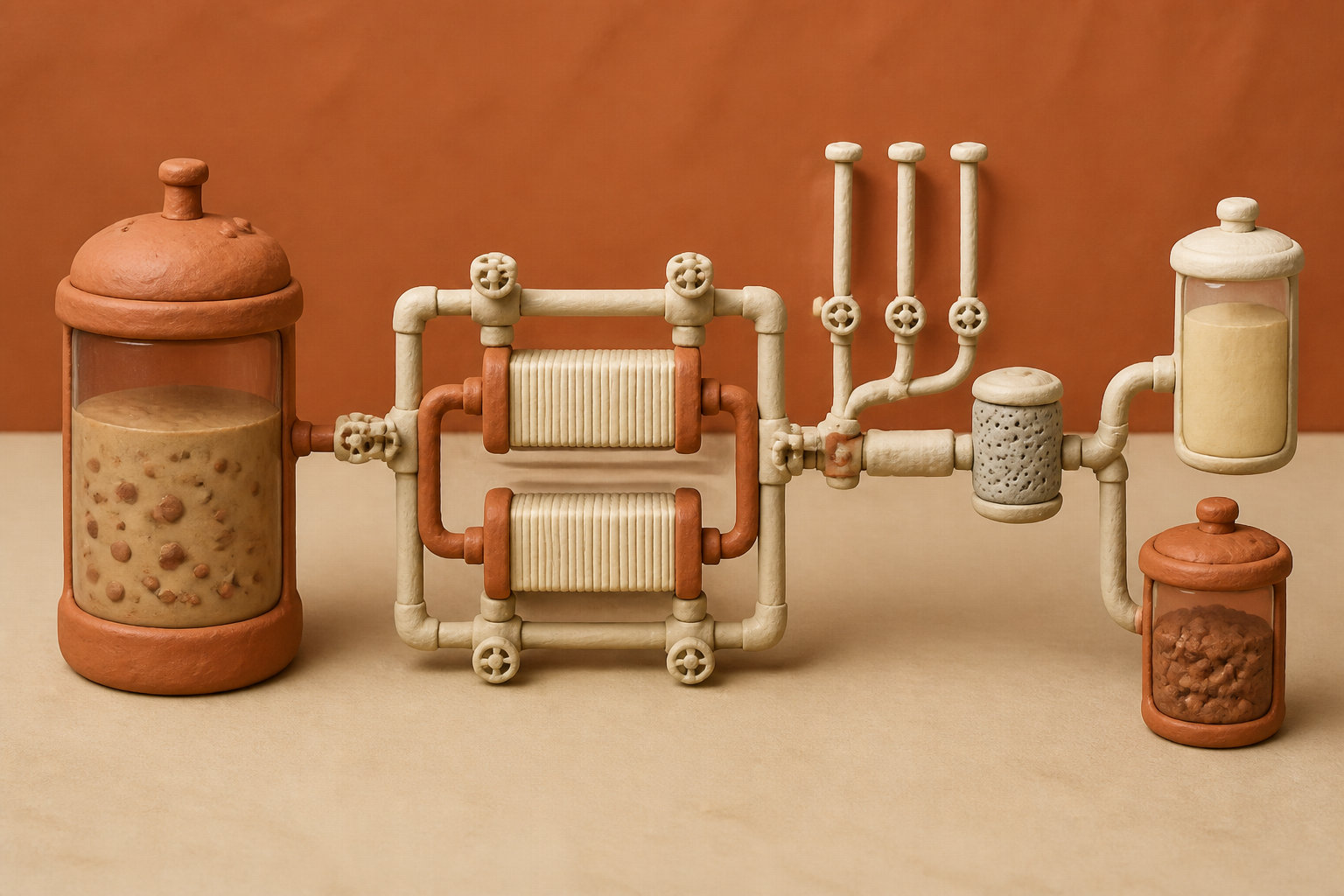
What changes in this design
At first glance, a reader may expect one container holding a mixed liquid. The stated problem is more particular: target molecules need separating from cells, leftover cell debris, and contaminants.
This record describes a tangential flow filtration/chromatography system built around a device with a fluid inlet, a membrane between two sections, and separate retentate and permeate outlets.
It gives a concrete picture of the separation task: the system is intended to sort wanted molecules away from several kinds of unwanted material, not merely move fluid from one place to another.
Twenty-five million cells
At 25 million cells per millilitre, a membrane can become the bottleneck fast. A 2025 study of bioreactor clarification found that microfiltration flux fell 61% in 40 minutes even after a hydrocyclone was added ahead of the membrane. Without that pre-clarification step, the fall was 75%.
What holds my attention is not the modest improvement, but what remained: more than half the flux vanished in less than an hour. The experiment does not test the newly published patent, and it cannot predict its performance. It does show that dense cell cultures keep making a simple demand of membrane systems very difficult: keep the liquid moving while cells, debris, and other material accumulate.
The combined membrane
That is the setting for US 2026/0257151 A1, filed by Sartorius Stedim Biotech on June 28, 2023 and published on September 3, 2026. The patent describes a tangential-flow filtration and chromatography system intended to separate target molecules from cells, cell debris, and contaminants through a device with an inlet, retentate and permeate outlets, and a membrane between the two sides.
This is not a filing about a marginally different filter housing. Its background acknowledges that existing clarification methods, including tangential-flow filtration, can “often reach technical or even economic limits” with high-cell-density fed-batch and perfusion cultures. The detail matters, I think, because it identifies the real wager: put filtration and chromatographic separation together, and the difficult first step may also become the place where more of the process has to succeed.
One step, before filing
The company was already using a similar phrase in public product marketing. On February 20, 2023, four months before the application was filed, Sartorius announced its StreamLink CC 15 sample-preparation system as able to clarify and purify monoclonal-antibody samples in one step. The announcement claimed 30% less hands-on time and 24 samples processed in two hours, at laboratory sample-preparation scale.
That does not establish what this patent can cover, and I would not infer a legal conclusion from a product announcement. To my eye, it does place the application in a visible product lineage rather than a distant research project. Sartorius also describes its membrane-chromatography line as a commercial-processing technology used for more than two decades, with convective flow through 1-5 micrometre pores designed to avoid the slower diffusion limits of resin columns.
The commercial context is unusually direct. In its first-half 2026 results, the company reported EUR 1.527 billion in sales and said recurring consumables business was its main growth driver. I do not see evidence that this particular filing produced those results. The filing instead sits inside a business where disposable filtration and chromatography components already matter.
The backflush alternative
A competing answer to membrane fouling is not to combine more work at the membrane, but to clean it while it runs. Repligen's XCell ATF system uses a diaphragm pump to alternately backflush a hollow-fiber membrane. Its cited malaria-vaccine case study reports cultures reaching 350 million cells per millilitre, alongside a 50% reduction in bioreactor time and a 20-fold yield increase.
Those are supplier-reported case-study figures, so I would not treat them as independent proof that backflushing wins everywhere. Still, the contrast is useful. One approach seeks an integrated membrane that can clarify and chromatographically separate. The other uses active, repeated reversal of flow to resist fouling before making any claim that one membrane should do more.
Regulation makes the timing more than academic. The European Medicines Agency's ICH Q13 guideline on continuous manufacturing was first published on January 6, 2023 and became legally effective in the EU on July 10, 2023, shortly after this application was filed. I cannot say the guideline caused the filing, but it provides a regulatory setting in which integrated processing of therapeutic proteins has a clearer route than it once did.
Where this leaves things
The patent is aimed at a real production problem, and its combined-step design is consistent with a long-running effort to make bioprocessing more continuous. But the strongest outside evidence here is still the 61% flux loss in a high-density clarification experiment. That finding does not refute the patented system. It does mean the central question is not answered by the filing itself.
I come away less interested in whether one membrane can be assigned two jobs than in whether it can keep doing them after a dense culture has had time to fight back. Sartorius has experience in membrane chromatography and a real consumables business around such tools. Yet the evidence available here supports a guarded view: integration may reduce a process step, while fouling remains the constraint that decides whether the promised simplification holds.
Sources
Reporting for this piece drew on the published filing and the references below.
- US20260257151A1 - Tangential Flow Filtration/Chromatography Systems, Use Thereof, And Methods Of Separation
- Sartorius Stedim Biotech continues positive development and expands profitable growth
- Enhancing the Performance of Tangential Flow Microfiltration for Bioreactor Clarification
- XCell ATF Technology
- New StreamLink CC 15 system for the preparation of mAbs
- Membrane Chromatography
- ICH guideline Q13 on continuous manufacturing of drug substances and drug products
The record, briefly. US20260257151A1, “Tangential Flow Filtration/Chromatography Systems, Use Thereof, And Methods Of Separation” A tangential flow filtration/chromatography system separates target molecules from cells, cell debris, and contaminants using a device with a fluid inlet, retentate and permeate outlets, and a membrane separating retentate and permeate sections.
More angles on this
- Method For Treating Cancer By Anti-B7H3 Antibody-Drug Conjugate Makes a Small Case for Better TimingAnother reading from the same C07K classification family, peptides.
- Timing at the Kilogram-Scale Mushroom HandoffAnother reading from the same B01D classification family, separation.
- CPC B01D: SeparationThe official classification family this record was filed into, published in the USPTO Cooperative Patent Classification scheme.
- CPC C07K: PeptidesThe official classification family this record was filed into, published in the USPTO Cooperative Patent Classification scheme.
- The Seed Method's Extremely Serious Fresh StartAnother reading from the neighbouring C07C classification family, acyclic or carbocyclic compounds.
Read around this one:Public patent recordUSPTO published figure