Machines
Centrifugal Microfluidic Analysis Chip Marks a Pause Worth Noticing
A phone-components subsidiary enters an old diagnostic-disc field with a US filing that closely resembles a Chinese rival’s granted patent.

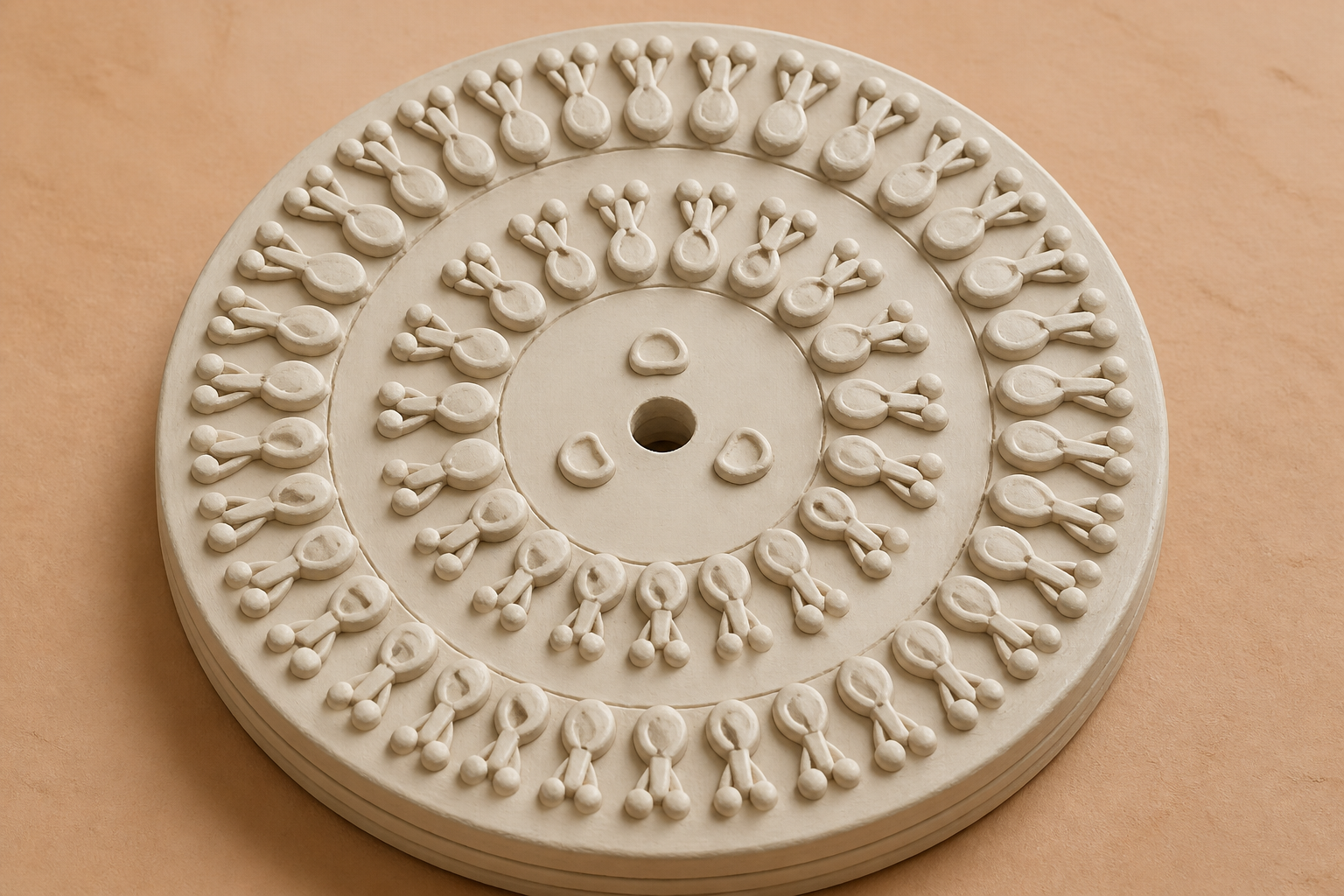
What changes in this design
A reader might otherwise picture an analysis chip as one small surface where liquids are handled in a single area, without knowing how its internal spaces are laid out.
Here, the chip has a central mounting hole for a rotating shaft and multiple liquid distribution and detection units arranged around it. Each unit includes a gas space, connecting paths, a dosing cell, a narrow capillary channel, and a reaction cell.
The layout makes the object easier to picture: it is not simply a flat chip, but a rotating platform with repeated small liquid-handling areas around its center.
A disc still needs a machine
The promise of a laboratory on a spinning disc has always been easy to picture: add a small blood sample, let rotation move it through tiny channels, and get an answer without a full laboratory. The harder part has been the equipment around that disc. Two established centrifugal diagnostic systems examined in a healthcare review required 120V AC power and complex instrumentation, putting them beyond what the authors considered true extreme point-of-care use.
That is the detail I kept coming back to. A clever channel layout can control liquid on a rotating chip, but it does not by itself supply power, prepare a difficult sample, preserve reagents, or make a result easy for someone to read. Those remain the unglamorous parts of getting a diagnostic test out of the lab and into the places that need it.
The familiar spinning disc
Into that long-running problem comes US20260257223A1, “Centrifugal Microfluidic Analysis Chip,” filed by AAC Microtech (Changzhou). The application describes a substrate and cover plate built around a central positioning hole for a rotating shaft. Around the disc sit liquid-distribution detection units containing gas reservoirs, connecting channels, dosing cells, capillary channels, and reaction cells.
The arrangement is recognisable because centrifugal microfluidics is not a fresh category. A commercial program began its work on laboratory miniaturisation in 1988, and the Gyrolab Workstation arrived in 2003 for nanolitre-scale protein quantification. Piccolo Xpress, another established disc-based analyser, offers 17 chemistry panels covering 31 tests, including 11 CLIA-waived tests. A national-lab project called SpinDx has claimed up to 64 parallel assays from less than 20 microlitres of whole blood in under 15 minutes.
None of that makes AAC Microtech’s filing unimportant. It does mean that novelty has to be judged against a mature field with products, prior engineering compromises, and an already demanding performance bar.
A Chinese patent already granted
The closer comparison is not merely with the old commercial systems. A Chinese patent, CN115155678B, carries the identical title, “Centrifugal Microfluidic Analysis Chip.” It was filed in June 2022, published that October, and granted in February 2024 to Autobio Labtec Instruments, an in-vitro diagnostics maker.
Its described hardware is strikingly close: a rotation-positioning hole, gas-storage chambers, metering tanks, capillary channels, and reaction chambers. The Chinese patent frames the design as an answer to complex chip structures, inaccurate liquid preparation, low throughput, and high cost. Those are not minor background details. They are the exact kinds of problems a reader would expect a new spinning-disc design to confront.
I could not establish from the public pages available here whether the two filings have a licensing, assignment, family, or other documented relationship. That uncertainty matters. Similar titles and overlapping component lists do not prove copying or misconduct, and the published US application should not be treated as proof of either. They do make the filing much less interesting as a clean story of a newcomer discovering an untouched idea.
An unusual applicant
AAC Microtech’s patent history gives the application its real tension. Public patent-analysis profiles describe the company’s activity as overwhelmingly concentrated in China and in consumer-electronics components such as speakers, receivers, microphones, and vibrators. Its recent US portfolio was concentrated in communications, with only one listed filing in chemical or materials engineering and none assigned to biotech or medical-device centres.
That makes this diagnostic-disc application a departure from the business most readers would associate with the company. My concern is not that a component maker must stay in its lane. Crossovers can be productive, especially where precision manufacturing, miniature motors, sensors, and fluid handling meet. But the filing offers no public basis for assuming that the applicant has solved the broader diagnostic workflow just because it can describe a well-known chip architecture.
The point-of-care market is large enough to invite such interest. A September 2026 market estimate put it at $24.5 billion globally and projected $36.5 billion by 2033, while crediting microfluidic and cartridge-based platforms with narrowing the gap between decentralised and central testing. That estimate does not single out spinning discs, and our confidence should stop there.
Where this leaves things
The research literature is blunt about what still blocks the most ambitious version of this technology: difficult fluid actuation, disc manufacturing and disposal costs, cold-chain-sensitive reagents, unclear readouts, and the work needed to turn a raw sample into something testable. A gas reservoir and capillary channel may help with one segment of that chain. They cannot, on their own, settle all five.
My view is that this patent is evidence of interest, not evidence of a diagnostic breakthrough. Its significance lies in the collision it reveals: an applicant from consumer components, a field with more than two decades of commercial history, and a closely matching granted Chinese patent owned by a different diagnostics company. Until a working system shows how it handles the machine, sample, reagent, and regulatory burdens together, the spinning disc remains a promising component inside a much larger device.
Sources
Reporting for this piece drew on the published filing and the references below.
- US20260257223A1 - Centrifugal Microfluidic Analysis Chip
- CN115155678B - Centrifugal Microfluidic Analysis Chip
- AAC Microtech (Changzhou) Patent Analysis
- AAC Microtech (Changzhou) company patent profile
- Gyrolab history
- Challenges in the Use of Compact Disc-Based Centrifugal Microfluidics for Healthcare Diagnostics at the Extreme Point of Care
- SpinDx: Point-of-Care Diagnostics Using Centrifugal Microfluidics
- Piccolo Xpress
The record, briefly. US20260257223A1, “Centrifugal Microfluidic Analysis Chip” A centrifugal microfluidic analysis chip has a substrate and cover plate with a central rotary positioning hole connected to a rotating shaft. Circumferential liquid distribution detection units each include a gas reservoir, connecting channels, dosing cell, capillary channel, and reaction cell.
More angles on this
- CPC B01L: Chemical or physical laboratory apparatus for general useThe official classification family this record was filed into, published in the USPTO Cooperative Patent Classification scheme.
- At the Filter Inlet, Ordinary Order Shows Its ConsequenceAnother reading from the neighbouring B01D classification family, separation.
- A Lanyard System That Waits for EvidenceAnother reading from the wider B66F classification family, hoisting.
- When Shared Pipes Need a PlanAnother reading in the same Machines category on this site.
Read around this one:Public patent recordUSPTO published figure