Machines
When Shared Pipes Need a Plan
A new reactor patent aims at the stop-start rhythm of renewables, where older claims and stubborn production costs are already waiting.

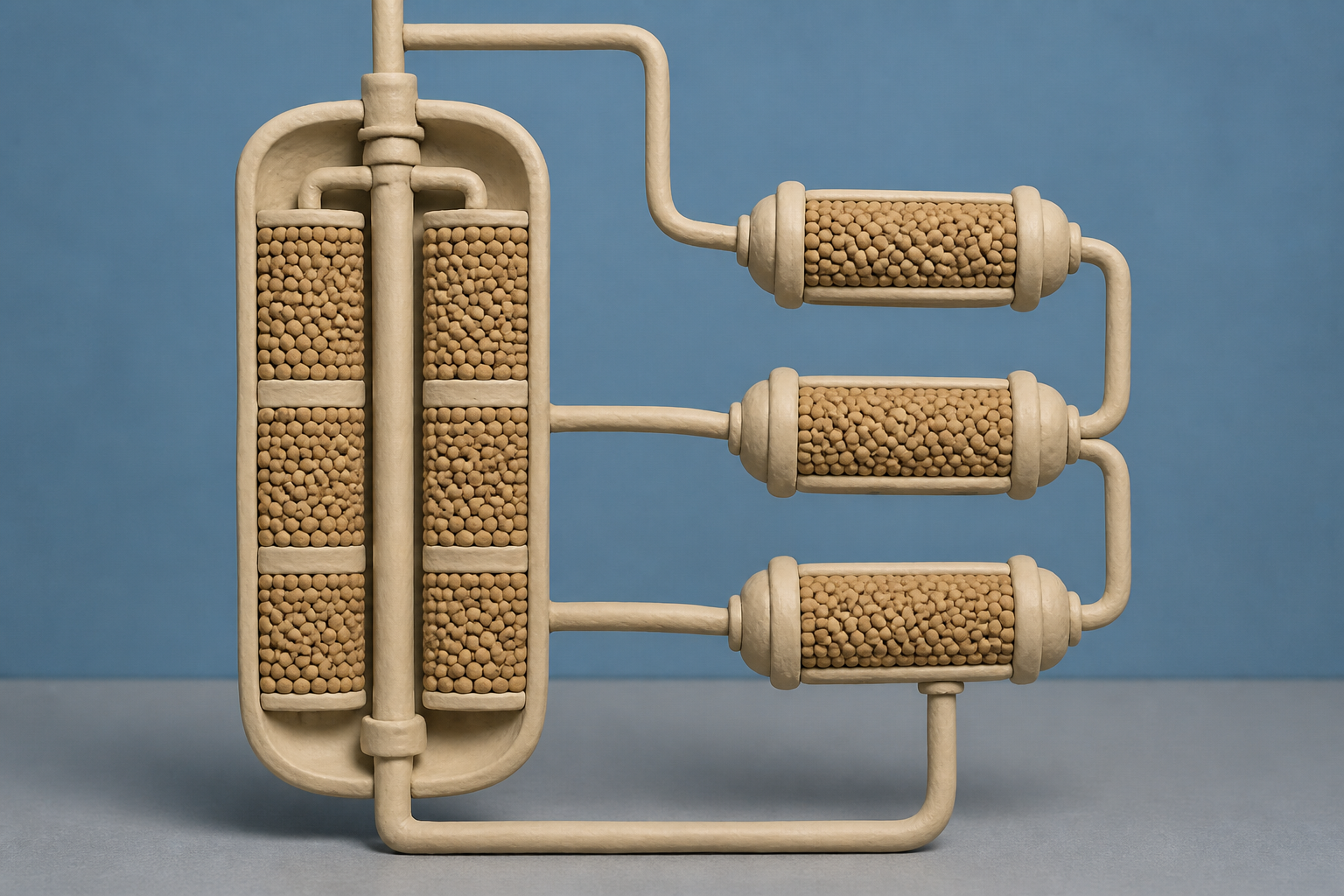
What changes in this design
A reader might picture each reactor as having its own separate connections for materials entering and products leaving. That is a simple mental model, but it does not address a setup where multiple reactors use common pipes.
This record covers batch, pseudo-batch, and dynamic reactors that use shared pipes and manifolds. It also includes mechanisms that control delivery of reactants and collection of the products made by the reactions.
It helps explain that the focus is not a single reactor by itself. The subject is the larger setup around several possible reactor styles, especially how materials are brought in and products are gathered through shared connections.
Thirty minutes without sun
A solar-powered ammonia plant can lose useful production time before it makes a molecule. One model of an islanded photovoltaic system found that its air-separation unit needs roughly 30 minutes to start, turning frequent power swings into a real operating penalty. The same study put ammonia from that setup at $416 to $514 per ton, against an approximate $200 per ton baseline for conventional production.
That gap is where the green-ammonia argument gets serious. The model favored about 3.7 megawatts of solar capacity for every megawatt of electrolyzer capacity, which means buying more generation to keep a smaller chemical plant fed. The figure I kept returning to was not the price alone, but the half-hour restart: a physical reminder that intermittent electricity and continuous industrial equipment have different habits.
The pipes in a new filing
Into that mismatch comes US20260257185A1, published September 3 under the title Reactor Systems For Gas Synthesis. The public application lists its assignee only as 17, Inc. and traces its earliest claimed priority to a June 7, 2023 provisional application, followed by a February 2024 non-provisional filing.
Its first claim describes batch, pseudo-batch, or dynamic reactors using shared pipes and manifolds to deliver reactants and collect products. The filing's discussion of Haber-Bosch makes the intended pressure point clearer: reactors designed to run continuously, day and night, fit poorly with small-scale green ammonia made from intermittent power. What I cannot establish from the public record is whether 17, Inc. has a plant, product, or operating demonstration behind this architecture. The claim is a design for controlling flows, not proof that the economics have been solved.
A periodic reactor from Delft
The central complication arrived years earlier. TU Delft received a U.S. patent in April 2023 for a periodic ammonia-production reactor, with priority reaching back to September 2019. That system switches between a full-extraction mode and low-flow recirculation during renewable-power shortages, seeking to protect the catalyst while the available energy changes.
The overlap is meaningful because both inventions address the same stubborn condition: ammonia equipment needs to survive a power supply that is not steady. It is not, by itself, a legal finding that the newer filing lacks novelty or cannot be granted. Patent claims can turn on technical details that a broad problem statement hides. Still, I read the older patent as a warning against treating intermittent-reactor design as untouched territory. The newer filing may have a distinct plumbing arrangement, but it enters a field where the basic idea of periodic operation has already been claimed and granted.
Plants already making fertilizer
The work is also no longer confined to patent diagrams. Talus Renewables raised $22 million in a 2023 Series A and has operated a solar-powered Iowa pilot making one to two tons of ammonia per day. Its larger wind-powered Iowa project was described as scaling toward 20 tons per day in 2025, while its containerized systems have also been described for remote farm communities in Kenya.
Another developer is pursuing direct electrochemical nitrogen reduction rather than adapting a Haber-Bosch loop, specifically to run in batches from solar and wind without storage. That split matters. The part that made me cautious about the new filing is that it must compete not only with the century-old process, but with several different attempts to make smaller, flexible ammonia systems work in the field.
Where the risk actually sits
Ammonia is not a niche chemical waiting for a clever gadget. Roughly 70 percent goes to nitrogen fertilizer, and research summarized by Our World in Data estimates that synthetic nitrogen fertilizer supports about 44 to 48 percent of the global population. Conventional ammonia also carries a climate cost of roughly 2.3 tons of carbon dioxide per ton produced, so the motive for changing the system is substantial.
The strongest case for US20260257185A1 is practical: a reactor that can change its mode of operation could help local production follow local renewable power. My view is that the filing's risk sits in three places at once: an earlier periodic-reactor patent, equipment that loses time whenever it cycles, and a cost gap that remains large in modeled off-grid systems. Shared manifolds may be useful engineering. They are not yet an answer to the question the fertilizer market will ask first: can this make dependable ammonia cheaply enough when the weather refuses to cooperate?
Sources
Reporting for this piece drew on the published filing and the references below.
- US20260257185 - Reactor Systems For Gas Synthesis
- US11618686B2 - Periodic ammonia production
- Can locally made green ammonia replace fertilizer from fossil fuels?
- Seeding a New Pathway: The Opportunity for Distributed Green Ammonia
- Energy Management and Economic Considerations of Intermittent Photovoltaic-Driven Electrochemical Ammonia Production
- Green Ammonia
- Talus Renewables: modular, renewable fertilizers in Kenya & Iowa
- How many people does synthetic fertilizer feed?
The record, briefly. US20260257185A1, “Reactor Systems For Gas Synthesis” Chemical reactor systems for gas synthesis include batch, pseudo-batch, or dynamic reactors with shared pipes and manifolds, and fluid control mechanisms for delivery of reactants and collection of reaction products.
More angles on this
- CPC B01J: Chemical or physical processes, e.g. catalysis or colloid chemistry; their relevant apparatusThe official classification family this record was filed into, published in the USPTO Cooperative Patent Classification scheme.
- CPC C01C: Ammonia; cyanogen; compounds thereofThe official classification family this record was filed into, published in the USPTO Cooperative Patent Classification scheme.
- Timing at the Kilogram-Scale Mushroom HandoffAnother reading from the neighbouring B01D classification family, separation.
- Method For Treating Cancer By Anti-B7H3 Antibody-Drug Conjugate Makes a Small Case for Better TimingAnother reading from the wider C07K classification family, peptides.
- When Sensor Data Takes the Handoff in Modular Sound SynthesisAnother reading in the same Machines category on this site.
Read around this one:Public patent recordUSPTO published figure