Machines
At the Filter Inlet, Ordinary Order Shows Its Consequence
A new Mitsubishi Heavy Industries filing puts chemistry inside a heat-resistant dust filter while carbon capture's price remains stubbornly high.

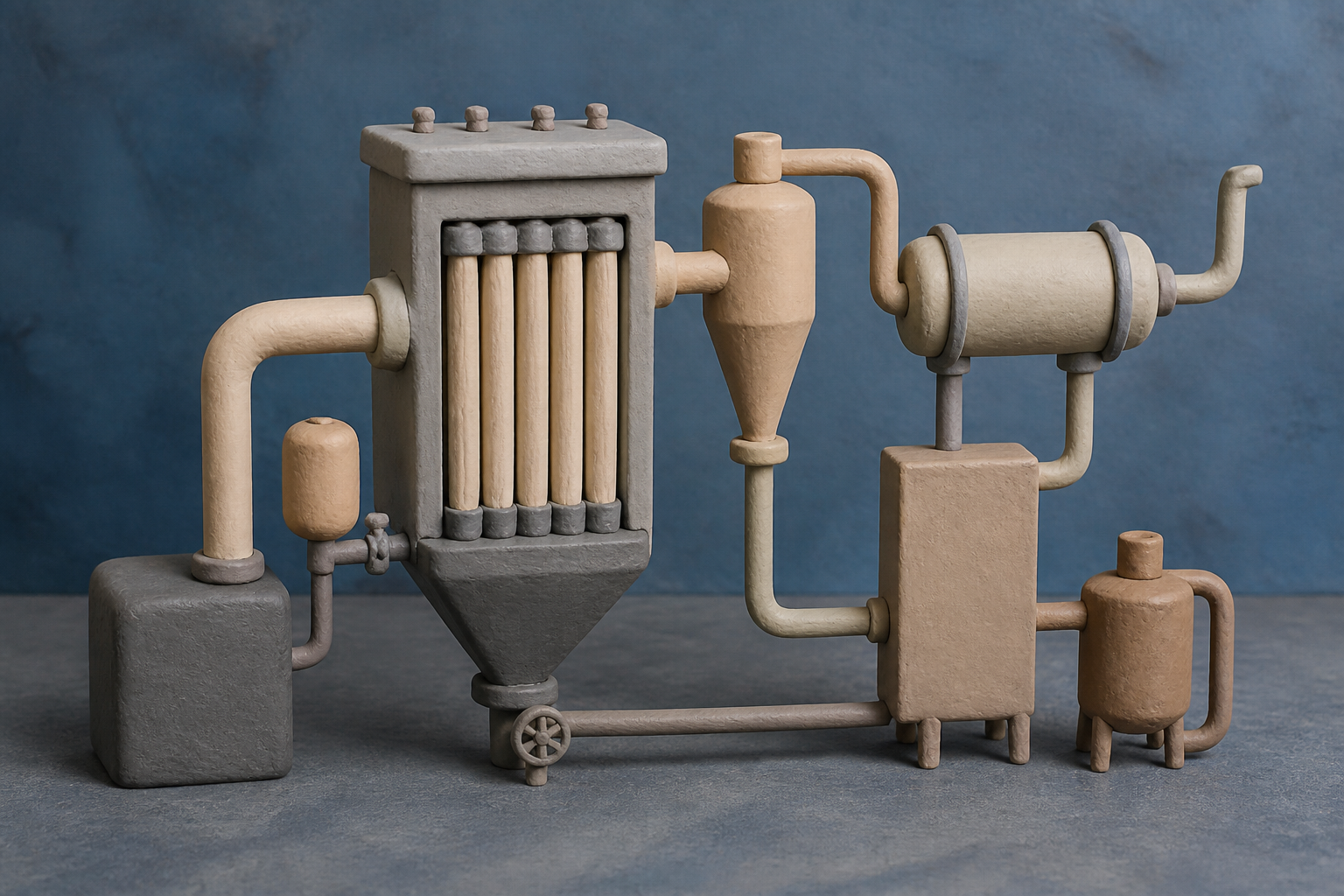
What changes in this design
Without this information, a reader might picture chemical treatment taking place after filtering or in a separate part of the facility.
Here, the reaction-agent supplier connects at the filter inlet or an inlet-side space. The facility also calls for a dust-collection filter with heat resistance of at least 250 C.
These details tell you where the reaction agent enters and what heat resistance is specified for the filter. What the treatment measures or achieves is not stated.
Yokkaichi's damaged lungs
By 1964, about 2.5% of people in Isozu, the district hit hardest by pollution from Yokkaichi's petrochemical complex, had symptoms associated with what became known as Yokkaichi asthma. The toll did not end with a bad-air day: later figures cited mortality from COPD and asthma at 10 to 20 times normal levels. Japan's 1968 Air Pollution Control Law required flue-gas desulfurization, turning dirty exhaust from an industrial nuisance into a regulated engineering problem.
I kept returning to that sequence because it explains why a filter can carry so much history. Dust collection and acid-gas treatment were not abstract equipment categories in postwar Japan. They were part of an answer, however incomplete, to air that had made people ill. The new carbon problem arrives through much of the same plumbing.
The filter at 250 C
Mitsubishi Heavy Industries' newly published US patent application, US20260257172A1, is called “Method For Treating Exhaust Gas, And Facility For Carrying Out Method.” Its central object is a dust-collection filter that withstands at least 250 C. Carbon-dioxide-containing acidic exhaust is supplied to it, while a reaction agent is introduced at the filter inlet or into the space just before it.
The arrangement is modest on paper, but its ambition is clear enough: put chemical treatment directly at a piece of hardware already meant to catch solids. The part I cannot settle from the filing alone is how well this configuration performs in a working plant, or what it costs to run. It gives us a layout, not the operating evidence that would make a retrofit decision easy.
Four years in the queue
The US application was filed on February 9, 2023, claimed priority from a Japanese application filed May 19, 2022, and appeared in the United States on September 3, 2026. That roughly four-year passage matters because the commercial setting changed while the paperwork moved. Japan's GX-League began as a voluntary program in April 2022 and became mandatory in 2026, covering more than 550 companies responsible for over half of national emissions.
Yet the current Japanese carbon tax is reported at about JPY289, roughly $2.16, per tonne. That is pressure, but it is not much money to spend on expensive machinery. The number that stopped me was not the tax, but a European estimate of EUR150 to 300 per tonne for capturing, transporting, and storing CO2, at least 50% above prior forecasts. Those costs leave private projects needing broad public support, according to the analysis.
Sixty-second cartridges
Mitsubishi Heavy Industries is not placing all its carbon hopes inside a dry filter. In 2025, the company won a basic-design contract for a much larger Japanese capture project using an amine-based liquid process, intended to capture 5,200 tonnes of CO2 a day. A 2026 collaboration with Entergy set an aim of cutting overall carbon-capture costs by 50%, while acknowledging that present economics are roughly double what broad affordability would require.
Competition is also arriving in the filter itself. Svante promotes CALF-20, a metal-organic-framework sorbent coated onto structured filters, cycled about every 60 seconds in a rotary machine for flue gas from cement, steel, and waste-to-energy facilities. I don't take that as proof that either approach will win. It does show that the industrial retrofit is becoming a contested design space, with chemical systems, filter materials, and cycle times all being patented and tested against the same price problem.
Where this leaves things
A separate Japanese cement-industry filing from 2024 sought to produce kiln exhaust with a higher CO2 concentration before downstream capture. Together, these filings suggest a practical race to make difficult exhaust streams less punishing before the most costly stage begins. The patent here is one move in that race: use a high-temperature dust filter as a place where a reaction agent can meet acidic, CO2-containing gas.
My judgement is that this is a meaningful engineering bet, not evidence that carbon capture has become economical. The Yokkaichi legacy gives the hardware lineage real weight, and mandatory carbon trading gives manufacturers a reason to look harder. But we should reserve confidence until a plant can show removal performance, energy use, reaction-agent consumption, and total cost under ordinary industrial conditions. A patent can establish a claim to a design. It cannot establish that the design deserves to be built at scale.
Sources
Reporting for this piece drew on the published filing and the references below.
- Method for Treating Exhaust Gas, and Facility for Carrying Out Method
- MHI Awarded Contract for Basic Design of Japan's Largest CO2 Capture Plant at Hokkaido Electric Power's Tomato-Atsuma Power Station
- Entergy and MHI Group outline collaborative partnership designed to accelerate commercialization and affordability around carbon capture solutions
- CCS far costlier than expected, needs broad state backing - analysis
- Solid Sorbents
- Yokkaichi asthma
- Inside Japan's GX-ETS carbon market and its global climate impact
- Taiheiyo Cement Files Patent For Cement Clinker Producing System With High CO2 Concentration Exhaust Gas
The record, briefly. US20260257172A1, “Method For Treating Exhaust Gas, And Facility For Carrying Out Method” An exhaust gas treatment facility includes a dust collection filter with heat resistance of at least 250 C, an exhaust-gas supply line for carbon-dioxide-containing acidic gas, and a reaction agent supplier connected to the filter inlet or an inlet-side space.
More angles on this
- Timing at the Kilogram-Scale Mushroom HandoffAnother reading from the same B01D classification family, separation.
- Degassing a bottle: a chamber, a pump, and the judgment left to whoever holds itAnother reading from the same B01D classification family, separation.
- CPC B01D: SeparationThe official classification family this record was filed into, published in the USPTO Cooperative Patent Classification scheme.
- A Lanyard System That Waits for EvidenceAnother reading from the wider B66F classification family, hoisting.
- When Sensor Data Takes the Handoff in Modular Sound SynthesisAnother reading in the same Machines category on this site.
Read around this one:Public patent recordUSPTO published figure