Machines
A Lanyard System That Waits for Evidence
A new Altec patent joins a long effort to make bucket-truck workers clip in, even though falls were not aerial lifts' leading historical killer.

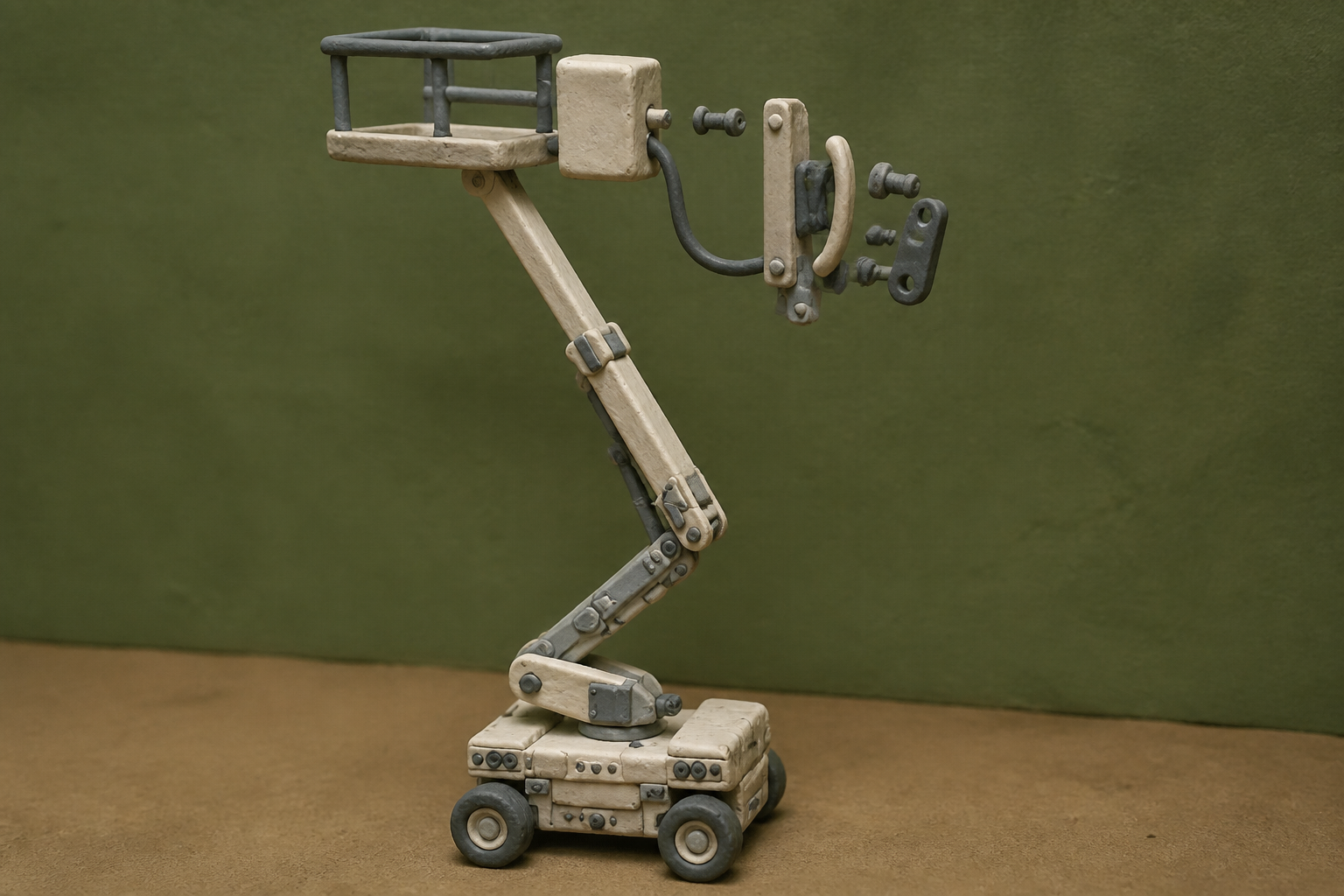
What changes in this design
A reader might otherwise assume the lanyard is attached because it appears to be, without a system checking for evidence of attachment.
Here, attaching the lanyard shifts a movable part. Sensors detect that shift, and the system may generate an alert after operator input if it determines the lanyard is not attached.
The key point is that attachment is tied to a physical change the sensors can detect. The alert is not automatic in every situation: it may occur in response to one or more operator inputs.
Sixty-four falls
Sixty-four of 207 documented U.S. aerial-lift deaths from 1992 to 1999 were falls. Electrocutions accounted for 69, while collapses and tip-overs added 46. That historical count is not a verdict on every lift used today, but it makes the safety gadget in a newly published patent feel both necessary and limited.
The gadget is meant to catch an ordinary lapse with grave stakes: a worker reaches the controls of an aerial device without connecting a fall-protection lanyard. US20260257086A1, titled Lanyard Detection System, describes an attachment that moves part of an assembly so sensors can register the lanyard. If later operator input arrives and the system decides the device is not attached, it can issue an alert. It addresses one missed connection, not the whole danger of aerial work.
Three patents, one prompt
Altec Industries filed this application on April 23, 2026, and it was published on September 3. It claims priority to two 2024 Altec applications, placing it in an active continuation chain rather than presenting it as a one-off arrival. What I see is a company continuing to refine a safety prompt that has occupied it for more than a decade.
Altec patented a hydraulic lanyard-interlock assembly in 2014. A 2021 patent then described detecting lanyard attachment on insulated utility platforms through fiber-optic light signals crossing a dielectric gap. The newer filing uses a movable element and sensors. Those documents do not prove that their claims are identical, and the current application may yet change. That history changes my reading: this is sustained engineering around a familiar safety task, not the birth of a new category.
An alarm workers can outwit
Altec already sells a product bearing the same name as the filing. One version, Lanyard Alert, makes an audible warning. Another, Lanyard Interlock, disables upper controls. Both are available for specified aerial-device lines, and the company says they can be retrofitted to units from 2016 onward. The product description also calls out an anti-tie-down feature intended to stop a worker from leaving a lanyard permanently clipped in simply to silence the system.
That last detail matters. A detector is useful only if it distinguishes a real, current connection from a workaround that merely looks connected. From the public material, I cannot tell whether the new claims map precisely onto either commercial configuration. But the anti-tie-down problem gives the moving piece in this application a practical purpose: the system has to notice attachment without becoming an easy ritual to defeat.
Competing ways to sense a clip
The basic alert was already spreading beyond one manufacturer. Terex publicized its Positive Attachment Lanyard warning in 2017 after a pilot with an electric utility cooperative, using an audible alarm on an Optima HR55 aerial device. Around the same period, RECON Dynamics developed a proximity-chip retrofit system. A utility contractor had installed it across 300 bucket trucks by 2017, and it had been commercially available for more than a year by late 2018.
Hydraulics, fiber optics, movable sensing parts, and proximity chips are different answers to the same question: is the worker clipped in now? What I cannot establish from these accounts is whether any particular system shares the same detailed sensing method or patent scope. The timing does establish something more modest and more revealing: manufacturers and retrofit suppliers had converged on lanyard reminders years before this publication. The filing belongs to that shared safety problem.
Where this leaves things
The number that changed my sense of the patent was 69, the historical tally of electrocutions, not the 64 falls. A lanyard detector may reduce a specific and serious fall hazard, but it cannot protect against every major cause of aerial-lift death. Formal personal-fall-protection anchorage requirements entered the ANSI A92.2 standard in 2009, including a 3,600-pound rating per occupant. Altec's own standards guidance identifies lanyard-detection sensors among manufacturer responses to the 2022 A92.2 update.
That makes this a patent about a real obligation in a changing safety regime, rather than a cure-all. I don't think its narrowness is a flaw. A reminder that prevents one worker from operating unprotected can matter enormously. For me, the sharper point is that patents can make a long-running industry response look newly invented when the harder story is repetition: a known hazard, several sensing methods, workers who can adapt around them, and standards that keep asking equipment makers to do better.
Sources
Reporting for this piece drew on the published filing and the references below.
- US20260257086A1 - Lanyard Detection System
- Altec Develops a Lanyard Detection System for Aerial Devices
- US9149670B1 - Lanyard interlock assembly
- US11192765B1 - Systems and methods for lanyard attachment detection on an aerial device
- US 2026/0257086 A1 patent record
- Terex Utilities Aerial Devices Feature Technology to Aid Operators
- New System Reminds Linemen to Clip In Lanyard
- Deaths From Aerial Lifts
- What Owners and Operators Should Know About ANSI A92.2: 2022 Changes and Training Requirements
- A92.2: The 2009 Standard
The record, briefly. US20260257086A1, “Lanyard Detection System” A lanyard attachment assembly may include a movable element displaced by attachment of a lanyard device so sensors detect attachment. In response to one or more operator inputs, an alert may be generated if the device is determined not to be attached.
More angles on this
- The Small Division Inside a Protective GarmentAnother reading from the same A62B classification family, devices, apparatus or methods for life-saving.
- CPC A62B: Devices, apparatus or methods for life-savingThe official classification family this record was filed into, published in the USPTO Cooperative Patent Classification scheme.
- CPC B66F: HoistingThe official classification family this record was filed into, published in the USPTO Cooperative Patent Classification scheme.
- When a Shredder's Boundary Becomes the QuestionAnother reading from the wider A47J classification family, kitchen equipment; coffee mills; spice mills; apparatus for making beverages.
- The Interior Route to Surface CoatingAnother reading in the same Machines category on this site.
Read around this one:Public patent recordUSPTO published figure