Field Notes
The Small Division Inside a Protective Garment
A new panel-and-layer patent joins a forty-year effort to make protective suits move better, while heat still sets the harder limit.

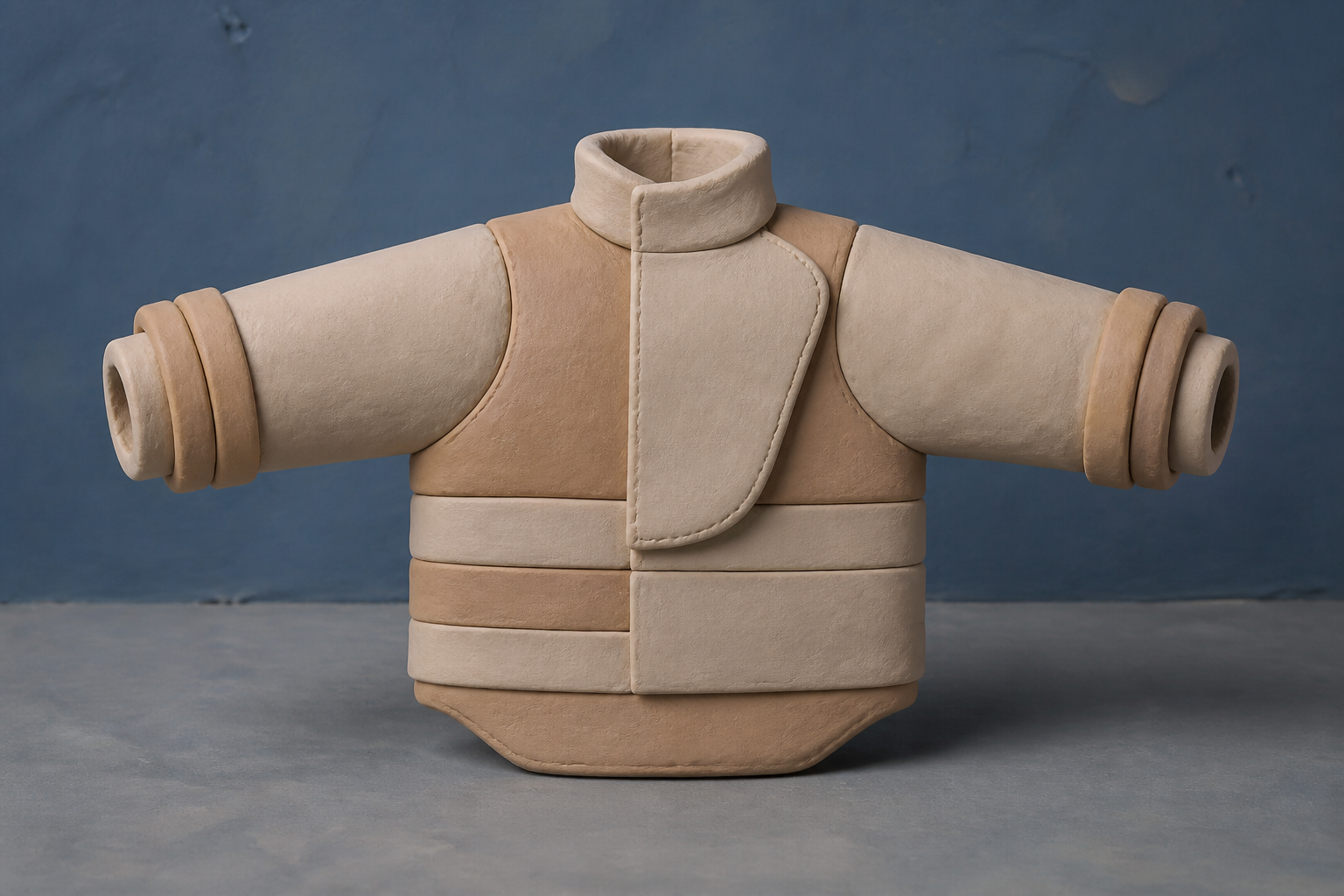
What changes in this design
Someone might picture protective clothing as one fixed covering, with all of its material joined together and moving in much the same way.
Here, the garment has two layers. The outside covering can be detached, and it includes flexible sections plus an added panel at one portion to provide flexibility there.
The key point is not flexibility everywhere. It is a layered garment that directs flexibility to one particular area while keeping the outside covering removable.
A cracked visor in Benicia
In 1983, a visor on a hazmat suit cracked during an incident in Benicia, California. The National Transportation Safety Board cited the failure when recommending performance standards, and the National Fire Protection Association issued its first comprehensive standard for this kind of protective clothing in 1990. A broken clear panel forced a hard question: how can a responder be sealed from danger without being trapped inside an unusable garment?
Early chemical-protective suits were heavy, stiff, and restrictive. Movement was not a luxury problem. Fire Engineering's history notes that gloves remain a weak point in chemical ensembles, where every bend, grip, and reach asks materials and seams to do incompatible jobs at once. That history matters, I think, because the struggle to make protection move with a human body is older than most of the products now sold as improvements.
The hourglass inside the suit
The harder limit may not be the garment's joints at all. A peer-reviewed study put 17 firefighters in six commercial fully encapsulating, impermeable suits and measured safe working times. At 20 degrees Celsius, the median was 50 minutes, with a 90 percent range of 30 to 60 minutes. At 37 degrees Celsius, the median fell to 28 minutes, with a range of 18 to 34 minutes. Low workload produced 60 minutes; high workload, 32.
Those figures make me wary of treating flexibility as the master answer. The study identifies ambient temperature and metabolic workload as the main determinants of working time, not panel articulation. It did not test whether a better-moving panel makes a wearer more comfortable or more capable at a particular task, so the study cannot settle that question. But it leaves me unconvinced that a mobility adjustment, by itself, changes the basic heat-stress clock.
A detachable outer layer
That is the setting for US20260257084A1, titled “Protective Garment.” The application describes an inner layer and a detachably attached outer layer. Flexible panels and an overlay panel are arranged to provide flexibility at a first portion of the garment. It is a specific mechanical answer to an old bodily problem: protection has to bend somewhere.
The filing does not arrive as a declaration that heat has been solved. Its described contribution is narrower, centered on how layers attach and how part of the garment flexes. In this respect, I read the application as a practical attempt to make movement less punishing, not evidence that a responder can safely remain in an impermeable suit longer. That distinction is important, because mobility and endurance are connected in practice without being the same engineering claim.
The crowded protective rack
The detachable-layer idea also has a history. A 2007 filing that later became US8997267B2 described separate inner and outer shells for protective wear. Its background addressed the problem of a single rigid-and-cushioned garment that could not be laundered or serviced independently. The new application uses the same broad logic of separable layers, even though the details and intended applications are not established as identical.
The filing is classified A62B17/003; the reported tally of 539 patents concerns the broader A62B 17/00 family. The largest holders in that group have 21, 20, and 19 patents, a sign of an established field with many overlapping efforts. The count makes me cautious, not dismissive. A crowded patent class does not prove a new design lacks value, but it does mean a local panel arrangement has to compete with decades of material, seam, cut, and layering work.
A current commercial example comes from Lakeland Industries, whose Super-B suit uses inset contoured sleeves in place of a “bat-wing” cut and a two-piece crotch gusset intended to spread seam stress. That is a different construction, but it addresses the same motion problem through the garment's shape rather than the newly published application's detachable layers and overlay panel. I cannot tell from the available evidence whether either approach offers better protection in a comparable use case.
The part worth watching
Commercial scale puts the claim in perspective. One market-research estimate places chemical protective clothing at USD 1.6 billion in 2025 and projects USD 2.5 billion by 2034, while other estimates for related definitions vary from USD 1.27 billion to USD 22 billion. I would treat those figures as a rough measure of commercial attention, not a precise account of a neatly bounded market. Definitions of disposable, reusable, chemical, and broader protective clothing plainly change the total.
Materials have been evolving for much longer than this panel design. DuPont dates Tyvek's discovery to 1955 and says more than 200 million Tyvek garments are now used annually worldwide. Against that scale, this patent looks like one incremental attempt to improve the garment's mechanics. That is why I would watch for evidence that the arrangement can preserve protection while making a real task easier, rather than for another claim that mobility alone defeats heat and workload. The 1983 visor failure still sets the right standard: a suit must protect a person who needs to move, see, work, and eventually get out.
Sources
Reporting for this piece drew on the published filing and the references below.
- Protective Garment, US20260257084A1
- US8997267B2 - Protective garment with separate inner and outer shells
- IP class holdings for A62B 17/00
- Advances in Chemical Protective Ensemble Technology
- Hazmat PPE Standards
- Combined thermal manikin and thermal model predictions of working times in fully encapsulated impermeable suits
- Chemical Protective Clothing Market
- Super-B: The Ultimate Hazmat Suit
- Tyvek 50th Anniversary
The record, briefly. US20260257084A1, “Protective Garment” A protective garment has an inner layer and a detachably attached outer layer with flexible panels and an overlay panel configured to provide flexibility at a first portion of the garment.
More angles on this
- CPC A62B: Devices, apparatus or methods for life-savingThe official classification family this record was filed into, published in the USPTO Cooperative Patent Classification scheme.
- Ambient Light's Quiet Job in Facial VideoAnother reading from the wider A61B classification family, diagnosis; surgery; identification.
- Timing at the Kilogram-Scale Mushroom HandoffAnother reading in the same Field Notes category on this site.
Read around this one:Public patent recordUSPTO published figure