Field Notes
Ambient Light's Quiet Job in Facial Video
A new face-video patent joins a crowded vital-signs race, where fairness and proof matter more than one more clever signal.

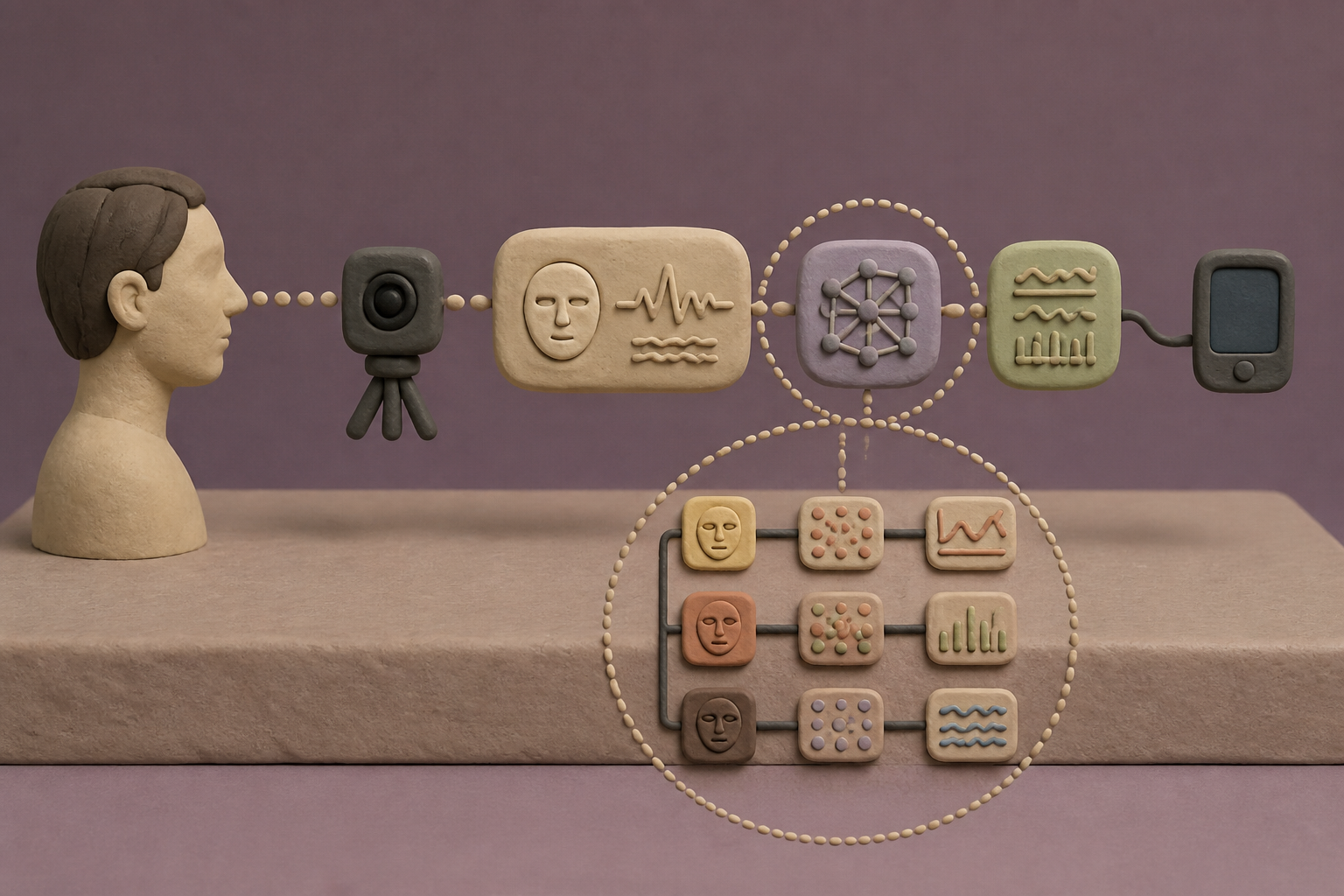
What changes in this design
Without this approach, a reader might expect pulse information to come from a device that touches the body or from counting beats directly. This record does not discuss those methods in detail.
Here, one color camera captures facial video in ambient light. Processors isolate facial skin regions, derive video-based skin signals and timing-related features, then use a trained neural network to predict pulse rate and other physiological parameters.
That is worth knowing because it identifies facial video as the input and a prediction as the output. The record does not give an accuracy figure or say which other physiological parameters are predicted.
A $4.99 iPhone app
In 2012, a $4.99 iPhone app offered to measure a user's heart rate by watching reflected light across the user's face through the front-facing camera. It came from a university lab and turned a quiet physical signal into a consumer promise. That was fourteen years before BRGX Technologies LLC filed its own application.
That history changes how a September patent reads. It is not a camera newly noticing a pulse. It is a push to reserve a particular combination of signals as the technology edges from novelty apps toward care. I came away thinking the question is no longer whether a face can yield a pulse under the right conditions. The harder question is whether the result holds for the people it is meant to monitor.
The September filing
US20260256363A1 was published on September 3, after BRGX filed it on April 23. The public web yields no company site, news trail, or other filings that I could find for BRGX, making this application almost the whole public portrait of its assignee.
At its base, the application uses a monocular RGB camera under ambient light, selects facial skin regions, extracts imaging photoplethysmography signals and temporal features, and sends them to a trained neural network. Pulse rate is the clearest output, alongside other proposed physiological parameters. Then it reaches further: the filing describes OCT-variation feature maps intended to emulate optical coherence tomography without the hardware, combined with motion-derived imaging ballistocardiography. That stack of signal names should not, in my view, be confused with evidence that the resulting measures are clinically useful.
December 2024
A closely overlapping patent, US12525360B1, was filed by a different health startup on December 23, 2024, and published January 13, 2026. It describes facial rPPG alongside imaging of the eyes and gums for heart rate, blood pressure, oxygen saturation, and metabolic-risk estimates. BRGX filed on April 23, 2026. Those dates are not, in my view, a legal answer about either patent's scope: claims turn on language, earlier work, and later examination. They do show multiple filers drawing around the same facial signal with different combinations of inputs and outcomes.
Philips makes the older ownership question plain in a different way. Its current licensing program covers basic implementations of camera-based vital-sign monitoring and is aimed at companies marketing camera-derived heart or breathing measurements under their own brands. That does not show that BRGX needs a license, and the filing alone cannot settle infringement. It does show that no newcomer is arriving on empty ground.
Fifty seconds, 13.58 beats
Regulatory progress is real, which makes the gap between a filed idea and a usable product more important. FDA granted a De Novo clearance for camera-based pulse and breathing monitoring in April 2021. A Taiwan developer then received a 2023 510(k) for contactless heart rate and a 2025 clearance for respiratory rate, using a phone-camera SDK that returns readings in 50 seconds. A Hong Kong mobile app got clearance for pulse rate in 2025, and another camera SDK was cleared for heart and respiratory rate in 2026, restricted to relaxed, seated adults aged 18 and over and not designed to treat or diagnose.
FDA's own AI-enabled device list includes two later entries for the 2021 developer, cleared in 2025 and 2026, among only a handful of contactless-monitoring entries. The category remains small beside the amount of patent activity. None of the clearance announcements I read discusses the darker-skin disparity in the research, though silence in an announcement cannot prove a maker ignored it.
The number I kept returning to was 13.58 beats per minute. An audit of 100 rPPG studies found mean absolute heart-rate error of 4.23 bpm for Fitzpatrick skin types I through V and 13.58 bpm for type VI. For chrominance-based methods, it rose from 5.2 to 14.1 bpm. The benchmark collections behind much of this work are tilted toward lighter-skinned subjects: White or lighter subjects average about 45 percent of dataset composition, while Black and Latino subjects account for less than 25 percent. One study of 200 people and 387 usable recordings reported 98.5 percent of 15-second heart-rate clips within 10 bpm, with a 3.25 bpm mean absolute error, and 98.4 percent of respiratory-rate readings within five breaths per minute. Its authors also said performance across a wider range of skin types still needed confirmation.
The part worth watching
The filing asks a camera to produce more than a pulse: cardiovascular parameter estimates and a wellness indication. Those broader promises demand a higher standard. I would want separate accuracy results by skin type, lighting, motion, age, and health status, plus clear failure states and an explanation of what the system should not be used for.
Until evidence of that kind is public, BRGX is a name on a new application in a field that has been commercial for years and regulated for several. The underlying signal is real. What I cannot accept is the shortcut from a face video that sometimes finds a pulse to a measurement readers are asked to trust equally for everyone.
Sources
Reporting for this piece drew on the published filing and the references below.
- US20260256363A1 patent record
- US20260256363A1 full patent record
- Biosensing by rPPG licensing program
- FDA green lights Oxehealth Vital Signs monitoring software
- FaceHeart received another FDA clearance for contactless respiratory-rate measurement
- FDA clears mobile app for contactless pulse-rate measurement
- Artificial Intelligence-Enabled Medical Devices
- FDA clears NuraLogix's Anura Mobile Core SDK
- Seconds Matter: Rapid Non-Contact Monitoring of Heart and Respiratory Rate from Face Videos
- Demographic bias in public remote photoplethysmography datasets
- Using The iPhone's Front-Facing Camera, Cardiio Measures Your Heartrate
The record, briefly. US20260256363A1, “Systems And Methods For Non-Invasive, Non-Contact Physiological Monitoring, Cardiovascular Parameter Estimation, And Wellness Indication Generation From Facial Video” A monocular RGB camera captures facial video under ambient lighting; processors segment facial skin regions, derive imaging photoplethysmography signals and temporal features, and use a trained neural network to predict pulse rate and other physiological parameters.
More angles on this
- The Boundary Inside Smart Pet MonitoringAnother reading from the same A61B classification family, diagnosis; surgery; identification.
- A Harder Member Between a Scope Cover's SurfacesAnother reading from the same A61B classification family, diagnosis; surgery; identification.
- CPC A61B: Diagnosis; surgery; identificationThe official classification family this record was filed into, published in the USPTO Cooperative Patent Classification scheme.
- CPC G06T: Image data processing or generation, in generalThe official classification family this record was filed into, published in the USPTO Cooperative Patent Classification scheme.
- When an Erase Setting Becomes a Timing PromiseAnother reading from the neighbouring G06F classification family, electric digital data processing.
Read around this one:Public patent recordUSPTO published figure