Machines
The Boundary Inside Smart Pet Monitoring
A new smart-pet filing arrives after a decade of deals and disputes, while the harder question remains: can collar data identify illness?

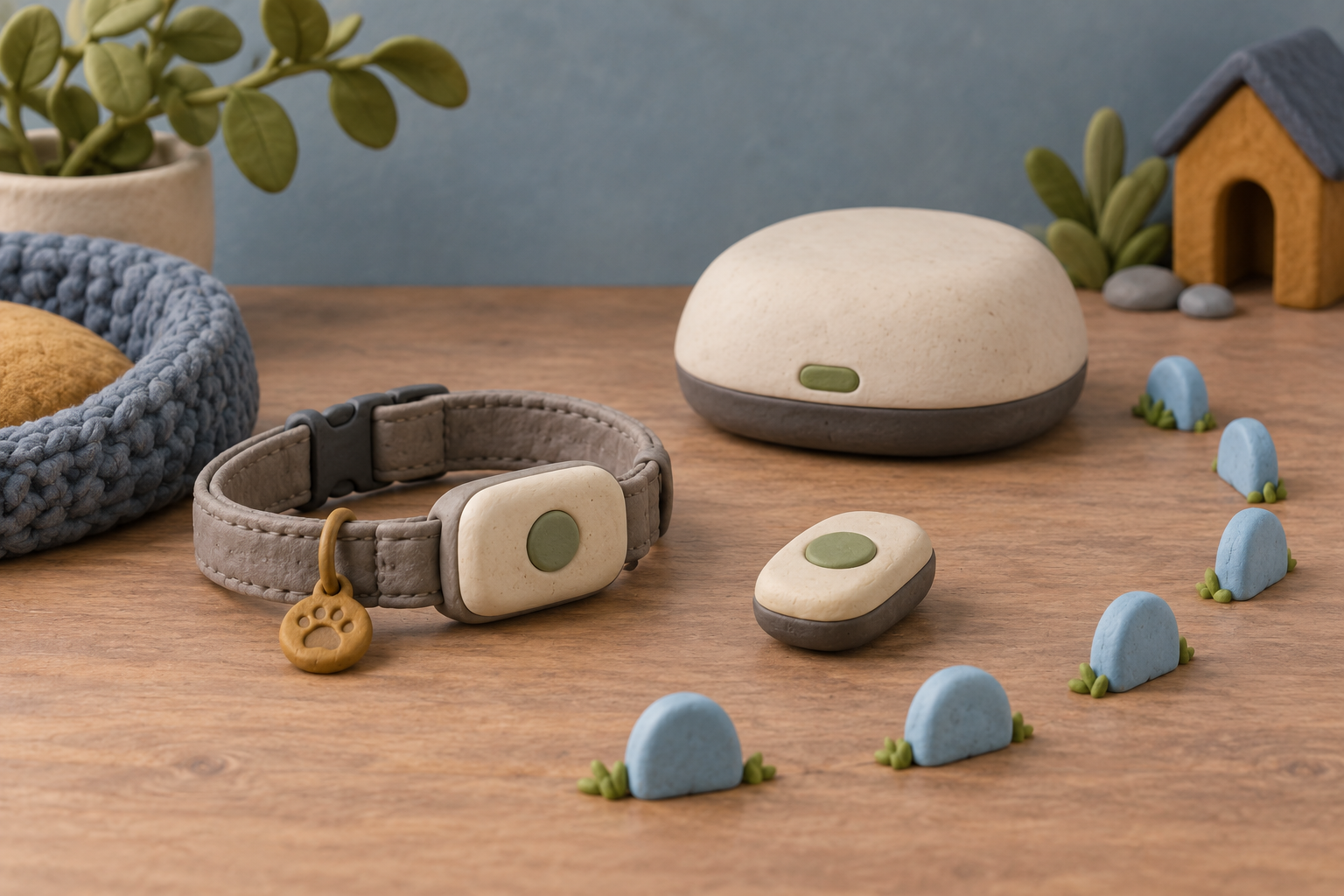
What changes in this design
Absent an animal-worn item like this, a reader might expect health-related information to be checked separately rather than collected while the animal wears it.
Here, an article worn by the animal supports an electronic module. Sensors collect animal health data, and processors analyze it to determine a health-related status, which can be provided through device outputs or an external device.
This helps explain why the item has electronics: they gather health data and turn it into a health-related status that can be provided through the item or another device.
Whistle's $117 million turn
In April 2016, Mars Petcare paid $117 million for Whistle, a San Francisco dog-tracker company founded four years earlier. The deal gave a small collar an unusually large vote of confidence: pets would wear sensors, owners would see a clearer account of their lives, and a consumer device might help notice trouble sooner. Whistle had already raised roughly $31 million across its early funding rounds.
By 2025, the story had turned. Tractive acquired Whistle out of Mars, discontinued the brand and product line, and moved customers to its own platform. The number that stays with me is not the purchase price but the short distance between that confidence and a shutdown. Pet wearables can attract serious money without proving that their central health promise holds up.
A crowded collar market
There is plainly a market for the promise. One industry forecast puts global pet wearables at $2.8 billion in 2025 and projects $7.2 billion by 2034, while estimating that smart collars account for 60.9% of sales. Those are market-research estimates, not clinical evidence, but they explain why so many firms want a place on an animal's neck.
The patent disputes have arrived too. A lawsuit over AI-enabled smart collars, filed in December 2024, ended in March 2026 with a stipulated dismissal with prejudice rather than a court ruling on the patent's reach. That leaves an important question unresolved for me: which parts of this familiar product category are actually protected, and which parts merely invite expensive arguments later?
That is the setting for US20260256361A1, titled Smart Pet Monitoring. It describes an animal-worn article carrying an electronic module, sensors and processors that collect health data, determine a health-related status, and present it on the device or elsewhere. It is a sensible description of where the category wants to go. It is not, by itself, evidence that the status determination is medically reliable.
The abandoned sensor stack
The idea has had a long runway. A 2014 animal-wearable application combined an accelerometer, ultra-wideband cardiopulmonary sensing, temperature sensing and audio in a collar or harness. Its proposed uses included flagging heat exhaustion, digestive trouble and trauma. The application was abandoned.
Sitting with that earlier filing, I find the abandonment more instructive than the sensor list. Putting several sensors on an animal is achievable; turning their signals into a defensible, useful account of illness is the hard part. A separate active patent, granted in 2025, takes another route, protecting collar hardware with curved patch and coil antennas for location and data relay to a base station and phone. Competitors are patenting the surrounding hardware as well as the health story.
None of this means the new filing cannot matter. It means it enters a field where years of engineering and patent drafting have not settled the central practical question.
Fur, skin and a worried owner
Veterinarians have been unusually direct about that question. Ernie Ward has described many dog trackers as little more than accelerometer-based pedometers, and has pointed out that thick neck skin and fur make human-style heart-rate sensing a poor fit for many dogs. Reduced movement is an observation. It does not automatically identify pain, anxiety, ageing, skin disease, or any other single cause.
A 2026 report quoting British Veterinary Association veterinarian Elizabeth Mullineaux makes the same consumer point: trackers can create needless worry when owners over-interpret their readings. That warning matters to me because a device that labels a health-related status can sound more certain than the underlying data warrants.
The regulatory gap is equally plain. The FDA says animal-only devices do not need a 510(k), premarket approval, registration, listing, or post-market reports. FDA can act when a device is misbranded or adulterated, but there is generally no premarket clinical check standing between a health-oriented collar and an owner. For owners and for us as readers, that makes careful language more important, not less.
What the filing is really betting on
This filing is betting that the useful part of pet monitoring is no longer simply tracking where an animal went or how much it moved. Its wager is that sensors plus processing can turn animal data into a health-related status worth showing to someone.
I do not read that as an empty wager. Early detection is a worthwhile aim, and a device that notices a meaningful change could give an owner a better reason to call a veterinarian. But the public description does not identify the sensors, the validation method, or how a reported status separates sickness from ordinary variation in a real animal's day.
The filing therefore belongs to a business story that is ahead of its proof. We should judge it less by the neatness of its sensor-and-processor arrangement than by the evidence eventually offered for what its outputs mean, how often they are wrong, and whether they improve veterinary care rather than merely intensify attention.
Sources
Reporting for this piece drew on the published filing and the references below.
- US20260256361A1 - Smart Pet Monitoring
- CA2907170A1 - Multiple sensors for monitoring health and wellness of an animal
- Social Positioning v. PetPace: Pet Tech Patent Dismissal
- Whistle (company)
- Dog Fitness Trackers Put Fat Doggos to Work, But Vets Question Accuracy
- Pet Wearable Market Size, Share, Trends & Forecast 2034
- Pet Fitness Trackers Raise New Questions for Owners and Vets
- US12193412B2 - Animal wearable tracker device and related methods
- How FDA Regulates Animal Devices
The record, briefly. US20260256361A1, “Smart Pet Monitoring” A wearable device for monitoring an animal includes a wearable article supporting an electronic module with one or more sensors and processors. The sensors collect animal health data, which processors analyze to determine a health-related status and provide through device outputs or an external device.
More angles on this
- A Harder Member Between a Scope Cover's SurfacesAnother reading from the same A61B classification family, diagnosis; surgery; identification.
- Tracking Wireless Monitoring With Reduced Data Loss Questions the Default ArrangementAnother reading from the same A61B classification family, diagnosis; surgery; identification.
- CPC A61B: Diagnosis; surgery; identificationThe official classification family this record was filed into, published in the USPTO Cooperative Patent Classification scheme.
- CPC A01K: Animal husbandryThe official classification family this record was filed into, published in the USPTO Cooperative Patent Classification scheme.
- The Light Loop Inside an Oral-Care RoutineAnother reading from the neighbouring A61C classification family, dentistry; apparatus or methods for oral or dental hygiene.
Read around this one:Public patent recordUSPTO published figure