Machines
The Interior Route to Surface Coating
A new Corning filing puts an old carbon-dioxide manufacturing technique beside cultivated meat's stubborn and costly microcarrier problem.

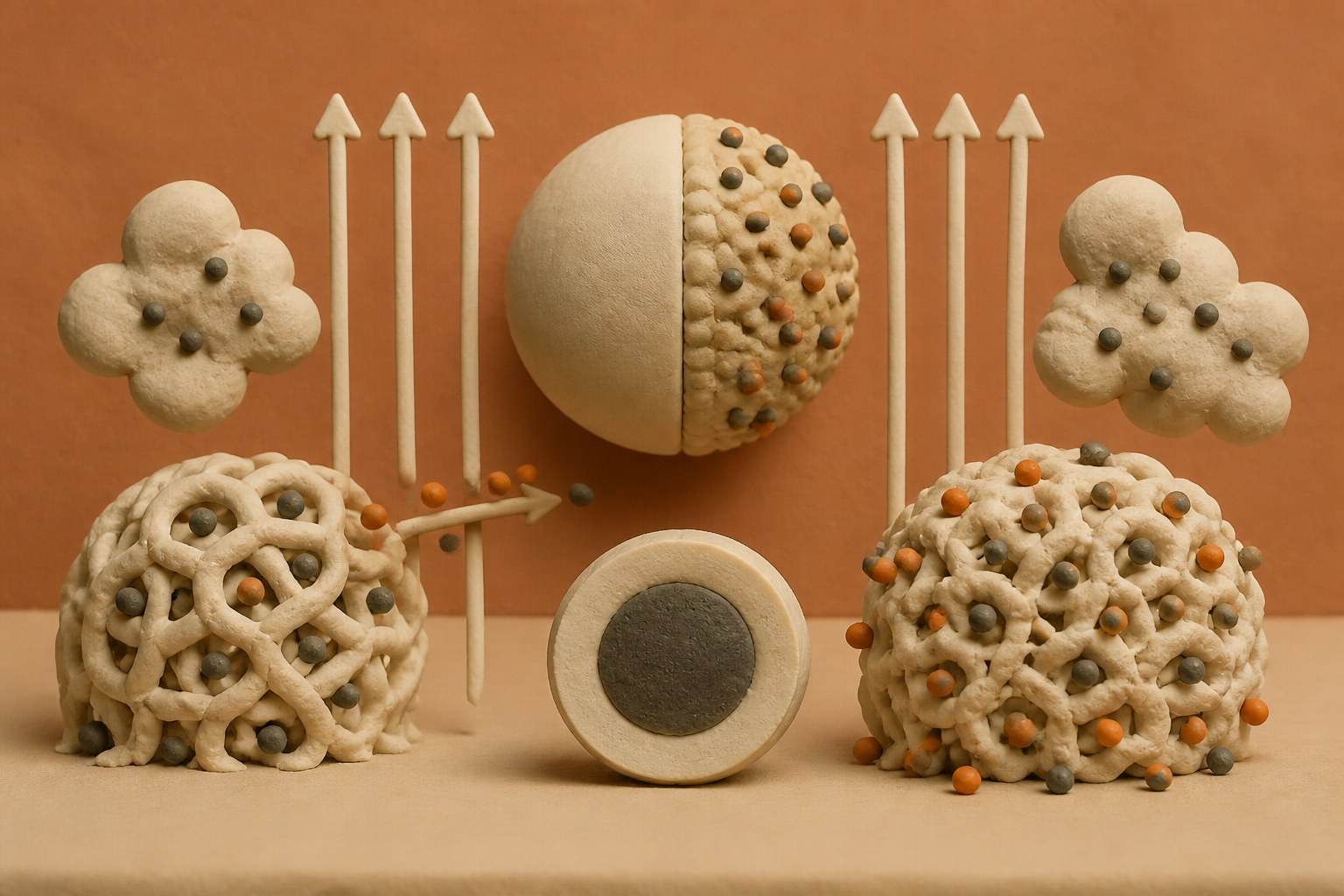
What changes in this design
A reader may picture a surface coating as something put directly on a material's outside. How coatings are ordinarily applied is not stated.
Instead, the method transfers chemicals present inside a porous soft material to its exterior through supercritical fluid exchange. That exchange may include supercritical carbon dioxide extraction.
It is worth knowing because the material's interior is the starting place for a surface coating. What the process measures or how it performs is not stated.
Twenty billion sterile devices
Roughly 20 billion medical devices are sterilized with ethylene oxide in the United States each year, according to a 2024 industry warning. That is about half of all sterile devices sold here, and the warning said an EPA rule could reduce ethylene-oxide capacity by as much as 50 percent. The number matters because manufacturers do not replace a process such as this casually. They need alternatives that work at scale, preserve delicate materials, and do not create a new bottleneck.
Supercritical carbon dioxide has become newly interesting in that setting. Under high pressure and heat, carbon dioxide takes on properties useful for moving through porous material and carrying compounds with it. The technology is not automatically a sterilization substitute, and I would not treat pressure on ethylene oxide as proof that any particular carbon-dioxide process will win. But it helps explain why an older manufacturing technique is being examined again wherever soft materials meet biology.
A coating from within
That is the setting for US20260256703A1, assigned to Corning and published on September 3, 2026. Filed in June 2023 and claiming a June 2022 provisional priority date, the patent describes using supercritical-fluid exchange, including supercritical carbon dioxide extraction, to move chemicals held inside a porous soft material out to its surface, creating a coating or surface feature.
The application names medical and life-science uses, including drug delivery, but its stated scope is much wider than one product. It even reaches for an example involving ferrous carbonate and coal gasification to argue that the general approach can travel across fields. The question I have is not whether that breadth is clever patent drafting. It plainly is. The harder question is whether a broad process claim can become a useful answer to a very specific manufacturing problem.
A contact-lens precedent
A contact-lens patent filed in 1995 shows how long the underlying move has been available. It described pressurizing carbon dioxide to 2,000 to 4,000 psi at 50 to 80 degrees Celsius, using it to draw unreacted monomer from hydrogel and silicone-hydrogel lenses. Its inventors claimed extraction up to ten times better than conventional alcohol and water washes.
Corning's filing is not merely a contact-lens cleaning patent. It is directed toward creating surface features by transferring intrinsic or encapsulated chemicals from a soft material's interior. Still, I do not see novelty in the basic proposition that supercritical carbon dioxide can penetrate and exchange chemicals within a porous polymer. The practical distinction would need to come from the material, the cargo, the resulting surface, or a manufacturing result that ordinary wet processing cannot match.
The alginate bead
Cultivated meat is one plausible place to test that distinction. Cells are often grown on tiny carriers or scaffolds, and separating them from non-edible carriers later adds cost and can introduce food-safety concerns. An industry research review makes the larger problem plain: a universal microcarrier is unlikely because cells and species do not all need the same thing.
The published claims here reference alginate-bead chemistry, which puts the patent near that unresolved problem. A separate Corning filing, published internationally in 2025, takes another route toward edible microcarriers using food-safe materials such as soy, whey, collagen, gelatin, and zein, with food-compatible crosslinkers. That overlap does not prove a commercial plan, but it does show multiple technical routes being claimed around the same point of friction.
Other applicants are working from the opposite direction. Mirai Foods has described an alginate-pectin hydrogel core with a food-grade gelatin coating, using EDTA or citrate to dissolve and recycle the polymer rather than relying on expensive enzymes. The source material leaves me skeptical that a supercritical exchange method, by itself, solves the carrier-removal problem. It may instead be one manufacturing option among several, competing against familiar wet chemistry on cost, throughput, and food compatibility.
The open question
Corning's company-wide results make the timing more interesting, not more conclusive. Core sales rose 17 percent year over year to $4.74 billion in the second quarter of 2026, driven by optical communications and solar, while its Life Sciences and Emerging Growth segment fell 15 percent to $294 million. That contrast says nothing direct about this patent's prospects, and it should not be used as a verdict on a research program.
What it does show is the difference between a filing and a finished business. This patent lays claim to a broad way of moving chemistry through soft, porous matter. The cultivated-meat field supplies a real and expensive problem, while older contact-lens work supplies a reminder that the physical technique is not new. I think the filing is most persuasive as evidence of a crowded search for viable microcarriers, not as evidence that the search is over. The unanswered test is whether supercritical exchange can make a carrier that is cheaper, safer, and easier to use than the wet-chemistry alternatives already on the bench.
Sources
Reporting for this piece drew on the published filing and the references below.
- US20260256703 - Methods for Formation of Surface Features on Soft Matter Materials Through Supercritical Fluid Exchange
- US20260256703A1 patent record
- CA2181984C - Treatment of contact lenses with supercritical fluid
- AdvaMed Anticipates EtO Sterilization Rule, Voices Concern About Impact on Patient Care
- Cultivated meat scaffolding deep dive
- WO2023104768A1 - Edible microcarrier for the preparation of cultured meat
- WO2025193526A1 - Edible microcarriers for cultivated meat
- Corning's Strong Second-Quarter 2026 Financial Results
The record, briefly. US20260256703A1, “Methods For Formation Of Surface Features On Soft Matter Materials Through Supercritical Fluid Exchange” A method of surface coating a porous soft matter substance transfers intrinsic or encapsulated chemicals from its interior to exterior through supercritical exchange, which may comprise supercritical carbon dioxide extraction.
More angles on this
- Confectionery Receives a Second Design ReviewAnother reading from the same A61K classification family, preparations for medical, dental or toiletry purposes.
- Chocolate, With Shape as Its Main ArgumentAnother reading from the same A61K classification family, preparations for medical, dental or toiletry purposes.
- CPC A61K: Preparations for medical, dental or toiletry purposesThe official classification family this record was filed into, published in the USPTO Cooperative Patent Classification scheme.
- Two Fibers and the Burden of ContextAnother reading from the neighbouring A61B classification family, diagnosis; surgery; identification.
- A Step, Two Hollows, and the Small Surface That Says Where a Mouthpiece StopsAnother reading from the wider A24F classification family, smokers' requisites; match boxes; simulated smoking devices.
Read around this one:Public patent recordUSPTO published figure