Objects
A Step, Two Hollows, and the Small Surface That Says Where a Mouthpiece Stops
An elastic mouthpiece latch reveals a vape industry's hardware polish amid a U.S. market where many finished products remain unauthorized.

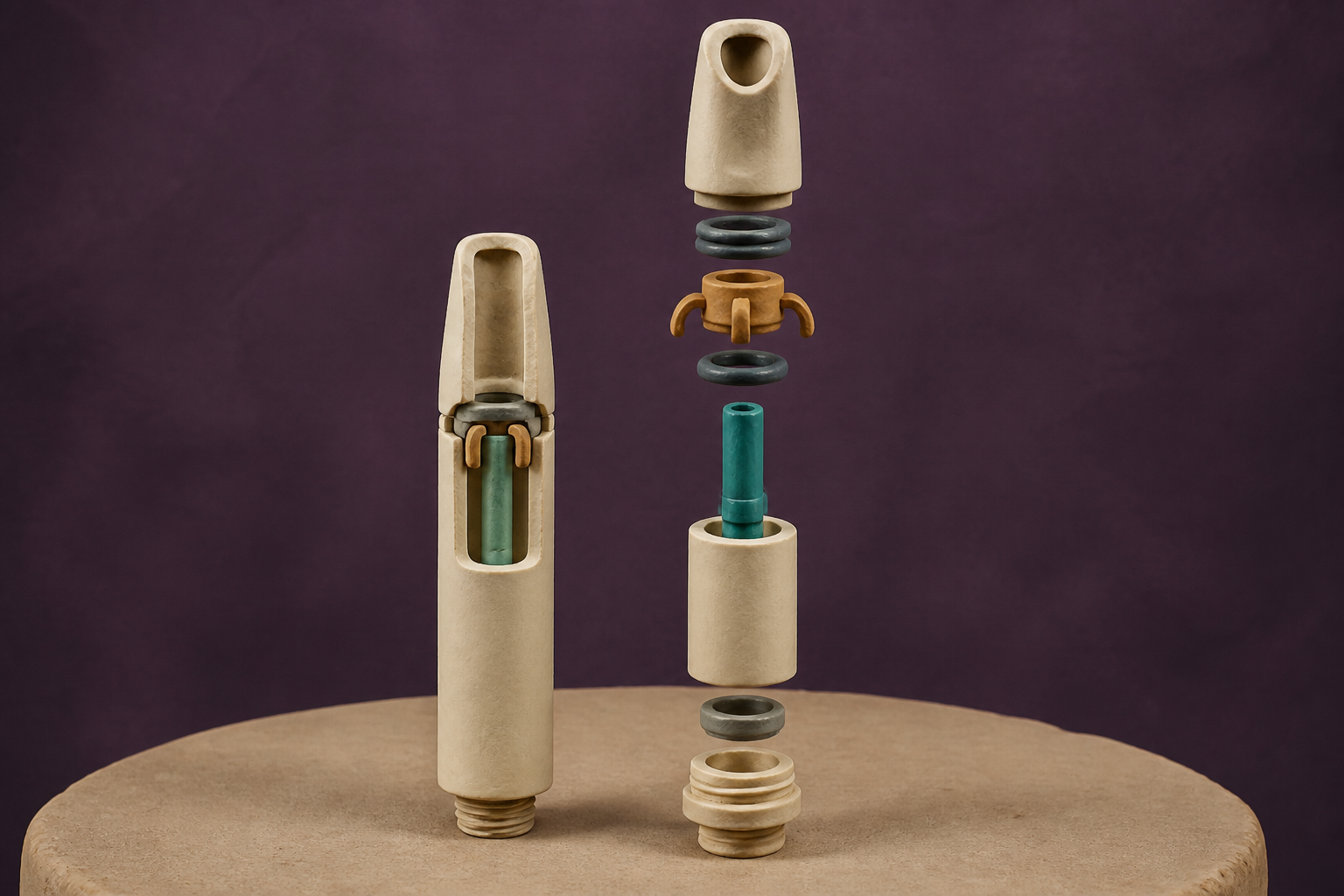
What changes in this design
Without further detail, a reader might picture a mouthpiece simply fitting over the tube that delivers aerosol.
Here, the mouthpiece has two internal hollow spaces with a step between them. Flexible arms extend into the first space and abut the step, fastening the mouthpiece assembly to the tube that outputs aerosol.
That detail makes the attachment easier to picture. The step is the surface the flexible arms abut as they fasten the mouthpiece assembly to the tube.
Eighteen million units
A May 14 account of Operation Red Mist described the seizure of 18 million unauthorized vape products valued at more than $175 million. The cargo originated in China and, according to that account, moved through maritime shipments that were misclassified or mislabeled. That is an unusually large number for something designed to disappear into a pocket.
The enforcement story is a useful place to start because patented hardware and an authorized finished product are very different things. A mouthpiece can be carefully engineered and manufactured at vast scale while sitting inside a product that has not cleared the U.S. system. The gap is the subject here, not a verdict on this particular application.
A latch in the mouthpiece
That small component appears in U.S. publication US20260256195A1, published September 3, 2026, under the familiar title Atomiser And Electronic Atomisation Device. The filing concerns a mouthpiece assembly with two successive hollows, a step between them, and elastic arms that extend into the first hollow and bear against that step. A tubular element delivers aerosol, while the arms fasten the mouthpiece assembly in place.
The interesting move is not a new vapor formula or a dramatic device shape. It is a fastening decision: make a flexible arm catch a ledge hidden inside a mouthpiece. The filing made me pause because it reduces a consumer-facing object to a very exact question: how can two parts stay together? In a mature hardware category, that question can earn a patent even when it looks slight on the page.
A week of seals
The application is assigned to Shenzhen First Union Technology Co., Ltd. It traces to Chinese priority filing 202210253182.8 of March 15, 2022; the U.S. application, 18/846,953, followed on March 14, 2023, before publication roughly four and a half years after priority. One week after that original priority date, the same company filed a Chinese application for another atomizer device. That one uses a movable suction nozzle to seal the liquid chamber in a second position.
Taken together, the two filings look less like a single grand redesign than a cluster of narrow attempts to control the joins around an atomizer. What I found in nearby patent work is not consensus on one best lock, but several mechanical answers to related weak points. It is easy to dismiss a latch as trivial until competing designers begin inventing around it.
Three answers to a loose joint
One independent 2023 U.S. design attacks mouthpiece retention from another direction. Its inventor identifies problems with multi-tooth clamps: uneven pressure can move a center post and lead to leaks, intricate teeth can degrade the mold, and failure of one tooth can disable the lock. The proposed answer is a continuous clamp with one notch, rather than an array of teeth.
A rival Shenzhen manufacturer had already received a U.S. patent in February 2025 under almost the same generic title, but for a different failure. Its design addresses negative pressure as e-liquid runs down, a condition associated there with burnt smell, using a ventilated liquid spacer. The same broad device name can cover a latch, a moving seal, a pressure-management spacer, and a clamp.
Patent volume and product volume
First Union is not filing from a garage. Its company profile says it was founded in 2004, has three manufacturing facilities totaling 120,000 square meters, and employs more than 3,000 people. In a May 2025 release, it said it held more than 2,000 related patents, including more than 200 international PCT patents, after more than a decade in heated-tobacco technology. It also claimed more than 50 patent families for one product line. Those are company-reported totals, but they put a tiny mouthpiece catch in a much larger filing program.
The money explains some of the attention without proving the value of any one patent. A market report estimated the global disposable e-cigarette market at $6.9 billion in 2024 and forecast $21.2 billion in 2034, an 11.9% compound annual growth rate. Forecasts are forecasts, and this one does not tell us how much of the trade is legal or how revenue is divided among brands and manufacturers. It does help explain why tiny tolerances invite so much patenting.
The harder half of the problem
Hardware progress does not settle market access. A September 30, 2025 report on an FDA statement said 54% of vape products then sold in the United States were unauthorized and illegally distributed, while only 39 vaping products nationwide had FDA authorization. The mismatch should make anyone reading this mouthpiece patent cautious: intellectual-property publication, component manufacture, and permission to sell a finished nicotine product are separate questions.
That separation is why the small elastic arms matter, and why they do not matter enough. They show real effort to refine a small mechanical connection, alongside other designers trying different fixes. I do not read the filing as a story of a clever latch winning the future. It is a case study in engineering polish applied to a category whose hardest question is still whether the finished product can lawfully reach the people it was made for.
Sources
Reporting for this piece drew on the published filing and the references below.
- Atomiser And Electronic Atomisation Device Patent Application
- U.S. Patent Application for Atomiser And Electronic Atomisation Device
- Vaping Mouthpiece Locking Structure Design, US11937634B1
- Atomizer and Electronic Atomization Device, US12225943B2
- Atomizer and Electronic Atomization Device, CN116807059A
- Shenzhen Firstunion Technology Co., Ltd. Company Profile
- FDA Declares 54% of Vapes Illegal: What Importers Must Know Now
- CBP, FDA Seize $175M in Chinese Illicit Vapes
- Disposable E-cigarettes Market Size, Share
The record, briefly. US20260256195A1, “Atomiser And Electronic Atomisation Device” An atomiser has a mouthpiece assembly with sequential first and second hollows and a step between them. A tubular element outputs aerosols to the assembly, while elastic arms extend into the first hollow and abut the step to fasten the assembly to the tubular element.
More angles on this
- CPC A24F: Smokers' requisites; match boxes; simulated smoking devicesThe official classification family this record was filed into, published in the USPTO Cooperative Patent Classification scheme.
- A Baseplate's Signal: From Guess to Defined ResponseAnother reading from the neighbouring A24B classification family, manufacture or preparation of tobacco for smoking or chewing; tobacco; snuff.
- Degassing a bottle: a chamber, a pump, and the judgment left to whoever holds itAnother reading from the wider A23L classification family, foods, foodstuffs or non-alcoholic beverages, not otherwise provided for; preparation or treatment thereof.
- Small Game Cleaning Device Makes the Next Move Easier to SeeAnother reading in the same Objects category on this site.
Read around this one:Public patent recordUSPTO published figure