Machines
Two Fibers and the Burden of Context
A new fiber-optic vitals filing enters the cuffless blood-pressure race as the category's accuracy problem becomes impossible to ignore.

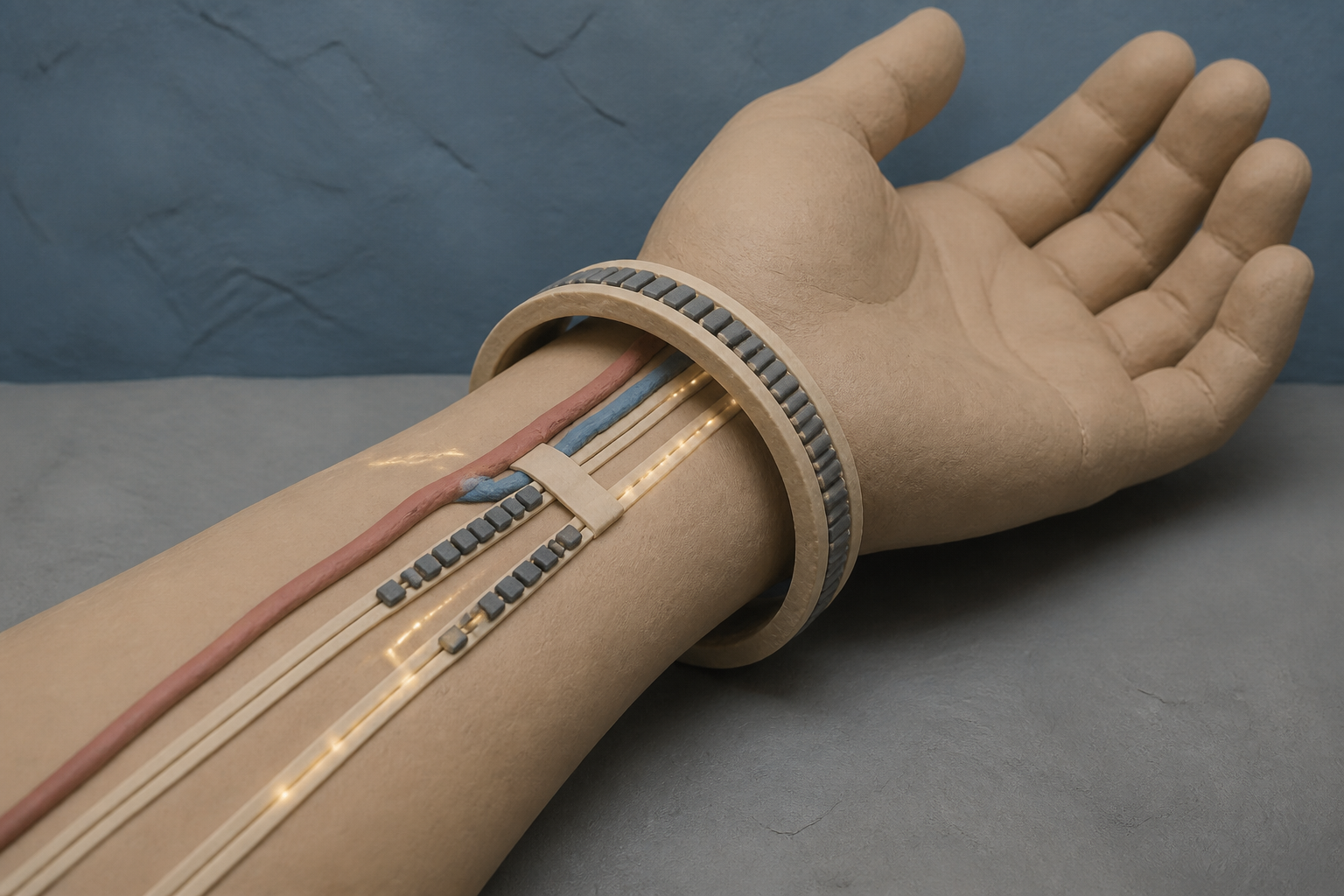
What changes in this design
Someone seeing a body monitor might expect one reading from one place on the skin. That setup would not include a separate reference reading farther from an artery or vein.
One light-sensing fiber section is put near an artery or vein, while a second one serves as a baseline, or reference, farther away. Light is sent through both. The device reads refractive-index changes, meaning changes in how the fibers affect the light, and uses stretching-related shifts in wave spacing with a calibration curve, a conversion guide, to estimate a bodily measurement.
This is worth knowing because the placement on the skin is part of how the estimate is made. One reading is treated as a reference. It also makes clear that light-related changes and a calibration curve are part of the process. Which bodily measurement it represents is not stated.
The 20 mmHg warning
Twenty millimeters of mercury is an awkward gap to wear on your wrist. In April 2025, a university medical newsroom reported on an analysis warning that cuffless blood-pressure devices can read roughly 20 mmHg too high or too low. That is the difference between a reassuring number and a disturbing one, which is why the number makes me wary of any wearable that turns a pulse signal into a health verdict.
Hypertension is not a niche annoyance waiting for a nicer gadget. The World Health Organization counted 1.3 billion people with hypertension in 2019, nearly half unaware they had it; about four in five were inadequately treated, and roughly one in five had it controlled. A continuous measurement that people will actually tolerate could matter enormously. The premise is compelling. The accuracy bar is the story.
Two gratings by an artery
That is the setting for US20260256364A1, Method And Apparatus For Continuous Vitals Monitoring. The filing proposes fiber Bragg gratings placed on the skin: a first grating near an artery or vein, and a baseline grating farther away. Light pulses through the pair; changes in refractive index and strain-linked wavelength shifts feed a calibration curve intended to estimate a physiological attribute.
Fiber Bragg gratings are patterned sections of optical fiber whose wavelength response shifts when strain changes. First demonstrated in fiber in 1978, they have spent decades in telecommunications and in measuring strain or temperature in things such as aircraft composites. What I keep returning to is the modesty of the move: take a mature way of noticing tiny physical changes and put it at the skin, for a use not normally associated with the technology.
The method described here names a physiological attribute rather than blood pressure. I can't tell from that description whether the technique is meant to deliver blood pressure, another vital, or several. But it plainly arrives amid a market pursuing continuous, cuff-free readings, and that context changes how demanding the claim feels.
The calibration curve
Calibration is the small word doing large work in this application. The proposed estimate comes from strain-related wavelength shifts and a calibration curve, so the fiber is not directly reading a finished clinical answer. It is measuring a change and asking a model to translate it.
That translation has troubled every branch of cuffless monitoring. A 2023 peer-reviewed wrist study using two optical pulse channels reported systolic error of 0.44 plus or minus 6.00 mmHg and diastolic error of minus 0.50 plus or minus 6.20 mmHg, within the accuracy thresholds cited by its authors. Yet the same paper lays out familiar obstacles: volume-clamp systems can be uncomfortable, tonometry is sensitive to motion, and methods based on pulse travel time often do not generalize well between people.
That is a promising study result, not proof that one sensing family has escaped the calibration problem. In my view, the FBG filing deserves interest precisely because it tries a different physical input, not because it establishes that the result will be accurate enough for a medical decision.
The one-time cuff calibration
In July 2025, Aktiia announced that its Hilo Band had received FDA 510(k) clearance as the first cuffless blood-pressure monitor cleared for over-the-counter use. Its wrist device uses optical PPG sensing and still requires a one-time cuff calibration. That pairing of clearance and calibration is useful reality-check material: regulatory progress has not made the cuff disappear from the process.
Elsewhere, market reporting places ultrasonic devices and AI-enabled wearable textiles beside optical bracelets. A commercial review of fiber Bragg grating patents, covering records through March 2026, grouped them around automotive, medical catheter, structural and energy, oil and gas, rail, and security uses. Continuous health monitoring did not appear as an established category in that review. This would be an unusual application of the fiber, which I find more interesting than another variation on familiar wrist sensing.
Where the risk actually sits
None of this makes a fiber on the skin a bad idea. The paired grating arrangement may yield a useful signal, and the filing is a public application, not a promise of a finished device. But the clinician warning remains the correct standard: cuffless readings should match the accuracy of cuff measurements used in medical settings, or not be used at all.
The question for me is not whether the optics are clever. It is whether the calibration curve can survive different bodies, different placement, ordinary motion, and the unforgiving moment when a number changes what someone does next. Until public evidence shows that it clears that bar, I would treat US20260256364A1 as a thoughtfully aimed entrant in a hard race, not evidence that the race has been won.
Sources
Reporting for this piece drew on the published filing and the references below.
- Method And Apparatus For Continuous Vitals Monitoring
- Caution advised toward 'cuffless' devices' BP readings
- First WHO report details devastating impact of hypertension and ways to stop it
- A new method of continuous blood pressure monitoring using multichannel sensing signals on the wrist
- Fiber Bragg grating
- Aktiia's Hilo Band Becomes First Cuffless Blood Pressure Monitor Cleared by FDA for Over-the-Counter Use
- FBG Sensor Patent Landscape 2026: Key Tech Clusters
- Blood Pressure Monitoring Devices Market
The record, briefly. US20260256364A1, “Method And Apparatus For Continuous Vitals Monitoring” A health monitoring device uses first and baseline fiber Bragg gratings placed on skin near and away from an artery or vein, pulses light through them, reads refractive-index changes, and estimates a physiological attribute using strain-related wavelength shifts and a calibration curve.
More angles on this
- The Boundary Inside Smart Pet MonitoringAnother reading from the same A61B classification family, diagnosis; surgery; identification.
- A Harder Member Between a Scope Cover's SurfacesAnother reading from the same A61B classification family, diagnosis; surgery; identification.
- CPC A61B: Diagnosis; surgery; identificationThe official classification family this record was filed into, published in the USPTO Cooperative Patent Classification scheme.
- The Light Loop Inside an Oral-Care RoutineAnother reading from the neighbouring A61C classification family, dentistry; apparatus or methods for oral or dental hygiene.
- A bath mat with a split grommet ring, and the drying decision it hands back to youAnother reading from the wider A47G classification family, household or table equipment.
Read around this one:Public patent recordUSPTO published figure