Field Notes
A bath mat with a split grommet ring, and the drying decision it hands back to you
After more than seventy years of patents for hanging wet bath goods, a new split-ring mat tests whether the showerhead arm is the right answer.

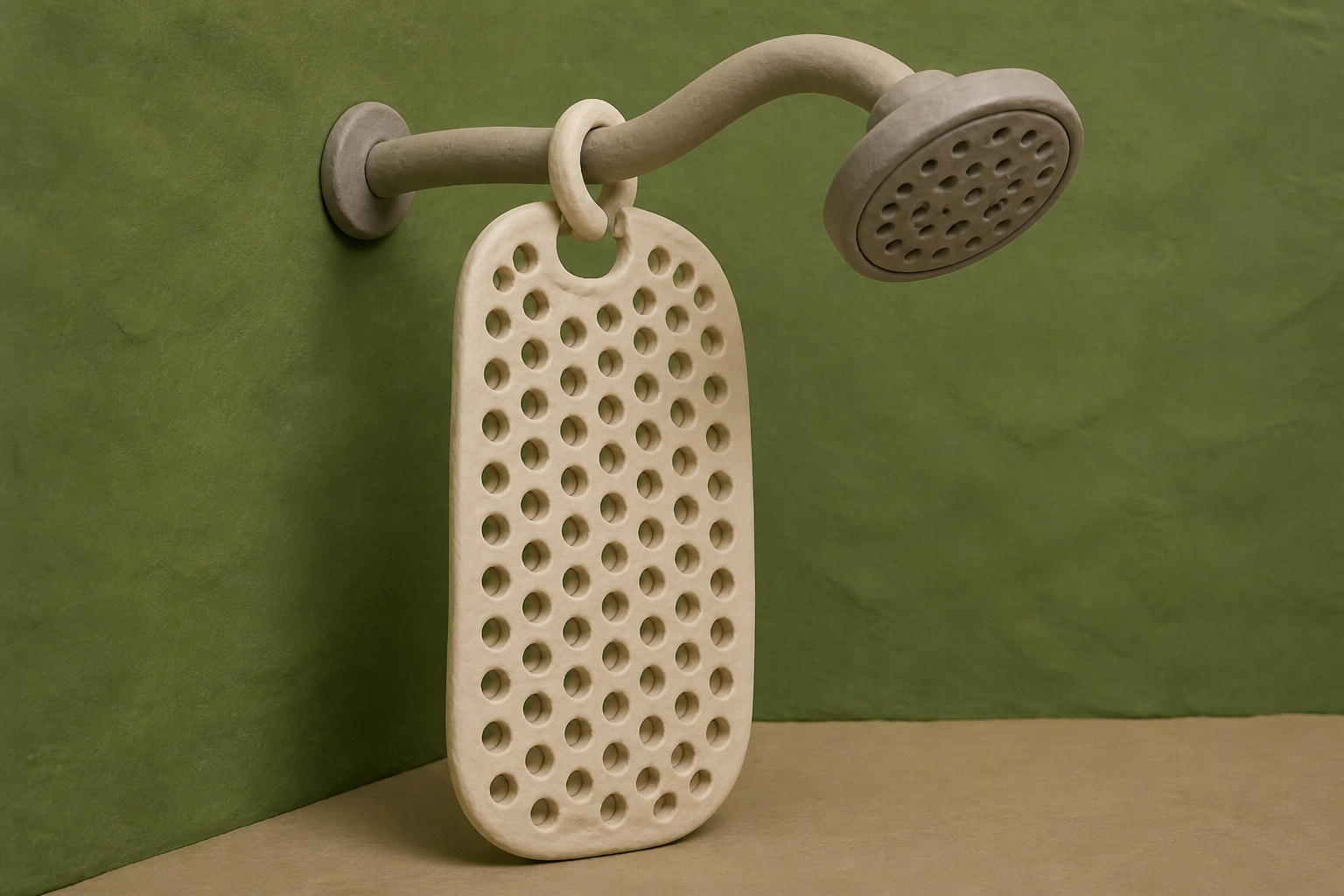
What changes in this design
Without a hanging feature, a reader might expect a bath mat to be laid out somewhere while it dries.
Instead, the bath mat has hanging openings with gaps and a flexible ring with a gap near one end, allowing it to hang from a shower head arm or other support.
This matters because it tells you why the mat includes openings and a flexible ring near one end: they make hanging it for drying possible.
234,000 bathroom injuries
In 2008, about 234,000 people age 15 and older were treated in U.S. emergency departments for bathroom injuries, according to CDC data reported at the time. That is roughly 640 people a day. More than 80 percent involved slips or falls, mostly as people entered or left a tub or shower.
Those figures do not identify bath mats as the cause, and they should not be made to carry that claim. But they show why a soaked strip of absorbent fabric on a bathroom floor is more than a housekeeping nuisance. A consumer home report describes how rubber-backed cotton, microfiber, and memory-foam mats can trap water, soap scum, and skin cells against the floor, creating conditions in which mold can grow. It recommends washing such mats every one to two weeks.
What I take from that is simple: an ordinary mat must become dry again after doing its job.
October 2, 1952
On October 2, 1952, Howard T. Flinn filed a U.S. patent for a gravity-powered, spring-loaded bath-mat hanger. It was granted in 1957, explicitly aimed at keeping wet mats from sitting on the floor and speeding their drying.
That puts the current concern in a long patent history. The old solution did not change the mat's fibers or make the floor less wet. It changed where the mat spent the hours between showers.
By 2001, another inventor had built a cord-and-ring drying arrangement into a bathing sponge. That application became a patent in 2006. The through line is useful, I think: designers keep adding a place to hang the wet thing rather than asking the wet thing to behave differently.
That history matters to my reading of the latest filing. It makes the ring look less like a sudden breakthrough and more like a durable answer to a durable annoyance.
A ring with a gap
US20260256310A1 arrives at the end of that line, titled Bath Mats With Split Hanging Grommet Rings. It describes a bath mat with a split hanging opening and a flexible split grommet ring near one end. The gap lets the ring go around a showerhead arm or another support member so the mat can hang while it dries.
The smallness of that hardware is precisely why its history matters. A 2017 filing, granted in 2020, used split-ring grommet hardware to let a shower curtain and a second liner hang from the same rod. The textile changed; the open-and-close mechanism did not.
I do not see that earlier curtain hardware as a reason to dismiss the bath-mat design. To my eye, it shows what this filing is really doing: carrying a proven way to open a ring around a support into a different wet-textile problem.
Whether that move is enough depends less on the ring than on where it is asked to hang.
The showerhead arm
A plumbing-company advisory raises the awkward practical issue. Showerheads and their arms are not designed to carry hanging loads, it says, and overloading can break the connection to the wall. A wet bath mat is precisely the kind of hanging load that weighs more than it did on the store shelf.
The filing permits another support member, which softens the issue. Still, the showerhead arm is prominent enough in the idea that I cannot ignore the mismatch between a drying solution and a component a plumber says should not be loaded.
The unanswered details are capacity, ring security, and suitable supports. Nothing in the sources I reviewed establishes how heavy a saturated mat may be or which showerhead arms can take it.
Other materials approach the same problem from a different direction. A teak-mat seller says its slatted surface lets air circulate and water drain, but that is the seller's own claim rather than an independent test. A seller of diatomite stone mats claims that its product absorbs up to 150 percent of its weight in moisture and releases it in seconds. I cannot verify those performance claims from the material here, but they matter because they remove the hanging step altogether.
The open question
One market report estimates the global bath-mats market at USD 139.28 million in 2025 and forecasts USD 169.70 million by 2033, or a 2.5 percent compound annual growth rate. It puts cotton at 41.8 percent of the category and bamboo as the fastest-growing material, at 19.5 percent CAGR. Those figures come from a market-report publisher, so I would treat them as directional rather than settled.
Even so, the pattern is clear enough: absorbent fabric remains a large part of the category, and products will keep trying to deal with the time it stays wet.
The new ring is a practical adaptation of a known bathroom-textile mechanism. It may give a cloth mat a more convenient place to dry, particularly if it is clipped to an appropriate separate support. But none of the evidence here shows that it reduces mold, prevents falls, or is safe on a particular showerhead arm.
What I want to know is the less glamorous part: compared with a normal wash routine, a slatted wood mat, or a diatomite mat, how much faster does it actually dry and where can it safely be hung? Until someone measures that, I think this is a thoughtful answer to a real household problem, but not yet the most direct one.
Sources
Reporting for this piece drew on the published filing and the references below.
- Bath Mats With Split Hanging Grommet Rings
- Bath mat hanger
- Multi-use and decorative bathing implement
- Hanger ring with integral hook
- Break Bad Shower Habits to Save Your Bathroom Plumbing
- The One Bath Mat Experts Say Is Practically A Mold Magnet
- How to Prevent Mold & Mildew Under Your Shower Mat
- Quick Dry Diatomite Mat
- Global Bath Mats Market
- CDC Report Shows Bathroom Injuries Cause Thousands of Visits to ER
The record, briefly. US20260256310A1, “Bath Mats With Split Hanging Grommet Rings” The publication describes bath mats with split hanging openings and a flexible split grommet ring near an end, enabling hanging on a shower head arm or other support member for drying.
More angles on this
- The pocketed corner that answers where a rug belongsAnother reading from the same A47G classification family, household or table equipment.
- The Suspender Belt Is Holding the Plot TogetherAnother reading from the same A47G classification family, household or table equipment.
- CPC A47G: Household or table equipmentThe official classification family this record was filed into, published in the USPTO Cooperative Patent Classification scheme.
- The Retractable Drawer Divider That Holds On By Leaning, Not FasteningAnother reading from the neighbouring A47B classification family, tables; desks; office furniture; cabinets; drawers; general details of furniture.
- A zipper slider whose underside is set at two heights on purposeAnother reading from the wider A44B classification family, buttons, pins, buckles, slide fasteners, or the like.
Read around this one:Public patent recordUSPTO published figure