Objects
A zipper slider whose underside is set at two heights on purpose
A new zipper filing turns a small safety claim into a view of the old, high-volume contest over who owns the slider.

What changes in this design
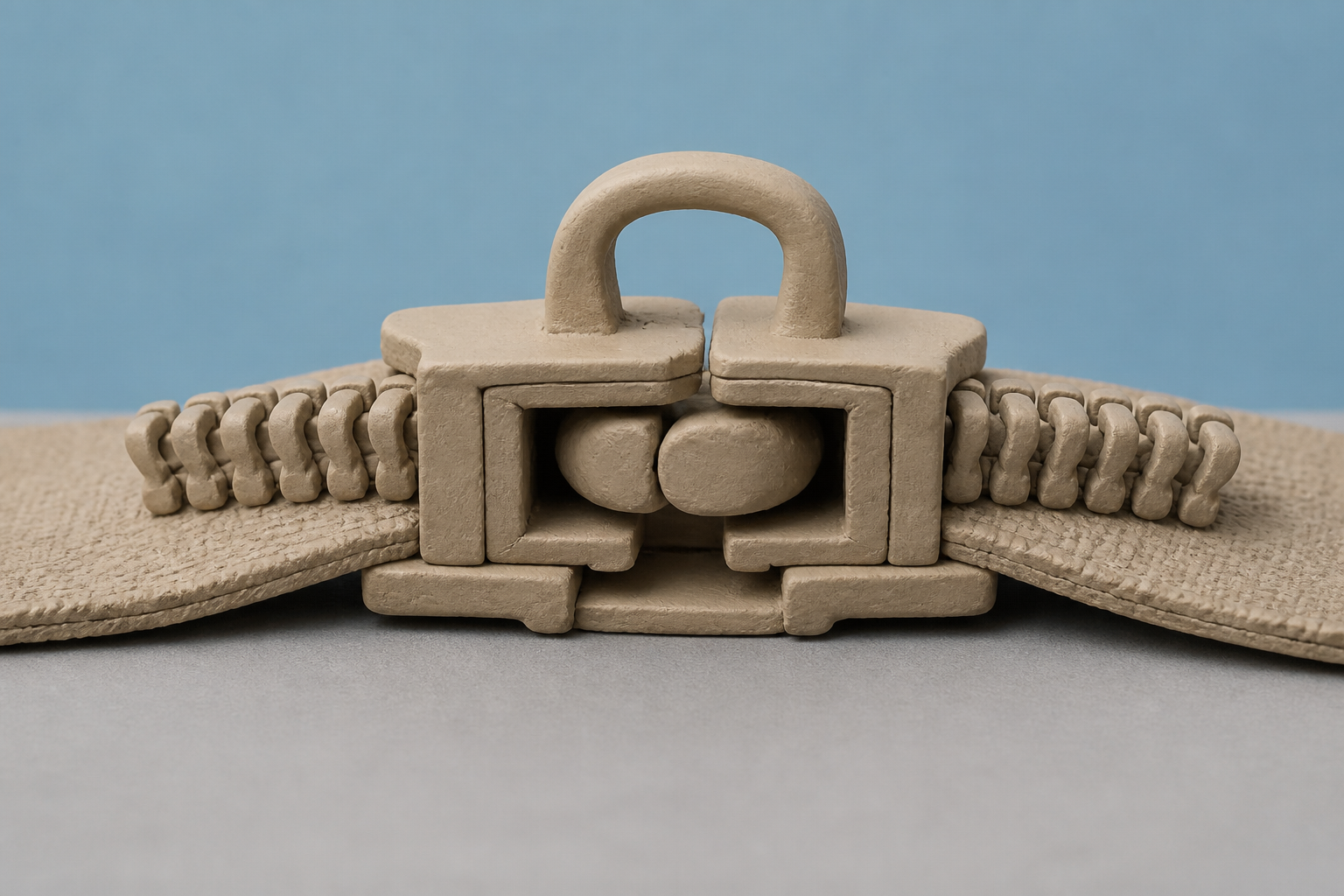
A reader may picture a zipper slider’s underside as a single, even surface close to its cloth tapes.
Here, the middle bottom and the side bottoms are at different heights. The side bottoms are for the cloth tapes, and the height difference creates a gap next to them.
That gap matters because it can keep the slider from touching a wearer’s skin. The record does not state how much clearance is used or which garments use it.
The emergency-room number
Between 2002 and 2012, U.S. emergency departments recorded an estimated 17,616 visits for zipper-related genital injuries, or about 1,700 a year. The number that made me pause is not huge by emergency-care standards, but it is not imaginary either: a tiny metal slider can turn an ordinary trip to the bathroom into an urgent problem. A 2013 analysis of national injury data found zippers to be the single most common cause of penile injury among adult men seeking emergency care.
Clinical guidance is revealingly low-tech: mineral oil for five to 30 minutes to soften trapped tissue, then, if needed, needle-nose pliers on the slider's median bar. By minor, I don't mean painless or insignificant. I mean the medical literature supplied for this story treats release as a non-surgical problem, not a reason to redesign the zipper. Nothing in those materials points to a rising-injury crisis or a regulator's mandate.
The gap beneath the slider
That is why US 2026/0256249 A1 caught my attention. Published September 3, 2026, it is called Non-Pressure-Sensing Slider and Zipper and lists Zhejiang Weixing Industrial Development Co., Ltd., the SAB-brand manufacturer, as filer. Its described solution is mechanical: a base core, side blocking plates that make channel walls, a base bottom, and side bottom plates for the cloth tapes. Their differing heights and a gap from the tapes form the channel's bottom, a shape the application says can keep skin from contacting the slider while it is worn.
The word can is doing honest work. The application claims a way to prevent contact during wearing; the materials I reviewed report no injury-rate testing, durability result, or comparison with an ordinary slider. A published application proves neither that the shape works in every garment nor that it is legally new. Still, this puts the safety idea into the slider's geometry rather than a guard added after the fact.
A 2022 Chinese priority filing
The trail starts earlier and elsewhere. U.S. application 18/995,872 entered the national stage from PCT/CN2023/106726, filed July 11, 2023, and claims priority to Chinese application 202221868841.0, filed July 19, 2022. That number identifies a utility model. Reading the dates, I was struck less by a sudden safety discovery than by an industrial design moving through national systems.
The source on China's system says utility models receive an initial novelty and formality check, with full substantive examination deferred until an enforcement dispute. It does not tell us this slider lacks novelty, and I would not claim that from its filing history. It does tell us not to mistake publication for a scientific verdict or a clean bill of originality. The materials identify no ASTM or ISO standard specifically governing zipper pinching.
Fifteen years of baffles
Anti-pinch zipper hardware has a longer history. In February 2011, Huang Chengyou filed CN201938539U for an anti-pinch zipper whose baffle plates push fabric away from the tooth inlet to keep an infant's skin from being caught. It is the earliest identifiable ancestor in these sources, not proof nobody had the idea first. Those records do not let me establish copying or decide whether the claims overlap. They do show a patentable anti-pinch theme at least 15 years old.
YKK's Anti-Snag Slider Cover takes another route: a permanently fused plastic cover for a #5 coil slider. Its product page says it is not suitable for items intended for children under three, even though young children are prominent in pediatric zipper-entrapment cases. For me, that limitation is a reason not to dismiss a base-slider redesign. A cover above the slider and a channel below it may solve different problems. But could is still the right word until someone tests it.
The part worth watching
Scale makes those narrow distinctions serious business. One industry estimate places the global zipper market at roughly $20 billion. YKK reports more than 10 billion zipper units sold in fiscal 2024, more than three million kilometers of zipper. Zhejiang Weixing says its five industrial parks produce more than 6.5 billion meters a year and launch more than 7,000 product designs annually. The same filer was using the PCT route for unrelated zipper hardware by 2013.
Those figures do not prove why this application was filed. My reading is that it belongs to a long competitive practice of claiming small changes in a crowded fastening business, not a newly discovered public-health emergency. The filing's claim is modest and concrete: a gap and a height difference meant to keep skin away. The part I will watch is whether that geometry can be shown to keep skin away in real garments without making the zipper harder to use, less durable, or less compatible with clothing. Until then, it is evidence of where the contest is fought, not that it has been won.
Sources
Reporting for this piece drew on the published filing and the references below.
- Non-Pressure-Sensing Slider And Zipper
- Zip-related genital injuries send 1,700 men to ER each year
- Penile Zipper and Ring Injuries
- China Patent Flood Stifles Foreign Filer Freedom
- CN201938539U - Anti-Pinch Zipper
- Anti-Snag Slider Cover
- YKK Surpasses 10 Billion Annual Global Zipper Unit Sales in FY2024
- About WeiXing Co., Ltd.
- WO2015010414A1
- The Humble Zipper Is at the Center of an Almost $20 Billion Global Battle
The record, briefly. US20260256249A1, “Non-Pressure-Sensing Slider And Zipper” A non-pressure-sensing slider has a base core, side blocking plates forming channel walls, a base bottom, and side bottom plates for cloth tapes. Their height difference and a gap from the cloth tapes form the channel bottom and can prevent skin contact during wearing.
More angles on this
- The Buckle Understands a Good EndingAnother reading from the same A44B classification family, buttons, pins, buckles, slide fasteners, or the like.
- CPC A44B: Buttons, pins, buckles, slide fasteners, or the likeThe official classification family this record was filed into, published in the USPTO Cooperative Patent Classification scheme.
- The Decorative Band Has Detachable ConfidenceAnother reading from the neighbouring A44C classification family, personal adornments, e.g. jewellery; coins.
- A crampon that puts the adjustment in the wire, not in the two parts it joinsAnother reading from the wider A43C classification family, fastenings or attachments of footwear; laces in general.
- A drawer connector that turns once, then declines to be talked out of itAnother reading in the same Objects category on this site.
Read around this one:Public patent recordUSPTO published figure