Objects
A drawer connector that turns once, then declines to be talked out of it
A small drawer latch from Guangdong lands in the United States after tariffs remapped the cabinet trade it was built to serve.

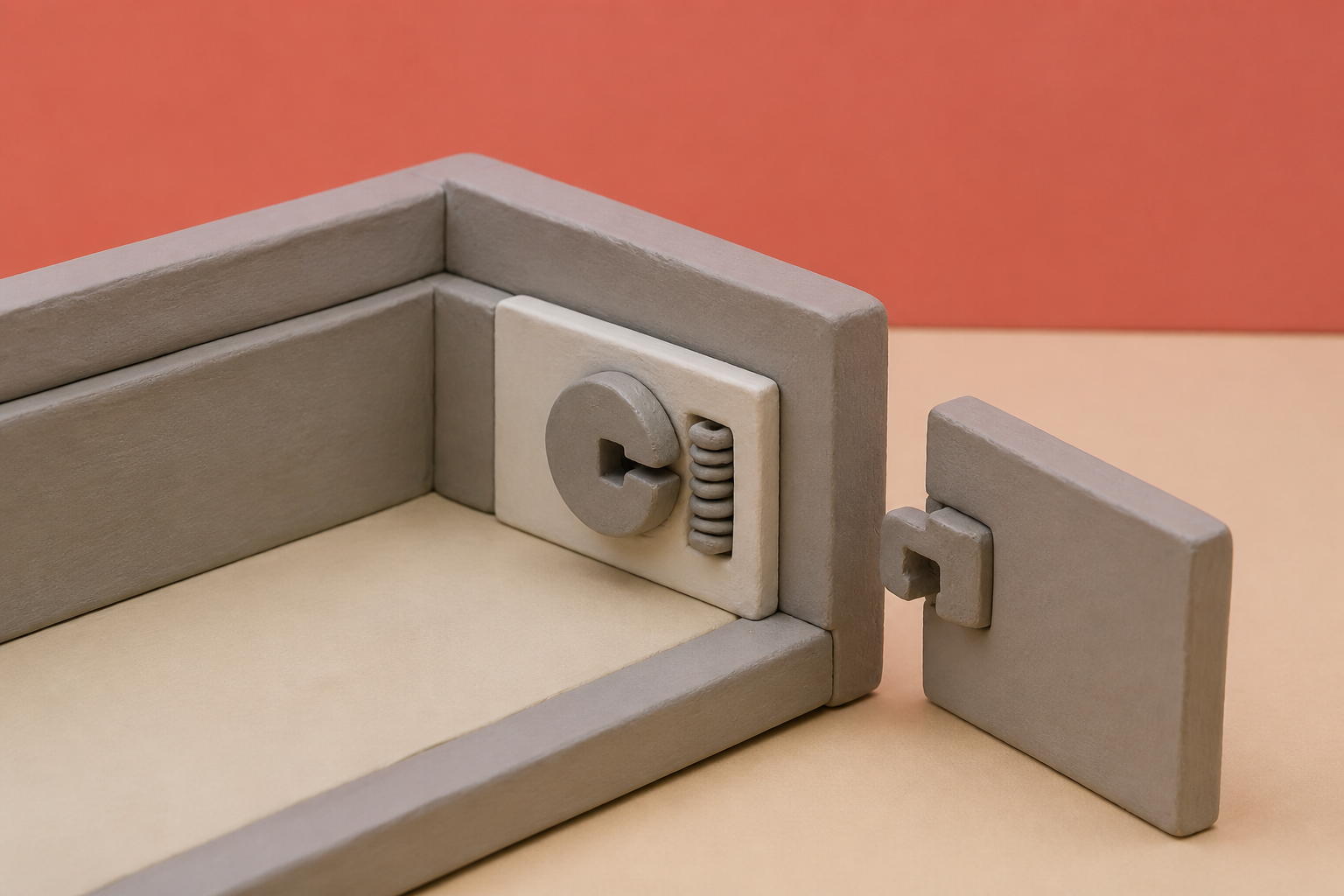
What changes in this design
A reader might expect a panel connector to hold an inserted piece once it is put into a slot. That leaves the practical question of what stops the piece from being pulled back out.
Here, the insert goes through an end opening to engage a slot. That causes the turning catch and insert to enter and remain in a held condition that prevents the insert from being withdrawn.
It matters because after insertion the connection keeps the piece from coming back out. What force it can resist, how it is released, and where it is used are not stated.
Three percent of a market
The number that stopped me was 3 percent. By 2024, one trade analysis put China's share of the US kitchen-furniture market there, down from 65 percent in 2017. Vietnam, which supplied 5 percent in 2019, accounted for about 35 percent by 2024. A drawer connection is a small thing, but it lives inside that dramatic rerouting of cabinets, vanities, panels, and the hardware tucked behind them.
That is why a new US filing for a spring-latch drawer connector deserves more attention than its size suggests. A 2020 federal trade decision found Chinese wooden cabinets and vanities dumped and subsidized, with final combined duty rates cited from 13.33 percent to 269.91 percent and a 58.89 percent all-others rate. The number makes me suspicious of easy stories about a new piece of furniture hardware appearing in a neutral market.
The latch in Dongguan
On September 3, 2026, US20260256285A1 was published under the title Connecting Assembly, Drawer Connecting Device, And Drawer. Its applicant is Dongguan Dige Hardware Products Co., Ltd., a Guangdong hardware manufacturer. The application was filed June 20, 2025, and a company-profile database lists the 2009-founded firm as holding 63 patents. This filing sits within an existing patent portfolio, not a consumer-product launch.
The mechanism is compact. A base plate holds a rotatable latch and elastic component; an insert enters a slot from an open end, and the latch holds it so it cannot be pulled back out. The filing presents the result as simple, safe, and reliable, without additional fastening hardware. The practical attraction is clear to me: someone assembling a drawer wants a front panel that locates, locks, and can be fitted without reaching for more screws.
What I cannot see from that description is a new category of mechanism. It is a particular implementation of an old furniture-hardware problem.
Fifteen years of connectors
Grass filed a European application in 2011, claiming priority to 2010, for a drawer-panel connector built around a base plate and tool-free adjustment. In 2016, Chinese inventor Chen Liyan filed a Chinese application describing a panel connector with a locking plate and spring mechanism for changing drawer fronts. The comparison makes me wary of treating Dige's published application as a breakthrough merely because it is new to the US publication stream.
The farther historical comparison is more limited, but still useful. John S. Kramer's 1919 drawer-lock filing, issued in 1920, used a concealed mechanism with a rotatable latch to control a drawer. It is not the same device and does not decide whether any later claim is valid. I would not call it prior-art proof for this application; it instead shows that turning a concealed part to govern a drawer has been an engineering problem for more than a century.
Vietnam's rising share
The market is not waiting for the general idea, either. Blum already sells a tool-free connector in its TANDEMBOX system, allowing a drawer front and gallery to be joined without tools and adjusted for alignment. That does not show that its product uses the same claim boundaries as Dige's filing. It does show a mature commercial expectation: installers have been promised fast, tool-free drawer-front fitting for years.
Trade policy changed the route through which that expectation is supplied. The cabinet and vanity order adds to a separate Section 301 tariff that a 2025 rate guide described as 7.5 percent for the relevant furniture and cabinet category. Another account of the federal investigation reported extensive transshipment networks through Vietnam and Malaysia. I cannot tell from those trade figures whether any Dige part is made, assembled, or shipped through either country, and the filing offers no answer.
Still, the timing is hard to ignore. Direct Chinese supply did not merely dip: the cited trade analysis places it at 3 percent by 2024, while Vietnam filled a much larger share. That shift should be read as a change in supply-chain geography, not evidence that every manufacturer has done anything improper.
Where the risk actually sits
The patent's important uncertainty is legal, not mechanical. A published application is not a ruling that its claims are valid, and its real reach could depend on details absent from a high-level description: geometry, engagement sequence, spring placement, or some other limitation. My reading is that the record supports an incremental connector in a crowded field, not a newly invented class of drawer hardware. That is a judgment about context, not a verdict on patentability.
For buyers, suppliers, and designers, the tangible risk is twofold. One question is whether a proposed connector falls within a final claim, which needs a claim-by-claim legal review rather than a glance at a latch. The other is origin documentation for the cabinet system around it, because the trade remedies discussed here concern cabinets and vanities, not whether a latch looks inventive. In a market reshaped by tariffs, this small US filing looks less like a fresh mechanical category than a record of ordinary hardware entering a contested trade route.
Sources
Reporting for this piece drew on the published filing and the references below.
- US20260256285 - Connecting Assembly, Drawer Connecting Device, and Drawer
- US20260256285A1 - Connecting Assembly, Drawer Connecting Device, and Drawer
- EP2575547A1 - Connecting device and drawer having a connecting device
- CN106333527A - Drawer panel connecting device
- US1352902A - Locking Device for Drawers
- TANDEMBOX assembly - INSERTA tool-free connection
- Dongguan Dige Hardware Products Co., Ltd. company profile
- AKCA Praises International Trade Commission Decision on Wooden Cabinets and Vanities from China
- U.S. Kitchen Cabinet Industry Needs Support Amid Unrelenting Import Surge
- North America's Kitchen Cabinet Trade: A Highly Interconnected Region
- Section 301 Tariffs Explained: Complete List & Rates 2025
The record, briefly. US20260256285A1, “Connecting Assembly, Drawer Connecting Device, And Drawer” A panel-connection assembly includes a base plate, rotatable latch, and elastic component. An insert engages a slot through an end opening, causing the latch and insert to enter and remain in a locking state that prevents the insert from being withdrawn.
More angles on this
- CPC A47B: Tables; desks; office furniture; cabinets; drawers; general details of furnitureThe official classification family this record was filed into, published in the USPTO Cooperative Patent Classification scheme.
- The Suspender Belt Is Holding the Plot TogetherAnother reading from the neighbouring A47G classification family, household or table equipment.
- The Light Loop Inside an Oral-Care RoutineAnother reading from the wider A46B classification family, brushes.
- Inside brush, methodAnother reading in the same Objects category on this site.
Read around this one:Public patent recordUSPTO published figure