Objects
The Retractable Drawer Divider That Holds On By Leaning, Not Fastening
A new drawer-divider application matters less for its bend of plastic than for the marketplace power a granted patent can give a seller.

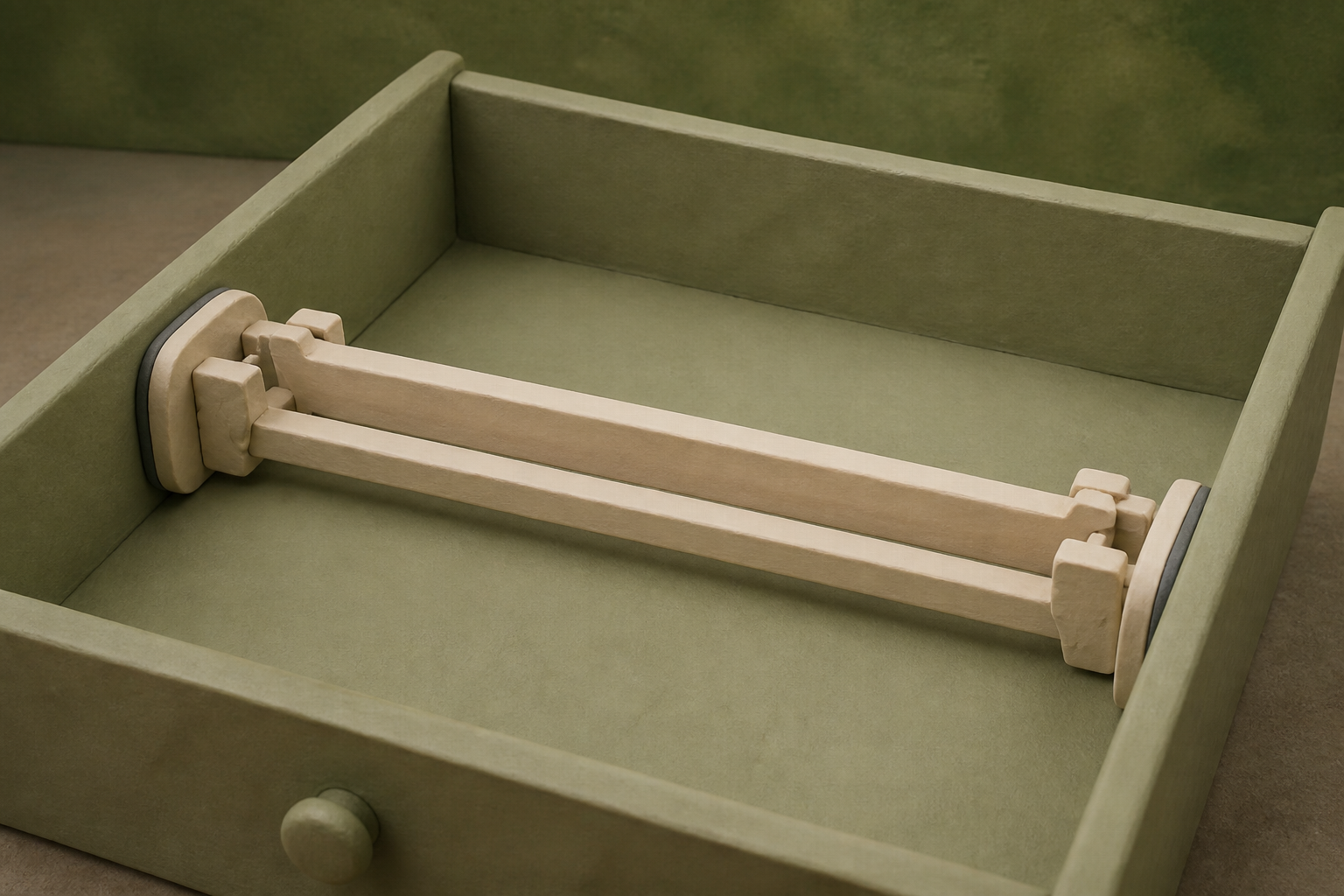
What changes in this design
Someone might assume a drawer divider needs a fastener to keep it from moving around inside a drawer.
Here, curved, springy sections press against the drawer's inner sidewall. The divider can include one or two flat panels, an EVA layer, and built-in locking pieces that assemble with the panels.
Its hold comes from contact with the drawer wall rather than a separate fastener. The exact holding strength and compatible drawer sizes are not stated.
Three weeks on a listing
Three weeks is not much time for a marketplace seller to decide whether to defend a product listing. Amazon's Patent Evaluation Express, or APEX, lets a brand-registry-enrolled utility-patent owner seek an evaluation of a competing ASIN. The accused seller has roughly three weeks to answer, and a seller who does not respond can have the listing removed. Each side puts up a $4,000 evaluator deposit; the prevailing side gets it back.
That is the number I keep returning to while looking at a newly published drawer-divider application. A pending application cannot itself start that process. But a granted U.S. utility patent can turn a small difference in a plastic organizer into a fast, expensive question for another seller. The point is not that every drawer divider deserves suspicion. It is that the commercial setting changes what repetition in a patent file can mean.
A curve from 1960
Retractable Drawer Dividing Device, published as US20260256286A1, enters that setting. It describes one or two partition plates whose arcing elastic ends press against a drawer's inner wall. An EVA layer may improve conformity and stability, while integrally formed locking pieces are intended to complete assembly as the plates join. It is a practical response to a familiar failure: a divider slips, and the compartments stop being compartments.
The central move is much older. Donald H. Kirkman's 1960 application for a plastic cabinet-drawer partition used opposing projections to bend a plastic divider into a curved or arcuate form. The bend created friction against drawer-wall grooves and was expressly meant to keep the part from being accidentally displaced. That patent issued in 1961 to Akro-Mils. The 2026 device may have different parts and claims, but the broad idea of a springing curve gripping a drawer wall is at least 65 years old.
Collapsible strips
Nor did the wish for adjustable storage begin with that older patent. A 1994 drawer-divider patent described a collapsible grating made from resilient strips rather than rigid partitions. Its background complained that fixed slot boards and grates occupied the same amount of drawer space whatever was stored in them. The objection feels modest, but it matters: this is a mature category of household engineering, worked over because drawers are irregular and their contents keep changing.
That history does not settle whether the new claims will be allowed or how narrowly they might be read. I don't think the right question is whether a curved divider was ever conceived before. Patent rights rest on particular claims and their treatment, not a general resemblance between two objects. Still, an application centered on elastic arcs should be read with the old arc in view, rather than as a newly discovered principle of order.
Two filings, one seller
Fujian EastWest Lifewit Technology Co., Ltd. filed the newer U.S. application on August 4, 2025, claiming a March 3 Chinese priority filing. It was not its first trip through this aisle. The same assignee received U.S. Patent 12,336,628 on June 24, 2025, after filing a near-identically titled retractable drawer dividing device in 2024 with a March 2023 priority date. Two closely spaced efforts do not prove a strategy. They do show repeated attention to this particular product category.
The company leaves enough physical trace to make that attention more than paperwork in the abstract. A trade-data tracker recorded 113 of its bills of lading into U.S. ports between March 2021 and January 2022, although that dated window cannot tell us current shipment volume. An account of its cloud ERP rollout described seven corporate entities and work undertaken ahead of an anticipated IPO. I found no confirmation there of an IPO occurring, and none is needed to see a multi-entity cross-border operation.
Where this leaves things
No public material I reviewed shows this company using APEX against a rival, or shows a rival copying this divider. That boundary matters. US20260256286A1 is an application, not a grant; it may change during examination, fail, or issue with claims too narrow to matter to another listing. No CPC classification was recorded for it. That omission does not tell us whether the claims will survive examination or how broadly they could matter.
For me, the filing is more revealing as a piece of market infrastructure than as a new way to divide socks. It traces a line from a 1960 plastic curve, through an established product problem, to a company with a newly published application and a 2025 granted sibling patent in a marketplace where a granted U.S. utility patent can trigger a high-pressure review. We should be careful not to mistake that possibility for evidence of misuse. But we should not mistake a modest household object for a modest commercial tool, either.
Sources
Reporting for this piece drew on the published filing and the references below.
- Retractable Drawer Dividing Device
- US2026/0256286A1 - Retractable Drawer Dividing Device
- US12336628B2 - Retractable drawer dividing device
- US2985333A - Plastic cabinet drawer with removable partitions
- US5292571A - Drawer divider
- APEX: How does Amazon handle utility patent infringement between sellers?
- Amazon APEX: How Are Utility Patent Violations By Sellers Handled?
- Acloudear and Lifewit successfully launched SAP cloud ERP project
- FUJIAN EASTWEST LIFEWIT TECHNOLOGY CO., LTD U.S. Import Activity
The record, briefly. US20260256286A1, “Retractable Drawer Dividing Device” A retractable drawer divider has one or two partition plates with arcuate elastic portions bearing against a drawer's inner sidewall. An EVA layer may improve conformity and stability, while integral locking-structure sub-components assemble with the plates.
More angles on this
- A drawer connector that turns once, then declines to be talked out of itAnother reading from the same A47B classification family, tables; desks; office furniture; cabinets; drawers; general details of furniture.
- CPC A47B: Tables; desks; office furniture; cabinets; drawers; general details of furnitureThe official classification family this record was filed into, published in the USPTO Cooperative Patent Classification scheme.
- A chair with a battery, a column, and a pedal that never touches itAnother reading from the neighbouring A47C classification family, chairs; sofas; beds.
- A zipper slider whose underside is set at two heights on purposeAnother reading from the wider A44B classification family, buttons, pins, buckles, slide fasteners, or the like.
- At the Switch, Selective Erase Becomes a Question of ResponsibilityAnother reading in the same Objects category on this site.
Read around this one:Public patent recordUSPTO published figure