Objects
The pocketed corner that answers where a rug belongs
Tumble's corner-pocket rug filing belongs to a longer contest over how a washable rug stays flat after real life gets to it.

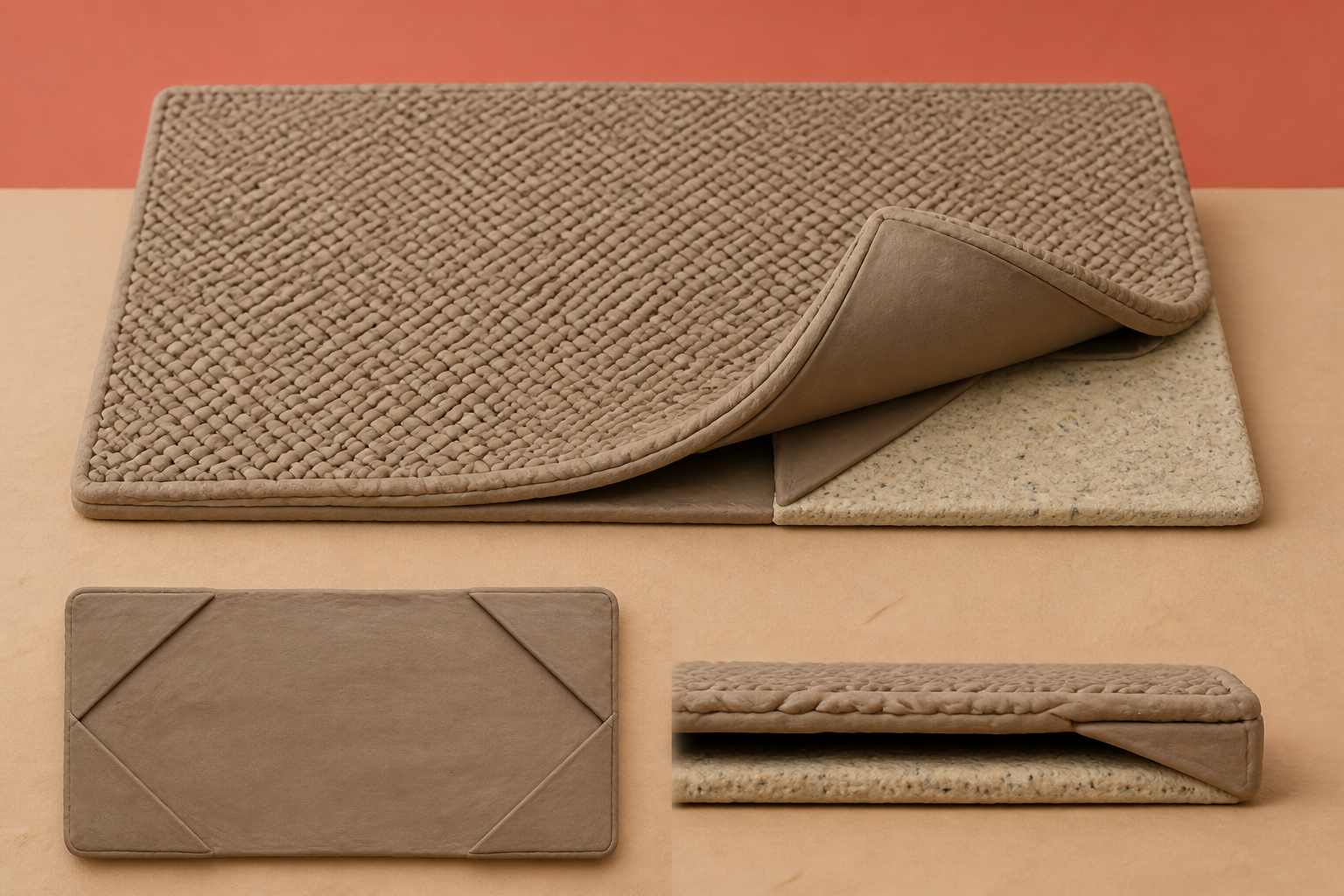
What changes in this design
A reader might otherwise picture a rug resting above a mat, with no indication of how the upper layer stays in place.
Instead, the upper rug has pocketed corner areas that receive corresponding mat corners. Those corners secure the rug while allowing airflow between the two layers.
Knowing this helps make sense of the two-piece setup: the corners are where the pieces connect, and the connection leaves room for air between them.
A runner lifted for crumbs
One long-term owner describes lifting one end of a washable kitchen runner to vacuum crumbs, then finding the interlocking pad pieces had sometimes come apart. After years of repeated washing, the same heavily used rugs had become more prone to wrinkling. That small failure caught my attention because it occurs during the ordinary maintenance the product is supposed to make easier.
Two-piece washable rugs promise a sensible trade: put the decorative cover in the wash and leave a grippy mat behind. But the cover must stay aligned while people walk, pets run and vacuums tug. A multi-brand hands-on test reported that a 4-by-6 flatwoven Ruggable cost $299 and that its Velcro-style cover could curl at the edges or pull up during vacuuming. The category's challenge is not washing. It is retention.
Three fastening methods
That problem has been claimed for a while. U.S. Patent 8,309,198 began as an application filed in 2010 and was granted in 2012. It describes a two-piece rug system held by hook-and-loop material, embedded grit, or a resinous coating with microscopic projections. Ruggable identifies that patent as a basis for its removable cover and nonslip pad system.
Those are three different ways of making surfaces grip. The public patent record lists a related later Tumble Living patent among the patents that cite 8,309,198, which makes the lineage visible without proving any broader legal conclusion. What I take from it is a very practical design contest: keep a washable layer from creeping, lifting, or curling, without making the customer dread putting it back together.
Four corner pockets
US20260256309A1 enters that contest with a different fastening bet. Its title is Multi-Piece Rug And Mat Arrangement And Assembly For Forming A Floor Covering, and it describes an upper rug portion and a lower mat portion. Corner pockets in the rug receive the matching corners of the mat, securing the pair while leaving room for air to move between them. Its related granted patent, US12171355B2, was assigned to Tumble Living and claims priority to October 20, 2020.
The company calls the consumer version a Velcro-Free System: assemble the puzzle-piece pad, then tuck the rug's corners into pockets. The filing gives me a useful way to see that marketing line. It is not merely a claim that a cover can be washed; it is a claim that the weak point should move from a broad field of hook-and-loop contact to four corners held in pockets. That is a real design choice, not just a slogan.
Years in a kitchen
At first, the corner approach looks well suited to the complaints about a cover that peels up. A 2021 hands-on review reported no lasting wrinkles after washing, flat edges, and a pad that did not tuck out from under the rug. That is evidence from one reviewer at one point in ownership, not a durability verdict. I think that distinction matters, because the short review describes the mechanism working while the longer one records how it may age.
Longer use adds a harder detail. The owner who reported occasional pad disconnections was not describing a cover simply drifting loose; the interlocking sections themselves could separate during cleaning, particularly when one end of a runner was pulled up. The filing's aim of a uniform, planar floor covering therefore deserves a narrow reading. It addresses one path to misalignment. It does not establish that every component will remain locked through years of washing and heavy traffic.
Eight burn-test squares
Attachment is only one piece of whether a rug belongs on a U.S. floor. The U.S. Consumer Product Safety Commission requires surface-flammability testing for rugs, under different rules for smaller pieces and for larger ones that exceed six feet in a dimension or 24 square feet. The test uses methenamine tablets on eight specimens, with at least seven required to pass. Corner pockets do not change that obligation.
That regulatory boundary helps keep the patent in proportion. The application concerns attachment and airflow, not a blanket assurance about every property a buyer might care about. I could not determine from the public material whether any particular Tumble rug model has passed a specified flammability test, so I would not treat the fastening design as evidence on safety. Its question is more modest: can a washable top stay put without a large Velcro field?
Where this leaves things
Two college classmates began developing Tumble in fall 2019 and launched it in April 2021, according to a founder profile. The same account says the business passed $50 million in revenue in under four years after starting with crowdfunding and personal savings. A September 2025 fulfillment announcement added a New Jersey facility, another sign that this isn't a laboratory exercise. The corner-pocket design has become a commercial answer to a well-known domestic irritation.
That answer is better understood as an alternative trade-off than a final fix. I don't read US20260256309A1 as proof that four pockets beat hook-and-loop in every home. The research supports a smaller, stronger point: its mechanism targets a complaint that independent users have actually described, and independent users have also described its own limits. For buyers, the useful question is not whether a washable rug has solved maintenance. It is which annoyance they would rather manage.
Sources
Reporting for this piece drew on the published filing and the references below.
- Multi-Piece Rug And Mat Arrangement And Assembly For Forming A Floor Covering
- US12171355B2 - Multi-piece rug and mat arrangement and assembly for forming a floor covering
- US8309198B2 - Rugs with a mat portion
- Patented 2-Piece Rug System
- How We're Different
- These College Classmates Started a Side Hustle... Then Scaled It From $0 to Over $50 Million in Under 4 Years
- Rolling Out Nationwide: Barrett Distribution Centers to Deliver Tumble Living Rugs
- Best Washable Rugs, Tested: 9 Brands Reviewed
- Tumble Washable Rugs Review
- Tumble Rugs Review
- Carpets and Rugs FAQ
The record, briefly. US20260256309A1, “Multi-Piece Rug And Mat Arrangement And Assembly For Forming A Floor Covering” A multi-piece floor arrangement includes an upper rug portion and lower mat portion, with pocketed corner areas that receive corresponding mat corners to secure the rug while allowing airflow between the portions.
More angles on this
- Seeing the Elastic Pattern Before You Decide What It MeansAnother reading from the same B32B classification family, layered products, i.e. products built-up of strata of flat or non-flat, e.g. cellular or honeycomb, form.
- The Suspender Belt Is Holding the Plot TogetherAnother reading from the same A47G classification family, household or table equipment.
- CPC A47G: Household or table equipmentThe official classification family this record was filed into, published in the USPTO Cooperative Patent Classification scheme.
- CPC B32B: Layered products, i.e. products built-up of strata of flat or non-flat, e.g. cellular or honeycomb, formThe official classification family this record was filed into, published in the USPTO Cooperative Patent Classification scheme.
- A chair with a battery, a column, and a pedal that never touches itAnother reading from the neighbouring A47C classification family, chairs; sofas; beds.
Read around this one:Public patent recordUSPTO published figure