Objects
Before the Chemical Spreads, the Drum Decides
Japan is building several ways to recycle used diapers, but a new chemical-drum patent exposes how much harder collection and cost remain.

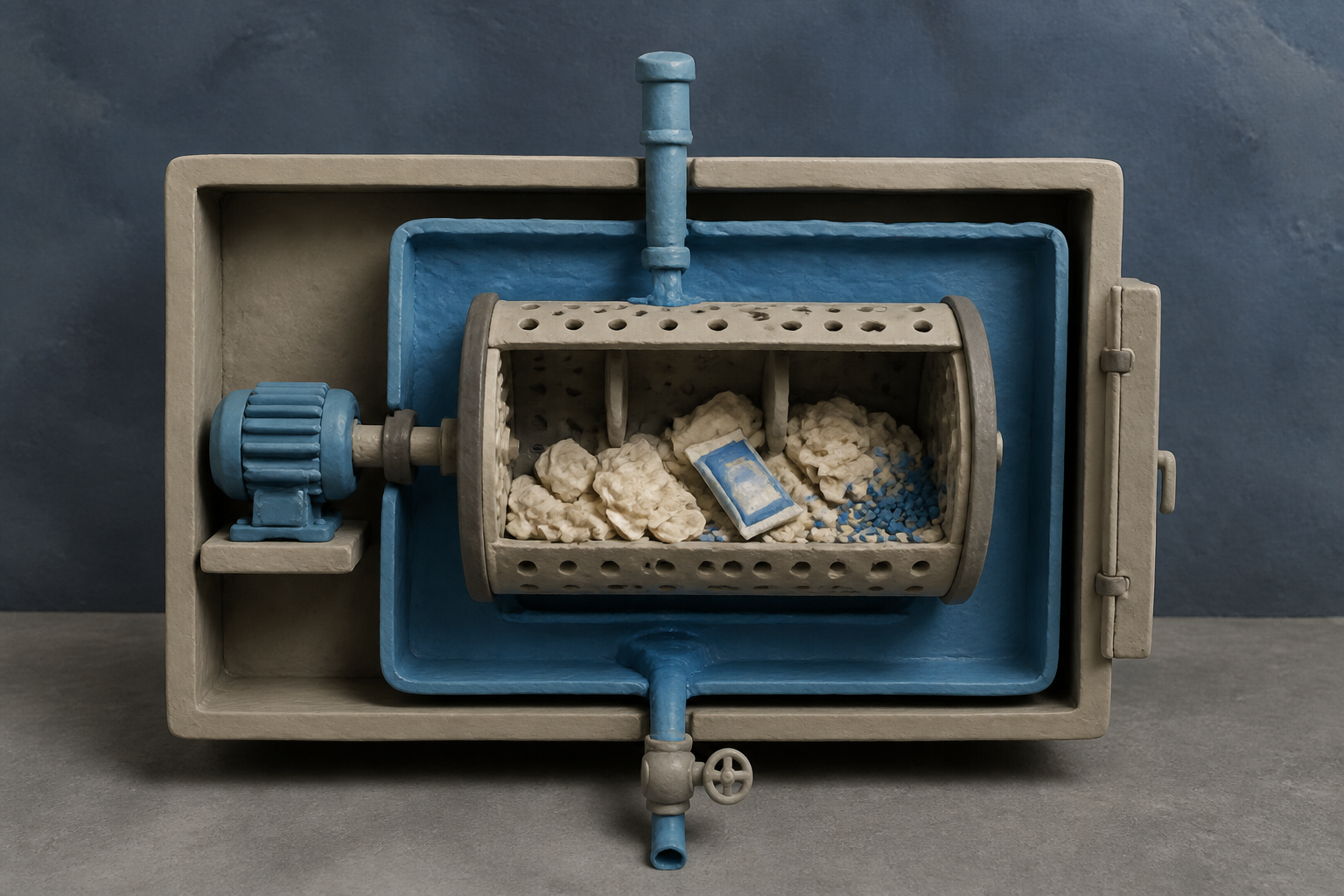
What changes in this design
Without more detail, a reader might assume treatment involves adding a chemical directly to the goods. How such treatment is ordinarily done is not stated.
Here, the chemical begins inside a package placed in a rotary drum with the goods. As the drum rotates, the package breaks and the chemical diffuses.
This helps explain the central idea: the chemical is released only after the packaged container breaks while the drum is rotating.
Nine-point-six billion adult units
In 2024, Japan produced 9.6 billion adult incontinence units and 8 billion baby diapers. The number that stopped me was not the narrow gap between them, but the direction of travel: diaper waste is projected to grow from about 2.2 million tonnes in 2020 to 2.6 million in 2030 as the population ages.
That shift makes the ordinary disposable diaper an industrial problem. It is a sealed bundle of plastic, pulp, superabsorbent polymer and human waste, with a collection system that has to work before any recycler can begin separating its ingredients. Small pilot towns have reportedly diverted 80 percent of waste, but the national ambition of more than 100 diaper-recycling municipalities by 2030 is still an ambition, not evidence that a national system is in hand.
Two packages in a drum
Into that unsettled effort comes a patent published on September 3, 2026: US20260257260A1, "Treatment Method For Used Sanitary Goods." Its central move is stark. Used sanitary goods go into a rotary drum with packages containing chemicals; as the drum turns, the packages break and the chemicals diffuse through the load.
A related international application supplies the working scale: 1,000 used diapers and two 20-litre chemical packages rotate at 30 rpm, then undergo centrifuging at 700 rpm to separate plastic from pulp. The chemical mixture can be mostly slaked lime, with 2 to 20 percent calcium hypochlorite. The packages themselves can have walls from 0.003 to 1 millimetre thick, made from plastics including polyethylene, polypropylene, polyester, polyamide or water-soluble PVA.
I do not mean that description as a dismissal. The packages are a practical detail in a job where workers should not need to dose loose treatment chemicals into an opened mass of used diapers. But the patent is a treatment step, not a demonstrated answer to what happens before the drum is filled or after its separated materials emerge.
Three routes through the mess
Japan has been trying incompatible answers for years. Total Care System has operated a water-solubilization plant in Omuta since 2005, processing more than 5,000 tonnes of used diapers annually and reporting a 37 percent carbon-dioxide reduction versus incineration. A later alliance involving that operator focused on recovering superabsorbent polymer as well as pulp and plastic.
Kao is testing a different route: carbonization, with a 50-kilogram-per-cycle system in Kamikatsu after earlier 30-kilogram trials. An older patent family took another chemical route, crushing diapers before treating them with calcium chloride and sulfuric acid and screening out fiber and superabsorbent polymer. Its ceased status does not prove the method failed technically, but it does show that this waste stream has already attracted approaches that did not remain active patents.
Kurita Water Industries, the applicant behind the new family, is notable because it is a long-established industrial water-treatment company, not a hygiene-products maker. Its commercial description of a used-diaper system promises sterilizing, washing, decomposition and sorting, with early demonstrations aimed at nursing homes and hospitals. I see that institutional focus as the filing's most credible setting: a bounded stream of incontinence waste is easier to handle than millions of households each making their own disposal choices.
Bedsides before bins
The chemical drum therefore belongs to a real industrial program, rather than a patent drawn up in isolation. Kurita describes treated water and pulp that could also be explored for methane fermentation, suggesting that the value of the process depends on more than recovering clean-looking plastic. Each outlet has to accept material reliably, and each stage has to tolerate contamination without merely moving it elsewhere.
That is the part we tend to skip when a recycling process produces an impressive separation result. Collection routes, storage, hygienic handling, transport, treatment capacity and buyers for recovered materials are not background details. They are the system. The patent's rotating drum may make one difficult handoff more manageable, but it cannot make those other handoffs disappear.
The harder half of the problem
A peer-reviewed life-cycle assessment offers a strong reason to keep trying: it estimated that closed-loop diaper recycling could cut greenhouse-gas emissions by 39 percent versus incineration and 47 percent versus landfill. Its national scenario projected 1.314 million tonnes of carbon-dioxide-equivalent savings each year if Japan recycled all diaper waste.
Yet the same study says no comparative cost study had been conducted, and identifies collection infrastructure and end markets for recycled material as uncertain. That frankness is what I trust most in the evidence. Cost is the unresolved word, and I cannot turn an emissions comparison into a claim that the logistics work at scale.
So this is not a story about a clever pouch bursting in a steel drum. It is about a country whose waste is changing with its population, and whose engineers are testing several answers at once because none has yet solved the harder half: getting every used diaper to the right machine, at a price someone can bear.
Sources
Reporting for this piece drew on the published filing and the references below.
- Treatment Method For Used Sanitary Goods
- WO2024024593A1 - Treatment method for used sanitary goods
- WO2014203922A1 - Method for treating used sanitary goods
- Complete Material Recycling System for Disposable Diapers
- Nippon Shokubai Teams with LiveDo and Total Care System to Spread Used Disposable Diaper-recycling Systems
- Kao Begins Verification Testing for a Used Disposable Diaper Carbonization Recycling System in Kamikatsu, Japan
- Dirty diapers born again in Japan recycling breakthrough
- Life Cycle Assessment of the Closed-Loop Recycling of Used Disposable Diapers
The record, briefly. US20260257260A1, “Treatment Method For Used Sanitary Goods” A method treats used sanitary goods by placing a chemical-containing packaged chemical in a rotary drum with the goods and rotating the drum so the container breaks and the chemical diffuses.
More angles on this
- The Storage Condition Behind a Carbon Removal FilingAnother reading from the same B09B classification family, disposal of solid waste not otherwise provided for.
- CPC B09B: Disposal of solid waste not otherwise provided forThe official classification family this record was filed into, published in the USPTO Cooperative Patent Classification scheme.
- CPC A61L: Methods or apparatus for sterilising materials or objects in generalThe official classification family this record was filed into, published in the USPTO Cooperative Patent Classification scheme.
- Where Upward Assistance Enters an Exercise-Machine LiftAnother reading from the neighbouring A61H classification family, physical therapy apparatus, e.g. devices for locating or stimulating reflex points in the body.
- Apparatus, System And Method For Coordinated Fluid Dispersal Marks a Pause Worth NoticingAnother reading from the wider B05B classification family, spraying apparatus; atomising apparatus; nozzles.
Read around this one:Public patent recordUSPTO published figure