Machines
Where Upward Assistance Enters an Exercise-Machine Lift
Movable Arm and User Starting Force: A force assistance system for an exercise machine applies upward assistance to a movable arm during an initial portion of a lift.

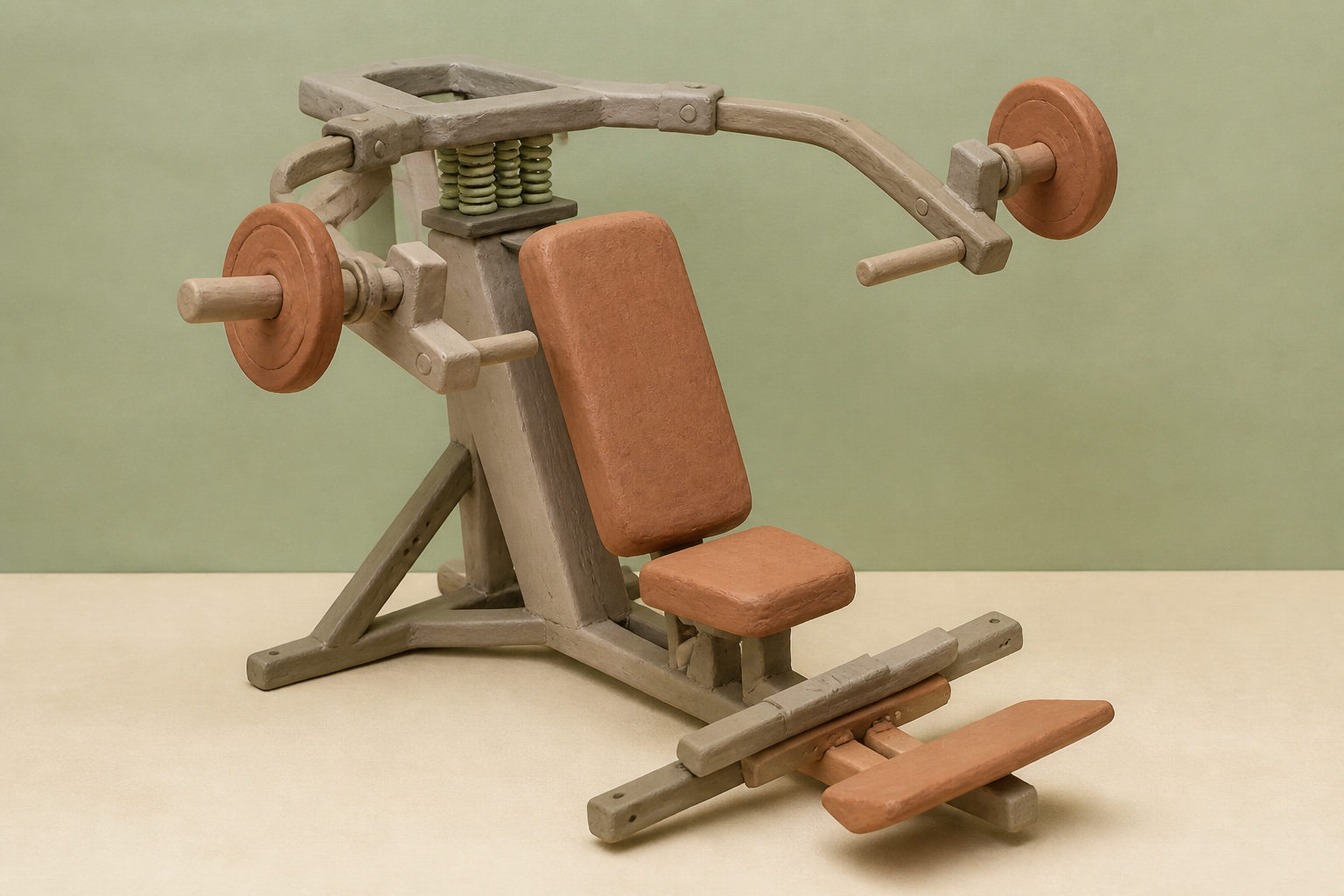
First, the setting
Starting a heavy exercise movement can be the hardest moment. In a gym or rehabilitation setting, people may want to practice a controlled motion while managing strain, confidence, and balance. Equipment is designed around how bodies move so a person can focus on the exercise rather than wrestling with an awkward start.
Picture someone seated or standing beside a weight machine, gripping handles connected to a pivoting arm. As the person begins the lift, the arm moves upward through its path. A helper mechanism built into the machine can take some of the load at the start, while the user and nearby coach feel a smoother beginning.
What changes in this design
Without this kind of help, a person would supply the force needed to start the lift themselves. The moving part would begin without an upward boost from this system.
Here, the machine applies upward assistance to the movable arm during the initial part of the lift. That reduces the force the user needs at the start and supports exercise with higher weights.
This matters because the system is aimed at the beginning of a lift. It offers a clear purpose: reducing starting effort while supporting exercise with higher weights.
Assistance at the First Lift
Upward assistance changes the start of a lift, the change reduces the user's starting force, and the next choice is to notice where that help enters. In this concrete moment, you see a movable arm receiving upward help as a lift begins. Published on September 3, 2026 as US20260257096A1, Force Assistance System For An Exercise Machine describes a system intended to reduce the user's starting force and support exercise with higher weights.
That purpose becomes easier to follow once its terms lose their machinery-room echo. A movable arm is the part of the exercise machine that moves during the lift. Upward assistance means help directed upward, while the initial portion is the beginning stretch of the lift. The upward help has the air of a stage manager nudging the movable arm into its first cue. I use signal here not as a named machine part, but as a design cue: the specified place where uncertainty becomes a choice.
With those words settled, the picture sharpens into one sequence: the arm begins moving, upward help appears during that initial portion, and the user begins with less starting force. The first portion of the lift is less like a blank hallway and more like a doorway with a quiet label. What made me look twice was the treatment of the beginning as a distinct moment rather than an indistinct lead-in. The arrangement supports exercise with higher weights within the limited description provided.
Upward Help's Defining Moment
That defined beginning leads directly to the mechanism described in the filing: upward assistance is applied to the movable arm during an initial portion of a lift, reducing the user's starting force. For a comparable record, the useful contrast is not between winners and losers; it is between a broad idea of making a lift easier and a defined response that says when help acts. A defined response replaces a guess when you can point to the first portion and ask what changes there. The decision sits as if a careful librarian had placed a bookmark at the moment help begins.
Comparable First-Step Questions
That comparison carries a design lesson beyond exercise machines. When a task begins with uncertainty, you can look for the smallest moment that changes the next decision instead of treating the whole task as one undifferentiated block. First identify the precise starting condition that creates hesitation or demand. Then ask what kind of support, prompt, or constraint belongs at that point, and name the effect you expect it to have. The point worth your attention is the sequence: cause, response, and practical test.
That test offers a second transferable observation: distinguish the action from its timing. A system may contain help, but the question worth carrying elsewhere is whether that help connects to a stated moment and a stated consequence. I cannot tell from the published record how every detail might be implemented, and the editorial point does not need to fill that gap. When uncertainty slows a first step, seek the signal that identifies the moment, the response, and the next choice.
The record, briefly. US20260257096A1, “Force Assistance System For An Exercise Machine” A force assistance system for an exercise machine applies upward assistance to a movable arm during an initial portion of a lift, reducing the user's starting force and supporting exercise with higher weights.
More angles on this
- Where a Massaging Balm Applicator Makes Its Meeting Points ClearAnother reading from the same A61H classification family, physical therapy apparatus, e.g. devices for locating or stimulating reflex points in the body.
- A Glove With a PortfolioAnother reading from the same A63B classification family, apparatus for physical training, gymnastics, swimming, climbing, or fencing; ball games; training equipment.
- CPC A63B: Apparatus for physical training, gymnastics, swimming, climbing, or fencing; ball games; training equipmentThe official classification family this record was filed into, published in the USPTO Cooperative Patent Classification scheme.
- CPC A61H: Physical therapy apparatus, e.g. devices for locating or stimulating reflex points in the bodyThe official classification family this record was filed into, published in the USPTO Cooperative Patent Classification scheme.
- Ambient Light's Quiet Job in Facial VideoAnother reading from the neighbouring A61B classification family, diagnosis; surgery; identification.
Read around this one:Public patent recordUSPTO published figure