Objects
Game Belt: Serious Equipment for an Unclear Game
Flag football spent a century engineering an honest way to end a play. Four months after the Olympic vote, someone patented how the belt looks.

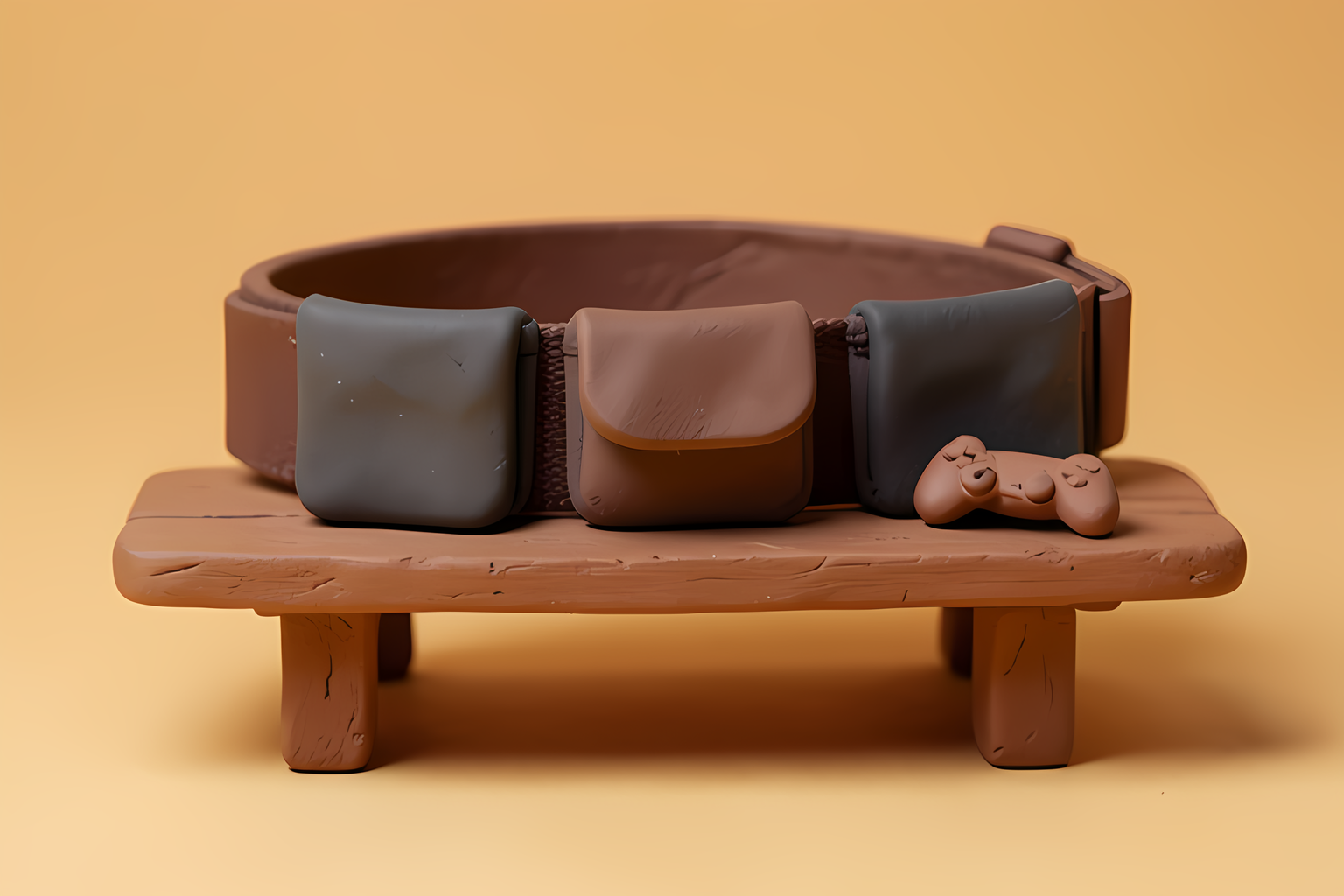
What changes in this design
Without more information, a reader might expect an item called a game belt to explain what it helps a player do. This record offers no such functional explanation.
Instead, the record gives a visual: a narrow waist band, multiple separated strips hanging across the standing figure's front, and small tabs or loop-like elements along the band's front portion.
That is worth knowing because the image can tell you about the object's appearance, but it cannot reliably answer what game it belongs to or how anyone uses it.
A chemistry lecturer and a safety crisis
Touch football starts with a safety crisis. In 1910, James A. Gibson, a chemistry lecturer and assistant coach in Missouri, wanted a version of the game that did not maim the people playing it. Clair K. Turner adapted it for grade-schoolers two years later. It travelled with the doughboys to France in 1917.
Then it broke. Touch was too vague to referee. Defenders struck runners rather than touched them, arguments followed, and Kentucky schools had dropped the game by 1940. Flags came in during the 1940s to make the stop a thing you could see. A Texas university ran leagues in March 1947 with a cloth roughly three feet by 28 inches stuffed in the waistband.
Porter Wilson's swivel, and the noise of a crowd
The belt is an engineering answer to an engineering problem. Porter C. Wilson, a Tucson teacher, filed in March 1969 and was granted a patent in 1971. His complaint was that earlier couplings sat rigidly on the belt, so a flag could come off by contact other than pulling: a player's own arm brushing along the body, or two players colliding. His fix was a ball-and-socket coupling on an omega-shaped hasp, letting the flag swivel to any point in the hemisphere beside the player so it took the same pull from every angle.
The line continued. A 2004 filing, granted in 2007, put an electronic noisemaker in the flag because the tearing sound of hook-and-loop was judged not loud or distinctive enough to be heard over the din of normal play. Every step is about the same thing: the play ends, and nobody argues.
Four months after the IOC vote
On October 13, 2023, the IOC executive board added flag football to the Los Angeles 2028 programme, five-on-five on a fifty-yard field, in a package with cricket, lacrosse, squash and baseball-softball. Four months later, on February 16, 2024, a private individual named David Bath filed application 29/928,890. It issued on August 4, 2026, as US D1,137,991 S, titled Game Belt.
It is a design patent, so it covers appearance and nothing else. The whole claim is one line: the ornamental design for a game belt as shown. The title never says football, but the drawings do. Figure 1 shows a runner with a ball drawn in broken lines as unclaimed background. The front elevation shows three full-width flags across the front with two more seen edge-on at the sides.
I went looking for the person behind it and found nothing. No company, no product listing, no trademark, no news item. It lists the same name at two addresses, applicant in Faribault, Minnesota, assignee in Snohomish, Washington, with no explanation.
Victorian garters and a marathon bib
The classifications are the strangest part. The filing sits in A41F 11/16, garters, alongside 11/02, devices for attaching the stocking to the suspender, and 11/00, stocking or sock suspenders. The examiner's cited art follows: two garter patents from 1898 and 1899, plus a 2016 design patent for a race belt that holds a runner's bib. There is no drawer in the taxonomy for Olympic flag football, so a piece of sporting equipment got searched against Victorian hosiery hardware.
The rulebook got there first
The international rules for the Olympic format have already fixed almost everything a belt maker could vary. Exactly two flags, one on each hip. The patent drawings show five. Flag length 15 to 16 inches from the socket, width 1.8 to 2.0 inches, tear resistance at least 300 newtons, pull-off force no more than 100 newtons in senior games and 50 everywhere else, all holding from 32 to 86 degrees Fahrenheit. Branding is capped at two inches by three. Flags may not be greased, glued or altered in any way.
The part worth watching
Just over six months before this certificate printed, the Federal Circuit decided Range of Motion Products v. Armaid and told courts to identify and discount the parts of a claimed design dictated by function before comparing anything. A strap, a buckle and hanging cloth are close to pure function, and the rest is spelled out by a rulebook in newtons. I do not think this patent stops anyone from selling a belt.
The demand behind it is real, though. High school surveys counted 68,847 girls playing flag in 2024-25, up 388 percent in four years. The NCAA made it an emerging sport for women in January 2026. Among six to twelve year olds, more play flag than tackle, and have since 2017. That is a lot of new buyers. What I will watch is whether the belt itself becomes a product people fight over, or stays what the rules have made it: a commodity with two flags on it.
Sources
Reporting for this piece drew on the published filing and the references below.
- US D1,137,991 S - Game Belt (USPTO full-text image)
- US 3,579,745 - Flag Football Belt Device (Porter C. Wilson)
- US 7,288,035 B2 - Flag apparatus with electronic sound generating device
- US D765,945 S - Race belt
- CPC Scheme A41F - Garment Fastenings; Suspenders
- IFAF International Flag Football Rules 2023
- How Touch and Flag Football Were Born
- IOC approves cricket, flag football and three other sports for 2028 Los Angeles Games
- High School Football Continues to Rebound From Pre-Pandemic Decline
- State of Play 2025: Participation Trends
- Federal Circuit Narrows Design Patent Scope Based on Functional Considerations
The record, briefly. USD1137991S1, “Game Belt” The checked public record identifies a U.S. design patent titled 'Game Belt'. The reading treats the published title and figure as a visual starting point and does not infer a material, mechanism, or performance claim not established there.
More angles on this
- A Glove With a PortfolioAnother reading from the same A41D classification family, outerwear; protective garments; accessories.
- The Pants Have a Particular Part To PlayAnother reading from the same A41D classification family, outerwear; protective garments; accessories.
- CPC A41F: Garment fastenings; suspendersThe official classification family this record was filed into, published in the USPTO Cooperative Patent Classification scheme.
- CPC A47G: Household or table equipmentThe official classification family this record was filed into, published in the USPTO Cooperative Patent Classification scheme.
- An Apparel Pattern Wants To Be Noticed Before It Is WornAnother reading from the neighbouring A41C classification family, corsets; brassieres.
Read around this one:Public patent recordUSPTO published figurePatent issue-date index