Objects
Inside bilingual augmented reality lamp
A one-person tutoring brand in Sherman Oaks has patented a camera-and-microphone lamp for kids, in the state with the strictest recording law in the country.

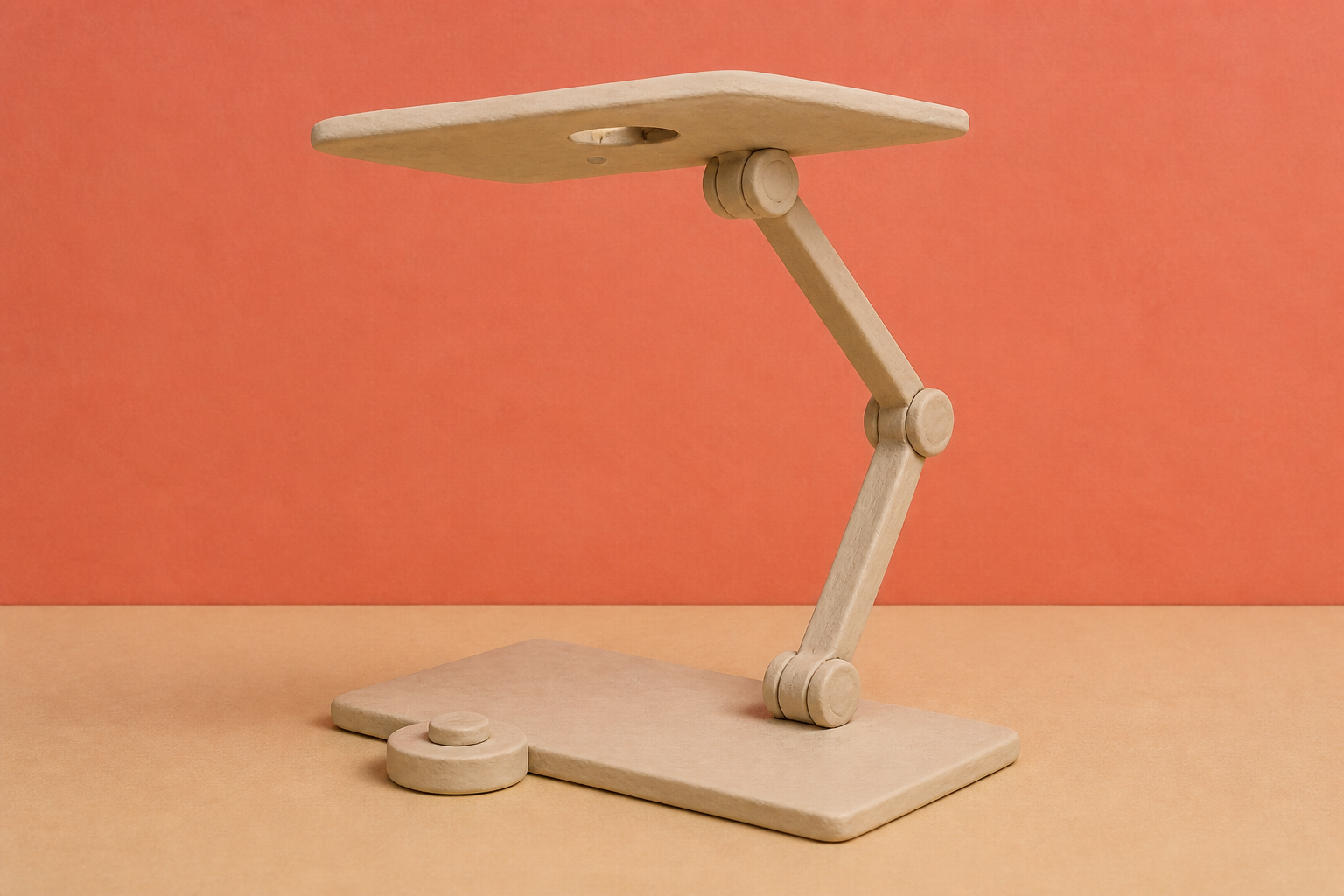
What changes in this design
Normally, translating printed text means picking up a phone, opening a translation app, and pointing its camera at the page, or typing words into a dictionary by hand. The reading lamp and the translation tool are two separate objects, and the lamp itself has no idea what language the page in front of it holds.
Here the camera lives inside the lamp head itself, already aimed at the reading surface it lights up. Processors built into the assembly identify the page images, work out what language the text or pictures are in, and then output either a translation or an augmented-reality projection laid over the page in a second language.
Combining the light source and the camera into one object means the translation step happens right where you're already reading, without reaching for a separate phone or app. For anyone working through foreign-language material, that could mean the tool doing the identifying and translating is always pointed exactly where it needs to be.
A French Tutor's Next Product
Mayelice Castro Fil teaches French to children ages five to ten in Sherman Oaks, California, through a small business called Mon Petit World. Its website lists one product as coming soon: StoryGlow, described there as a patent-pending storytelling experience that mixes language learning with imagination. There's no photo of it, no camera specification, no price, no ship date. What sits behind that page is a lamp, filed with federal patent authorities on February 19, 2026.
The application, published as US 2026/0259485 A1, names Castro Fil as the sole inventor and lists MonPetitWorld LLC, the tutoring brand's parent company, as the assignee, both at the same Sherman Oaks address. It traces back to a provisional filing from February 21, 2025, almost exactly a year earlier, and became public on September 3, 2026. I went looking for the device itself, beyond the filing, and found nothing more: no funding announcement, no staff page, no press mention anywhere I could find.
What the Lamp Is Supposed to Do
The design has a stem that doubles as a reading surface, a camera built into the lamp head, and processors meant to look at a page, recognize the text or pictures on it, run that content through a model, and then speak or project a translation into a second language. Point it at a picture book in French, get English back, or the reverse, without picking up a phone or opening an app. On paper, it reads like a natural fit for a French tutor's business, though nothing I found explains how the projection or the translation would actually perform.
The application's own classification codes describe something narrower than a bilingual lamp. They cover document and text recognition, stereoscopic image processing, audio-based interfaces, and projection equipment - the parts of the idea, not a category for children's furniture or augmented-reality toys, because no such category exists yet for the classifiers to reach for. Reading through them, I noticed how much of a filing's apparent novelty comes from stacking parts that are each already logged somewhere else.
Cameras Have Read Signs Before
Real-time camera translation didn't wait for a lamp to arrive. An app called Word Lens let a phone camera translate street signs on the spot starting in 2010, and within four years its maker had been bought by a major phone and software company, which folded the feature into a translation app now free on most phones. A camera-equipped reading companion for children has already shipped, too: a robot called Luka, made in China, has been reading aloud from a library of more than 90,000 titles since 2018, recognizing a book from its cover much the way this lamp proposes to recognize a page.
Nor is this the first patent to put cameras and augmented reality together for children's language learning. A state university holds a patent granted in 2023 covering AR-delivered bilingual vocabulary for English learners, triggered by scanning printed codes in curriculum materials - a narrower trigger than live page recognition, but the same territory. A separate filing from 2013 that covered camera-based translation displayed near a speaker's face was abandoned before it ever reached a product. We've been here more than once.
The Device That Got Discontinued
The clearest precedent isn't a patent at all. It's a company that built almost exactly this kind of hardware and then shut it down. OrCam sold a clip-on camera called MyEye starting in 2015, dedicated hardware built for one job: reading printed text aloud for people with low vision. OrCam discontinued its entire reading-device line in July 2024, saying that progress in phone-based AI had made a standalone reading camera unnecessary. Its headcount fell from hundreds of employees to somewhere between ten and forty-nine within about a year.
None of that proves a lamp aimed at five-year-olds will meet the same fate. Children's products sell on things a bare utility device doesn't need: a warm object in a bedroom, a parent's willingness to buy something built to look like it belongs to a child rather than borrowed from an adult's pocket. Still, the audience this filing is aimed at is already served for free: American public schools reported 5.3 million English learners in 2021, 10.6 percent of enrollment, up from 9.4 percent a decade earlier, and more than three in four of them speak Spanish at home, on phones that already translate a page for nothing.
Where the risk actually sits
A camera and a microphone built into a child's bedroom lamp raise a question that has nothing to do with translation quality. California is one of eleven states that require every party to a conversation to consent before it's recorded, and a lamp built to listen for a child's voice and watch a child's book would sit inside exactly that law, in exactly the state where MonPetitWorld LLC is based. Federal penalties for children's connected devices that mishandle recordings can run from sixteen thousand to forty thousand dollars per violation.
None of that means a violation has happened, because no product exists yet to violate anything with. The Federal Trade Commission holds this authority and, as far as I can find, has never brought an enforcement action against a connected toy operator, a gap that has held for the whole span connected toys have been sold. My honest read is that the interesting part of this filing isn't the lamp itself. It's that a single-inventor micro-business can file, and eventually publish, a patent built from recognition, translation, and projection technology a phone already performs for free, and call the result a coming-soon product years before anyone has to prove the lamp works, is safe, or exists at all.
Sources
Reporting for this piece drew on the published filing and the references below.
- US 2026/0259485 A1 patent filing
- Mon Petit World
- US20140129207A1 - Augmented Reality Language Translation
- English Learners in Public Schools (NCES)
- Luka Reading Robot
- Legal and Privacy Issues with Connected Toys
- OrCam device - Wikipedia
- Google Acquires Quest Visual, Maker of Word Lens
- US11810475B2 - System of language learning with augmented reality
The record, briefly. US20260259485A1, “Bilingual Augmented Reality Lamp With Interactive Language Switching Features” A lamp assembly has a reading-surface stem, lamp head camera, and processors that identify page images, process content in models, determine first-language textual or visual content, and output its translation or augmented-reality projection in a second language.
More angles on this
- Camera Array With Reduced Cross-Talk Makes the Next Move Easier to SeeAnother reading from the same G03B classification family, apparatus or arrangements for taking photographs or for projecting or viewing them.
- When One Optical Region Is Kept WarmerAnother reading from the same G03B classification family, apparatus or arrangements for taking photographs or for projecting or viewing them.
- CPC G03B: Apparatus or arrangements for taking photographs or for projecting or viewing themThe official classification family this record was filed into, published in the USPTO Cooperative Patent Classification scheme.
- CPC G06F: Electric digital data processingThe official classification family this record was filed into, published in the USPTO Cooperative Patent Classification scheme.
- Inside protective film, methodAnother reading from the neighbouring H04M classification family, telephonic communication.
Read around this one:Public patent recordUSPTO published figure