Field Notes
Inside edible coating composition
An invisible food coating promises less waste and less plastic, but freezer physics and a fight over labels make the real question harder.

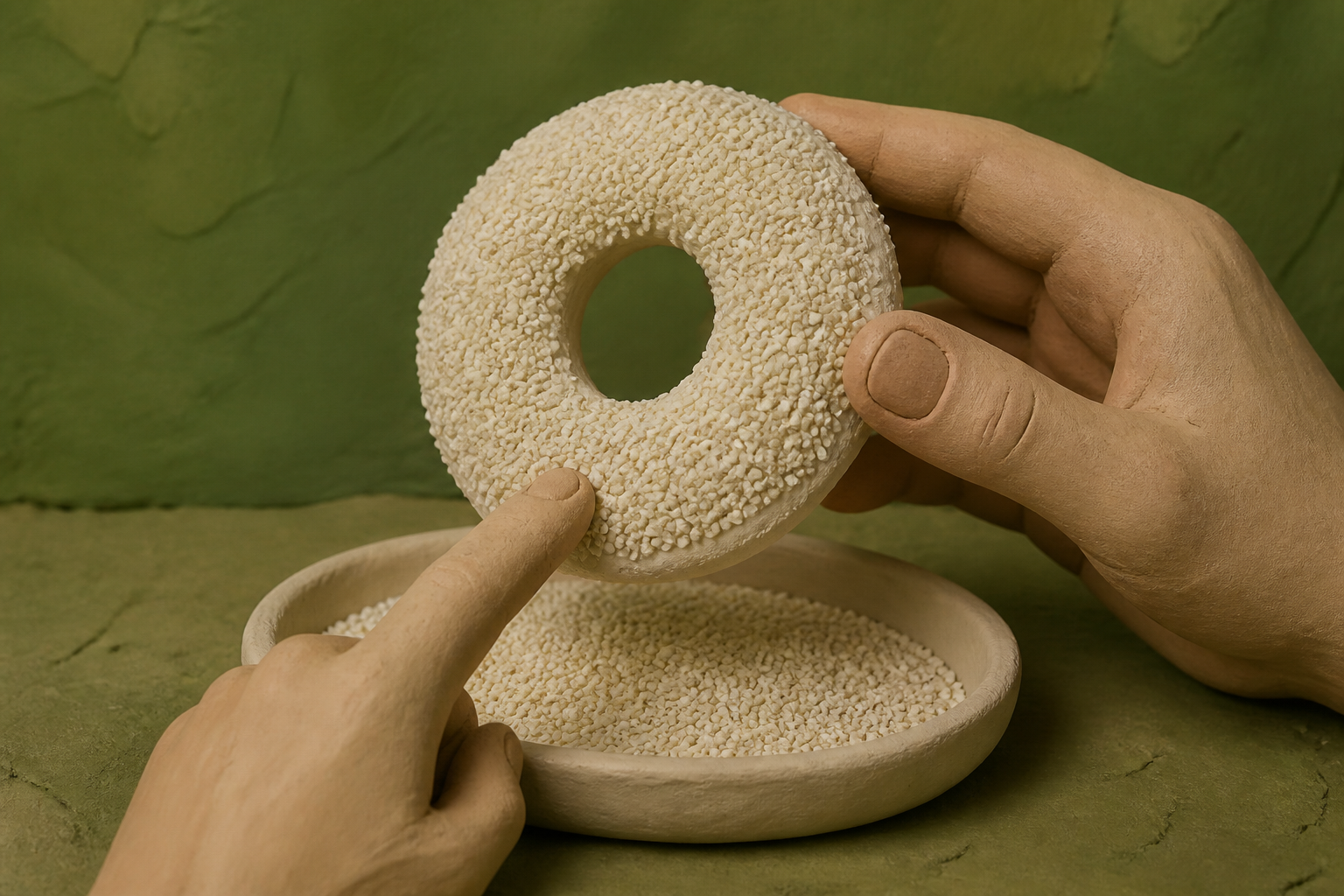
What changes in this design
Without more context, a reader might assume an edible coating is meant to cope with one storage condition at a time, such as a shelf or a freezer.
This one is presented as stable during both shelf storage and freezing. Its mixture has crystalline and non-crystalline phases, and it includes ways to make and produce that mixture.
That is worth knowing because the idea includes two storage situations and the preparation of the edible mixture, not just the mixture itself.
At the freezer door
A bakery freezer was my starting point, where a frosting can leave the freezer smooth and white, then come through a thaw with cracks, hairlines, and condensation. A 2017 patent publication addressed exactly that failure in frozen bakery goods. It described a low-viscosity coating intended to prevent the defects through freeze-thaw cycles. The appeal is plain: keep food usable longer, and less food gets tossed.
That practical wish has become a business category. A 2026 market report estimates edible coatings for produce at $1.12 billion in 2025, $1.20 billion in 2026, and $1.62 billion by 2030. It lists 20 active competitors. A market forecast is not something I take as a promise, but I do take it as evidence that coatings are no longer a lab curiosity. They are being sold as a response to plastic packaging and food waste, two problems we can see.
Two states of sugar
That is why I paused over US20260256150A1, published under the title Edible Coating Composition And Method For Making And Producing The Same. It describes an edible composition meant to be shelf-stable and freeze-stable, with both crystalline and non-crystalline phases, plus ways to make and produce it. A patent filing does not establish that a finished product will perform as promised. It identifies the problem someone wants to solve.
The phrase crystalline and non-crystalline is more than formulation decoration. Researchers studying sugar-polymer dispersions explain that amorphous sucrose and trehalose can be thermodynamically unstable above their glass-transition temperatures. Water makes the situation worse by lowering that threshold, and one experiment found lyophilized trehalose recrystallized at 63 percent relative humidity. The new filing looks to me like part of a stubborn effort to keep a coating stable across shifts in temperature and humidity.
Older coatings
This is not the first attempt. A 2016 publication described adding fatty acids and citrate esters to HPMC coatings so they could resist moisture uptake without swelling. The frozen-bakery patent was published the next year. Those filings do not tell us whether the latest composition is better, cheaper, or safer. They do show that moisture, swelling, freezing, and thawing have stayed hard for nearly a decade.
The history is longer still. A review of edible films traces the preservation idea back to prehistoric practice and places today's surge alongside the search for biodegradable alternatives to plastic. That continuity is useful to me, but it should not make us casual. Calling something edible tells us the intended route into the body, not the answer to every ingredient, exposure, allergen, or storage question. The review also flags allergenicity and pH or light instability for some ingredients. Whether those concerns apply to this composition is not something I can assume.
The label question
That gap between a coating's purpose and a shopper's understanding is now a public fight. In August 2025, Apeel Sciences sued wellness influencer Robyn Openshaw in Florida federal court after she called its coating toxic, alleged palladium, arsenic, lead, cadmium, and mercury, and urged boycotts. The company alleged defamation, trade libel, and false advertising, saying the statements were false. A lawsuit is not a scientific verdict, and I will not treat allegations from either side as fact.
Another dispute is over disclosure. H.R. 4737, called the Apeel Reveal Act, was introduced to require labels for produce coatings that extend shelf life. Apeel says it already follows labeling law. Routine, plain disclosure is, I think, the sensible rule even when a coating is lawful and useful. Shoppers should not need a lawsuit, a disputed claim, or a search through federal legislation to learn that a treatment was applied.
Where the risk actually sits
The risk I see is not that every invisible coating is dangerous, nor that every patent points to a breakthrough. The real risk sits in treating safety, stability, and disclosure as interchangeable. A composition can be technically clever and still leave unanswered questions about its ingredients or how it behaves after heat, cold, moisture, and time. A label can tell the truth without proving a product works. And a court fight can expose distrust without resolving chemistry.
US20260256150A1 belongs in that unfinished conversation. Its crystalline and non-crystalline formulation is a claimed route toward a real materials problem, not proof that the problem has been solved. Food makers should keep pursuing coatings that cut waste and plastic, which is what I want. The details should be readable before the coating disappears into the food; I want that, too. That is not a demand for alarm. It is the ordinary standard invisible technologies ought to meet.
Sources
Reporting for this piece drew on the published filing and the references below.
- US20260256150A1 - Edible Coating Composition And Method For Making And Producing The Same
- US20170006881A1 - Moisture-resistant edible food coating and method for applying the same
- Colyophilized Sugar-Polymer Dispersions for Enhanced Processing and Storage Stability
- US20160213030A1 - Edible coating compositions, edible coatings, and methods for making and using the same
- A Review on Edible Coatings and Films: Advances, Composition, Production Methods, and Safety Concerns
- Apeel Sciences sues wellness influencer Robyn Openshaw over toxic coating claims
- Apeel Sciences issues response to new federal labelling bill
The record, briefly. US20260256150A1, “Edible Coating Composition And Method For Making And Producing The Same” The disclosure concerns a shelf-stable and freeze-stable edible coating composition having crystalline and non-crystalline phases, with methods for making and producing the composition.
More angles on this
- Oat Flour's Next Pair of HandsAnother reading from the same A21D classification family, treatment of flour or dough for baking, e.g. by addition of materials; baking; bakery products.
- Confectionery, Seen Through the Eyes of a Tiny MuseumAnother reading from the same A23G classification family, cocoa.
- CPC A21D: Treatment of flour or dough for baking, e.g. by addition of materials; baking; bakery productsThe official classification family this record was filed into, published in the USPTO Cooperative Patent Classification scheme.
- CPC A23B: Preservation of foods, foodstuffs or non-alcoholic beverages; chemical ripening of fruit or vegetablesThe official classification family this record was filed into, published in the USPTO Cooperative Patent Classification scheme.
- The Potato Product Makes Its Entrance in SlicesAnother reading from the neighbouring A21C classification family, machines or equipment for making or processing doughs; handling baked articles made from dough.
Read around this one:Public patent recordUSPTO published figure