Field Notes
Oat Flour's Next Pair of Hands
A new oat-processing filing makes a familiar tradeoff sharper: the enzymes that steady a drink can also make its sugar story harder to tell.

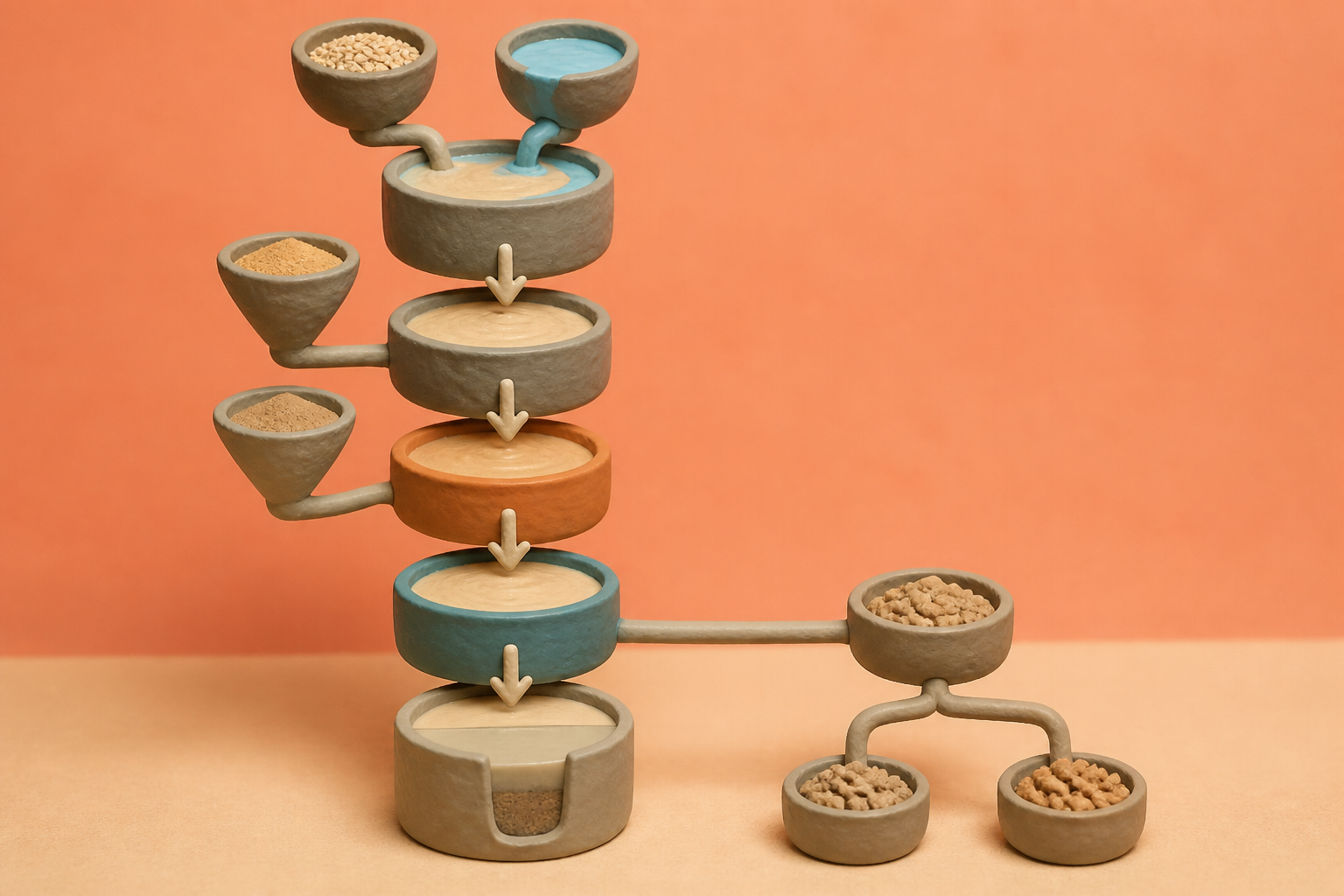
What changes in this design
The record does not say how oat-flour food mixtures are usually made. A reader might otherwise picture flour and water being mixed and shaped, without added enzyme blends, both warming and cooling, or a solids-removal step.
Here, oat flour is added to water. Enzyme blends are added while the temperature is raised and lowered; solids are removed; and the oat mixture is then formed. The temperatures, timing, and final food form are not stated.
For a curious cook or shopper, this shows that the subject is a way of processing oats, not merely an oat ingredient. Its stated goals include less manufacturing waste, more output, and a product that remains stable longer.
Three billion pounds of milk
On September 1, I saw Chobani announce a $1.2 billion, five-year investment in Pennsylvania dairy production. Its planned plant is meant to make high-protein cow's milk, create 900 jobs, and draw three billion pounds of Pennsylvania milk each year when it opens in 2027. The question I wanted to answer was why oats still demand a separate technical effort when so much money is going into cow's milk.
That made me look more closely at US20260256149A1, Method Of Making Oat Flour Based Food Composition. Related granted patents with near-identical title and language have been associated with Chobani, so I treat this publication as likely part of that family, not proof of a particular product plan. One inventor on those grants, Amrish Chawla, has since left the company, according to his public profile. The filing reads to me as a record of a harder, practical job: turn oats and water into a product that stays together, keeps longer, and wastes less in the plant.
A warm-cold enzyme cycle
The filing describes a sequence with more consequence than glamour. Oat flour goes into water. Enzyme blends are added as the mixture is taken through rising and falling temperatures. Solids come out, and the remaining oat composition is formed into food. The stated goals are higher yield, longer shelf stability, and less manufacturing waste. The key word, I think, is enzyme: that step is not just processing. It changes what the oat starch becomes.
Independent work on oat milk helps explain why. Researchers using amylase with a debranching enzyme reduced oat starch-particle size from 1,990 nanometres to 331 and reduced amylose from 27.68% to 4.69%. Their emulsion-stability index rose from 39.55 to 135.83 minutes. Those are striking results, but I would not paste them onto this filing: the study tested its own enzyme combination, not the process in this filing, and the authors say scale-up still needs trials.
Seven grams in a glass
Here is the catch I don't think an oat-processing story can skip. Breaking starch down more thoroughly can release free glucose. The researchers explicitly flag that sweetness tradeoff. A smoother, more stable drink may be easier to make and sell, while also carrying more sugar generated from the grain itself.
Oatly ran into the public version of that problem when a competitor challenged its no-added-sugars language for unsweetened oatmilk. The dispute drew attention to a cited FDA position: sugars created through controlled hydrolysis must be declared as added sugars. Oatly Original was reported at seven grams of sugar per serving, compared with zero for a named oat beverage rival. I am not saying this filing will yield the same label. The filing's reliance on enzymatic hydrolysis, I am saying, puts it next to a labeling question the industry has already had to confront.
The cost of soluble fiber
None of this started with trendy cartons. A report I found on a 2013 oat-fiber filing described the conventional enzyme-and-drying route as expensive and low-yield. The issue was not merely taste. To use the FDA heart-health claim for oat beta-glucan, a serving needs 0.75 grams of soluble fiber, within a daily three-gram threshold. Making a dependable ingredient that hits that standard has long been an industrial problem.
A different 2019 approach tried co-fermenting oat flour and dairy milk, after a yogurt venture had already collapsed. I take that history as a reminder that formulation patents are not simple product announcements. Companies can pursue several technical paths at once, and consumers may reject the result for reasons a process claim cannot fix. The current filing belongs in that longer search for yield, stability, cost, and a product people will keep buying.
The part worth watching
The ability of the process to make an oat product more stable and longer-lived is not the only thing I will watch. The filing already claims a route to more output, steadier storage, and less waste. The question is whether a finished food can retain the nutritional and labeling clarity many of us expect when we choose oats in the first place. Better stability is a real gain. It is not a free pass.
Chobani's dairy investment gives that question odd timing, not a contradiction. I see a company investing heavily in cow's milk while its related oat patent work keeps trying to make the oat side cheaper and more durable. That is not evidence of a retreat or a secret strategy. It is evidence that food companies can keep working on two difficult ingredient systems at once. The filing is most revealing to me where it is least promotional: in the enzyme step, where yield, shelf life, sweetness, and a label meet.
Sources
Reporting for this piece drew on the published filing and the references below.
- Method Of Making Oat Flour Based Food Composition
- Amylase and debranching enzyme study on oat milk stability
- Oatly's no-added-sugars challenge
- Chobani's Pennsylvania dairy investment
- Lower-cost soluble oat fiber patent report
- Oat flour and dairy milk co-fermentation patent report
- Amrish Chawla public profile
The record, briefly. US20260256149A1, “Method Of Making Oat Flour Based Food Composition” A method makes an oat composition by adding oat flour to water, adding enzyme blends while increasing and decreasing temperature, removing solids, and forming the oat composition to achieve higher yields, increased shelf stability, and lower manufacturing waste.
More angles on this
- CPC A21D: Treatment of flour or dough for baking, e.g. by addition of materials; baking; bakery productsThe official classification family this record was filed into, published in the USPTO Cooperative Patent Classification scheme.
- The Potato Product Makes Its Entrance in SlicesAnother reading from the neighbouring A21C classification family, machines or equipment for making or processing doughs; handling baked articles made from dough.
- A Field Robot's Route Plan Reads Less Like a Map and More Like a Rehearsal ScheduleAnother reading from the wider A01B classification family, soil working in agriculture or forestry.
- The Tilted Rim: An Editor's Reading of an Asymmetrical SiC SubstrateAnother reading in the same Field Notes category on this site.
Read around this one:Public patent recordUSPTO published figure