Machines
The Condition Between Joined Fibers and Connected Pores
The central pairing is Key detail with Arrangement: A heat transfer suppression sheet contains inorganic particles.

First, the setting
Rechargeable batteries sit inside many things people use every day, from vehicles to tools and home equipment. As they work, they can become warm. Designers pay attention to how heat moves through tightly packed parts because comfortable, dependable devices are easier to live and work with.
Inside a battery pack, thin layered materials can sit between battery cells, the individual units that store energy, and nearby parts. A driver may be traveling in an electric vehicle, or someone may be carrying a battery-powered tool, while hidden parts manage warmth within the enclosed pack. The user notices the device, not the layers inside it.
What changes in this design
A reader might picture a heat-limiting sheet as a mostly solid layer placed between parts of a battery pack.
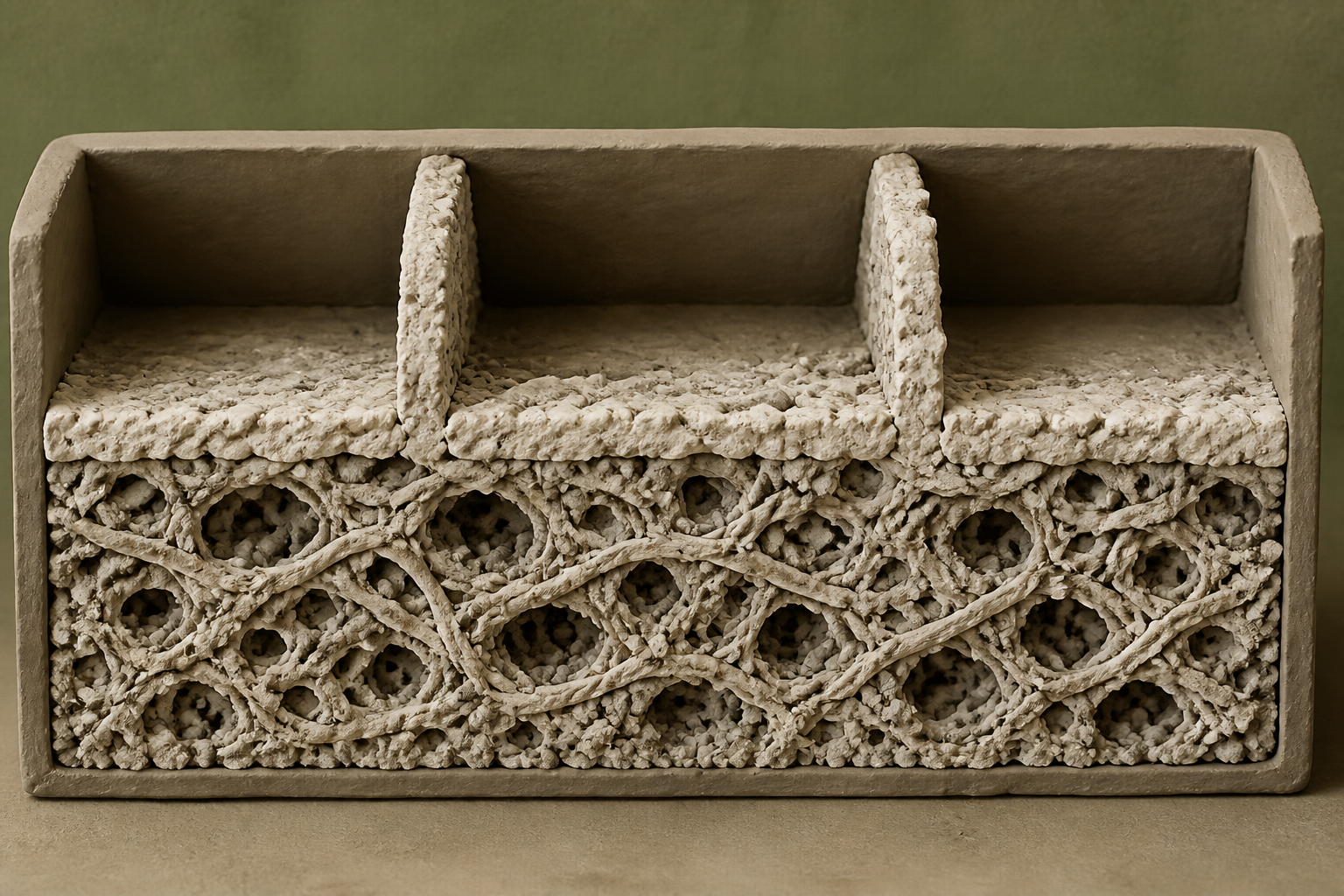
Here, the sheet contains inorganic particles, organic fibers, and connected pores running through the material. Where fibers meet particles, fused portions join them.
That internal makeup is the central idea to notice. The sheet is not presented simply as a solid barrier; it includes both connected open spaces and joined fiber-particle contact points.
Joined Fibers, Open Space
Cause, effect, next choice: the obvious headline is a heat transfer suppression sheet, but the more useful question begins with a picture of a sheet that is joined in places and still open through its body. The effect, in this editorial sense, is that you stop looking for a single uninterrupted wall; the next choice is to ask what is being joined and what is being left open. The published record, US20260260966A1, dated September 3, 2026 and titled Heat Transfer Suppression Sheet And Battery Pack, describes a sheet containing inorganic particles, organic fibers, and three-dimensionally connected pores, with fusion portions joining fibers to particles. What made me look twice was the coexistence of joining and open space, rather than the headline alone.
That picture needs terms before it earns an interpretation. The filing describes inorganic particles, meaning small pieces of inorganic material; organic fibers, meaning threadlike elements of organic material; and three-dimensionally connected pores, meaning open spaces that link through the sheet in more than one direction. It also describes fusion portions, or places where the fibers are joined to the particles. The minor condition worth naming is therefore the condition of fibers joined to particles while connected pores remain part of the same sheet. The arrangement feels less like a solid barrier and more like a stage manager quietly assigning everyone a place. I think that small relational detail is what prevents the description from dissolving into a generic story about a layer between two things.
Once the terms are on the table, the comparison becomes a defined response replacing a guess. An ordinary mental model for a heat-suppression sheet may ask whether the answer is simply to pack material tight or leave a layer empty. The filing instead puts particles, fibers, fusion portions, and connected pores into one stated arrangement, so you have something more specific to examine than either extreme. The filing is less like a single-material answer and more like a restrained committee: particles, fibers, pores, and fusion portions each have a seat. What I noticed here is not a result to declare, but a discipline of attention: identify the parts, then identify the condition that makes them coexist. That contrast gives you a practical test for any dense technical description: if removing the open spaces would change the picture, those spaces are not background.
Fusion Portions and Connected Pores
With that test in hand, the mechanism can be kept modest and visible. The published record says fusion portions join fibers to particles, while the pores are three-dimensionally connected. In everyday language, the described sheet is neither a single uniform mass nor merely loose ingredients: it has joining points and linked open spaces in the same arrangement. The three-dimensional connection has the air of a librarian keeping the gaps from wandering off. That image should not be pushed into a performance claim; it simply keeps the relation legible. What is held together on the page is a material arrangement with both contact and continuity of space, and that is the structural thought worth carrying forward.
Suppression Beyond the Headline
That structural thought brings the purpose back into view without letting it grow beyond the published facts. The title names a heat transfer suppression sheet and a battery pack. Yet the attention-grabbing purpose is paired with the quieter condition of particles, fibers, fusion portions, and three-dimensionally connected pores. The point is not to turn that pairing into a prediction about a battery pack. It is to notice a familiar design question made concrete: when a system is meant to moderate something, which relationships must be specified rather than assumed? The filing answers at the level it gives us, with an arrangement in which joining and open connected space are both named.
From that bounded purpose comes the takeaway you can carry elsewhere. First, when a design description names an aim, separate that aim from the condition that organizes its parts: here, suppression is the aim in the title, while the joined fibers, particles, and connected pores are the condition that makes the wording specific. Second, when a description includes both material pieces and spaces, inspect both with equal care; an empty region deliberately described as connected is not the same as a blank omission. A third observation follows from the fusion portions: connections deserve attention as their own question, rather than being treated as invisible glue between named ingredients. You do not need a grand verdict to use this habit. Elsewhere, it gives you a sharper next question before the headline decides what the design is.
The record, briefly. US20260260966A1, “Heat Transfer Suppression Sheet And Battery Pack” A heat transfer suppression sheet contains inorganic particles, organic fibers, and three-dimensionally connected pores, with fusion portions joining fibers to the particles.
More angles on this
- Carbon's Measured Line at the Electrode BoundaryAnother reading from the same H01M classification family, processes or means, e.g. batteries, for the direct conversion of chemical energy into electrical energy.
- Pores After Coating: The Boundary That Carries the Last ChangeAnother reading from the same H01M classification family, processes or means, e.g. batteries, for the direct conversion of chemical energy into electrical energy.
- CPC H01M: Processes or means, e.g. batteries, for the direct conversion of chemical energy into electrical energyThe official classification family this record was filed into, published in the USPTO Cooperative Patent Classification scheme.
- CPC B60L: Propulsion of electrically-propelled vehiclesThe official classification family this record was filed into, published in the USPTO Cooperative Patent Classification scheme.
- The Face a Radiation Window Names Before You ActAnother reading from the neighbouring H01J classification family, electric discharge tubes or discharge lamps.
Read around this one:Public patent recordUSPTO published figure