Wearables
The Headwear Article Is Keeping Its Options Open
A sun-hat company that rebuilt after the Almeda Fire spent five years and three months at the patent office and came away owning a triangle.
What changes in this design
Someone seeing a patent may expect an explanation of what an object does, what it is made of, or how it operates.
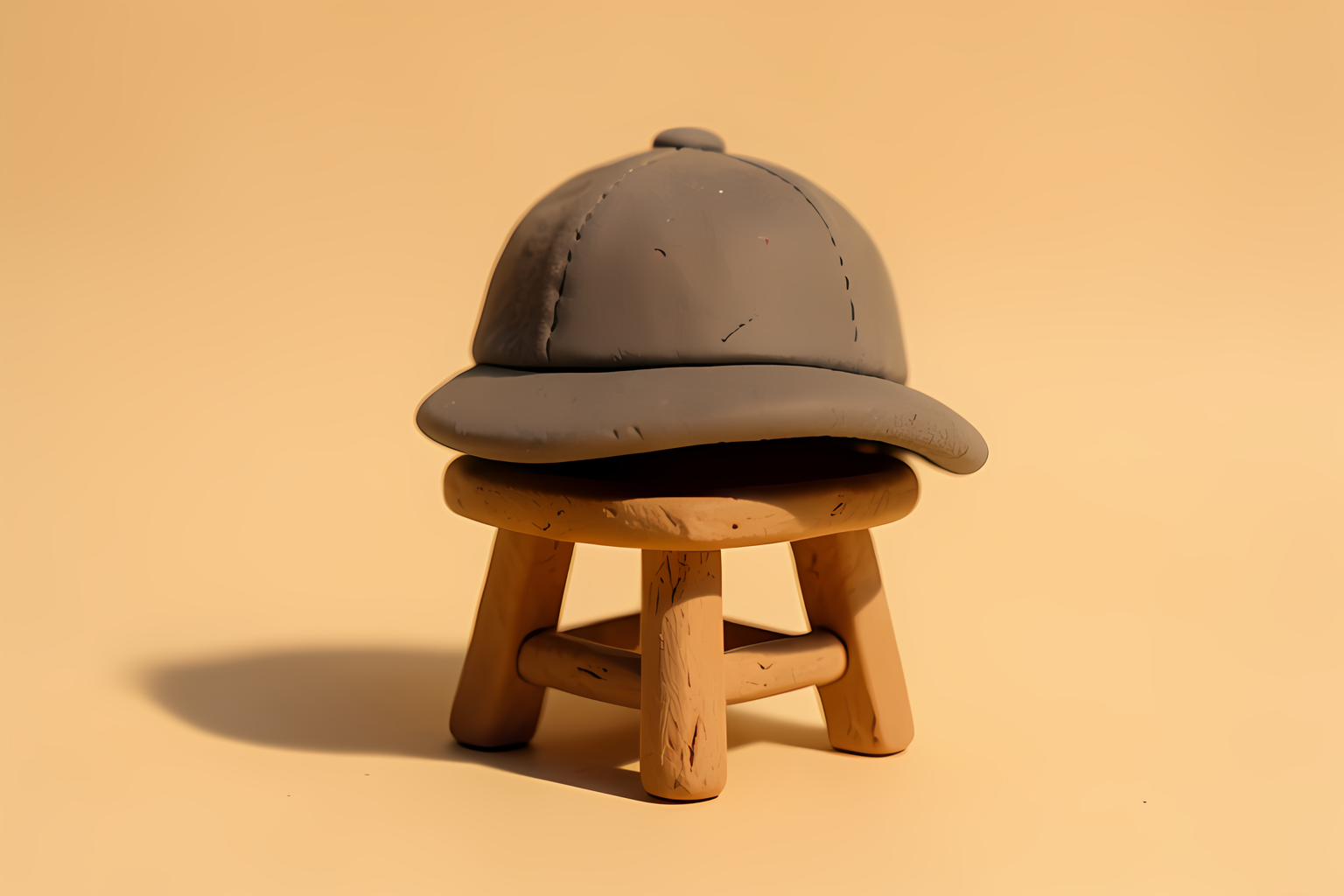
Instead, this record centers on visible shape. It shows a dome-like upper form, a long curved front projection broad at its outer edge, several parallel curved seams, a lower rear band, and a short rectangular tab.
This matters because the illustration is the evidence a reader can use to understand the recorded look. It does not establish materials, workings, or results.
The fire reached Talent in two hours
On September 8, 2020, at 11:07 in the morning, a fire started in southern Oregon. Winds gusting to 45 miles an hour pushed it into the town of Talent within two hours and into Phoenix within four. It burned 3,200 acres, destroyed more than 3,000 structures, killed three people, and was contained a week later. Five years on, about 85% of the destroyed single-family homes had been approved for rebuilding, but fewer than half the lost commercial units were back.
One of the businesses on Highway 99 was Sunday Afternoons, a sun-hat company founded in 1986 when Angeline and Robbin Lacy started sewing waterproof blankets to sell at Oregon craft fairs. Hats came later, made from scraps of the blanket fabric. Its headquarters was rebuilt. I went looking for what the company did next, and found it in the patent office.
Two applications, two weeks apart
On May 6, 2021, eight months after the fire, the company filed a design patent application on a headwear article. Six days earlier it had filed another one. Then on May 21 it filed something different in kind: a utility application, the sort that claims how a thing works rather than how it looks.
That utility application is the interesting one. It described a hat panel built as a three-layer sandwich with a semi-rigid mesh in the middle, so the hat would hold its shape and still let air through. Structure and breathability at once. It published in November 2022, was finally rejected in July 2023, and went abandoned on March 1, 2024. The mechanism didn't make it.
What survived is a triangle
The design application did make it, on August 11, 2026, as US D1,140,508. Eight sheets of drawings and a single claim. Read the drawings and almost the entire cap is in broken lines, which in design practice means unclaimed, not part of what you own. What's claimed in solid line is the triangular side sections, with oblique hatching that the description says represents material of a contrasting appearance. That is the property: a triangular contrasting side panel.
It took five years and three months. Design applications in fiscal 2025 averaged 21.5 months from filing to disposal, and first-action pendency has since fallen to about 14 months. A sibling application from the same week issued in December 2025, after roughly 55 months. So this wasn't a one-off backlog; both sat for years.
The closest prior art was the founder's own hat
Here's what I did not expect. In one study covering the 2000s the design allowance rate stayed above 90%, against roughly 44% for utility patents, and a sampled year of issued design patents showed prior-art rejections in just 1.2% of cases. The scholar Sarah Burstein argues this isn't laziness at the office so much as appellate case law that has made rejecting a design claim nearly impossible, regardless of how ordinary or functional it is.
Against that background, this filing looks strange. Four of its five patent references are marked as cited by the examiner rather than volunteered. Two of them are sun-hat designs from 2009 and 2010 naming Robbin J. Lacy as inventor, the surname of the people who started the company. The non-patent art cited is the company's own product listings. And the abandoned utility application was cited too. The nearest thing anyone could find to this hat was the same company's earlier work.
Where the risk actually sits
More than 9,500 Americans are diagnosed with skin cancer every day, and about one in five will get it by age 70. Doctors most often find basal and squamous cell cancers on the head and neck. MD Anderson advises a brim of at least two to three inches all the way around; a baseball cap covers part of the face and leaves the ears and back of the neck exposed, and a visor is worse. UPF protection comes from weave tightness, thickness, color, fiber and chemical absorbers, tested under a voluntary method with no government mandate behind it.
None of that is what this patent covers. You cannot own a weave, and the panel meant to keep a structured hat breathable is the thing that died in 2024. What's left is a shape on a side panel, defensible against a copy that looks like it, useless against one that works like it. I don't read that as a company overreaching. I read it as an accurate picture of what a mid-size consumer manufacturer can still get. The hat is real. The part the government agreed to enforce is a triangle.
Sources
Reporting for this piece drew on the published filing and the references below.
- US D1,140,508 S - Headwear Article (USPTO grant)
- US 2022/0369750 A1 - Headwear with layered construction
- Sarah Burstein, Is Design Patent Examination Too Lax? (Berkeley Tech. L.J.)
- USPTO Reports Faster Design Patent Examinations
- US D594,185 S - Sun hat (inventor Robbin J. Lacy)
- US D1,105,717 S - Headwear article
- Sunday Afternoons - Our Story
- Almeda Drive Fire
- Five Years After the Almeda Fire, Talent Rebuilding Strong
- Skin Cancer Facts & Statistics
- Sun hats, skin protection and cancer: 4 things to know (MD Anderson)
- UPF In Textiles (Textile World)
The record, briefly. USD1140508S1, “Headwear Article” The checked public record identifies a U.S. design patent titled 'Headwear Article'. The reading treats the published title and figure as a visual starting point and does not infer a material, mechanism, or performance claim not established there.
More angles on this
- The Helmet Visor Has Entered Sports DiplomacyAnother reading from the same A42B classification family, hats; head coverings.
- The Gaiter Has a Small But Specific MissionAnother reading from the same A42B classification family, hats; head coverings.
- CPC A42B: Hats; head coveringsThe official classification family this record was filed into, published in the USPTO Cooperative Patent Classification scheme.
- The Leveling Bar Has a Very Firm Opinion About LevelAnother reading from the wider A01B classification family, soil working in agriculture or forestry.
- A Glove With a PortfolioAnother reading in the same Wearables category on this site.
Read around this one:Public patent recordUSPTO published figurePatent issue-date index