Machines
The Oblong Carrier and the Mechanical Signal of Alignment
After cornering the market on advanced chip carriers, a Taiwanese supplier is designing boxes for oversized rectangular panels that the industry has not yet standardized.

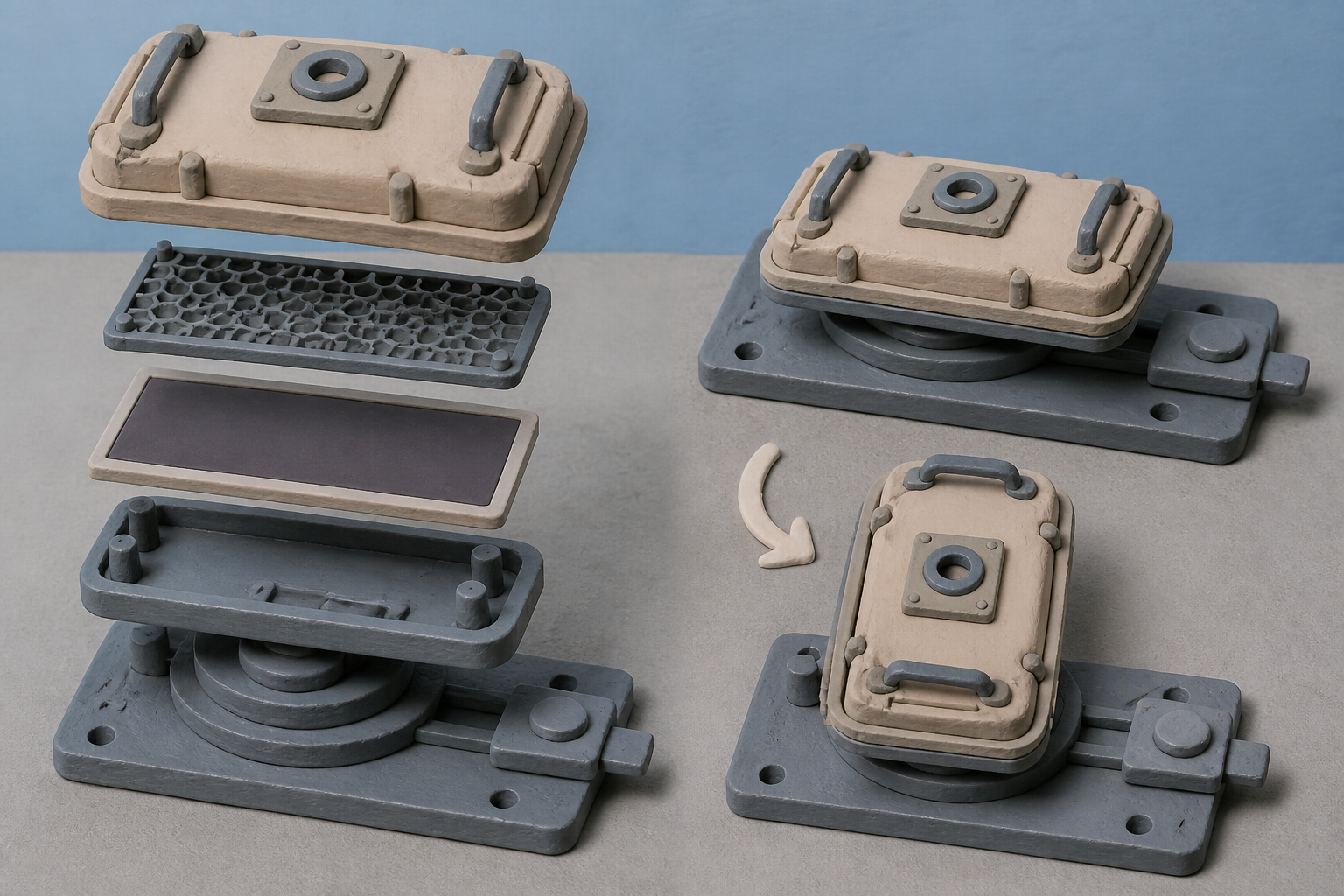
What changes in this design
Someone might assume a rectangular container used in semiconductor work stays fixed in whatever direction it is loaded, or that any required turning must be handled manually or by a separate machine handler before placement.
Here, the semiconductor container has its own bottom orienting assembly built in. When set directly onto a load port, this bottom assembly connects with a drive portion, physically turning the rectangular reticle pod from a first direction to a second direction according to a drive stroke.
Handling non-square rectangular pods means their orientation matters whenever they enter a load port. Built-in rotation allows the container to shift angles as part of the loading action itself, turning the carrier to line up with the receiving port.
The courtroom fine that built a monopoly
In March 2019, the Taiwan Intellectual Property Court ordered Gudeng Precision to pay NT$978.8 million-roughly $32.6 million-to its American competitor Entegris. The court ruled that Gudeng had infringed a patent on reticle carriers, demanding an immediate halt to sales and the destruction of existing stock. It stood as one of the largest patent infringement penalties in Taiwan's history. Twenty months later, in November 2020, the two companies settled all pending disputes through confidential cross-licensing agreements.
I find it striking how thoroughly that courtroom loss cleared the path for a near total lock on the market. Instead of fading away, Gudeng became the sole supplier of extreme ultraviolet (EUV) pods to TSMC. By 2024, reticle boxes and EUV carriers accounted for about 60 percent of Gudeng's NT$6.55 billion in annual revenue. When we look at its first-half results for 2026, net profit surged by over 200 percent as the company built out new manufacturing lines in Arizona and Japan to follow its primary customer abroad.
Tied to a single customer's tools
Dominating a single component creates an obvious hazard. In July 2025, an investment bank downgraded Gudeng and chopped its target price by more than half, from NT$750 down to NT$340. The trigger was not a manufacturing defect or a lost lawsuit. TSMC was simply tracking to install 17 or 18 EUV lithography machines in 2026 instead of the expected 20, while layer counts on next-generation chips remained flat.
The number that caught my attention was that two-machine gap. When a business relies so heavily on one buyer's lithography schedule, a minor pause in tool deliveries ripples straight through the order book. Reticle carriers are precision-engineered boxes designed to shield multimillion-dollar photomasks from the tiniest specks of dust, but they remain tied to the rhythm of standard wafer fabs. Growth requires either selling more boxes for the same circular wafers or finding an entirely different shape to carry.
Breaking out of the square box
That different shape is already arriving in advanced packaging. Traditional silicon manufacturing processes circular wafers 300 millimeters across, using square photomasks that fit neatly into standardized carrier pods. Advanced packaging, however, is increasingly moving toward rectangular panels. A single 500-by-500 millimeter panel can yield four and a half times as many finished dies as a standard wafer for less than half the additional cost.
The trouble is that rectangular panels have no universal rules. While square reticle containers have followed formal mechanical load-port standards since 2002, rectangular formats sit outside those old industry agreements. Equipment builders choose their own dimensions, ranging from 370 by 470 millimeters up to 600 by 600 millimeters. If we look at how chip packaging has evolved, the transition away from uniform squares has created a mechanical mess at the tool interface.
A rotating floor on the load port
That brings us to a patent application published on September 3, 2026: US20260259513A1, titled "Orientable Semiconductor Container And Orientation System For Semiconductor Container." Gudeng filed the non-provisional application in February 2026, exactly one year after securing a provisional filing in early 2025.
The core concept tackles a physical constraint of non-square carriers. When an asymmetric, rectangular reticle pod arrives at a processing station, it often faces the wrong direction for the internal transfer arm. Rotating a square pod is trivial, but an elongated rectangular box will collide with surrounding equipment if spun around its center inside a tight enclosure. A legacy computing pioneer patented in-pod reticle rotation back in 2000 to eliminate separate robotic indexers, but that approach assumed square carriers.
What caught my eye in the new patent is how directly the bottom orientating assembly solves the stroke clearance. Instead of relying on an overhead robotic arm or an external turntable, the carrier itself houses a specialized base. When the container docks onto a load port, the bottom assembly engages a drive mechanism that shifts and rotates the rectangular pod along a controlled drive stroke from an initial orientation to a second orientation. The movement happens right at the port, letting non-equilateral containers interface with machinery without demanding extra cleanroom floor space.
What would have to be true
For this mechanical container to become the dominant standard in panel-level packaging, several pieces must fall into place. First, packaging houses must converge on panel handling rather than continuing with proprietary handling jigs. The cost advantage of rectangular panels is clear, but without standardized load ports, every tool maker builds custom transfer docks.
Second, Gudeng must persuade packaging equipment makers to integrate its bottom-drive interface before rival carrier designs take root. In the EUV pod market, Gudeng gained its position by mastering cleanliness standards alongside TSMC. In panel packaging, no single customer holds total control over tool specifications. I doubt the industry will rush into a proprietary docking mechanism without a fight from established equipment makers. If the industry standards committee adopts an alternative open dock design, a proprietary orientable pod could remain a niche component rather than the next industry fixture.
Sources
Reporting for this piece drew on the published filing and the references below.
- Orientable Semiconductor Container and Orientation System (US2026/0259513A1)
- Taiwan Intellectual Property Court Finds Gudeng Precision Infringes Entegris' Reticle Pod Patent
- Gudeng Precision and Entegris, Inc. settle patent litigation
- Gudeng expecting revenue growth
- Morgan Stanley downgrades Gudeng Precision stock on TSMC EUV delivery concerns
- Litho Options For Panel Fan-out
- SEMI E117 - Specification for Reticle Load Port
The record, briefly. US20260259513A1, “Orientable Semiconductor Container And Orientation System For Semiconductor Container” An orientable semiconductor container adapted for a non-equilateral rectangular reticle pod includes a pod and a bottom orientating assembly. When placed on a load port, the assembly engages with a drive portion to rotate the reticle pod from a first direction to a second direction according to a drive stroke. An orientation system for the container is also provided.
More angles on this
- A reticle stage with a shield that travels with it, and what two positions make legibleAnother reading from the same G03F classification family, photomechanical production of textured or patterned surfaces, e.g. for printing, for processing of semiconductor devices.
- CPC G03F: Photomechanical production of textured or patterned surfaces, e.g. for printing, for processing of semiconductor devicesThe official classification family this record was filed into, published in the USPTO Cooperative Patent Classification scheme.
- CPC H10P: Generic processes or apparatus for the manufacture or treatment of devices covered by class H10The official classification family this record was filed into, published in the USPTO Cooperative Patent Classification scheme.
- Camera Array With Reduced Cross-Talk Makes the Next Move Easier to SeeAnother reading from the neighbouring G03B classification family, apparatus or arrangements for taking photographs or for projecting or viewing them.
- Portable And Low-Cost Microscopic Imaging Device Makes a Small Case for Better TimingAnother reading from the wider G02B classification family, optical elements, systems or apparatus.
Read around this one:Public patent recordUSPTO published figure