Machines
The Signal of Two Particle Scales
Start with Negative Electrode Plates and Key detail: A secondary battery includes positive and negative electrode plates and an electrolyte.

First, the setting
Everyday life depends on rechargeable power in things people carry, plug in, and travel in. Families want devices and vehicles to start when needed and keep working through ordinary routines. That is why people pay close attention to the materials inside batteries, where stored energy is managed.
A driver presses the accelerator and an electric vehicle moves quietly through traffic, drawing power from a battery pack tucked away beneath the cabin. Nearby, a passenger may notice a calm ride, a charging cable at a parking space, or a dashboard showing the vehicle's remaining stored energy.
What changes in this design
A reader may think of a battery mainly as its positive and negative internal layers plus an electrolyte that contains lithium salts, without focusing on particle size within a layer.
Here, the positive plate uses lithium-containing transition metal phosphate in two size ranges: submicron and micron-scale. Its electrolyte also includes lithium hexafluorophosphate and specified bis(imide) salts.
That focus is worth knowing because attention is on materials inside the battery, especially particle scale and the listed salts, rather than merely its outer form.
Particle Scales in the Positive Plate
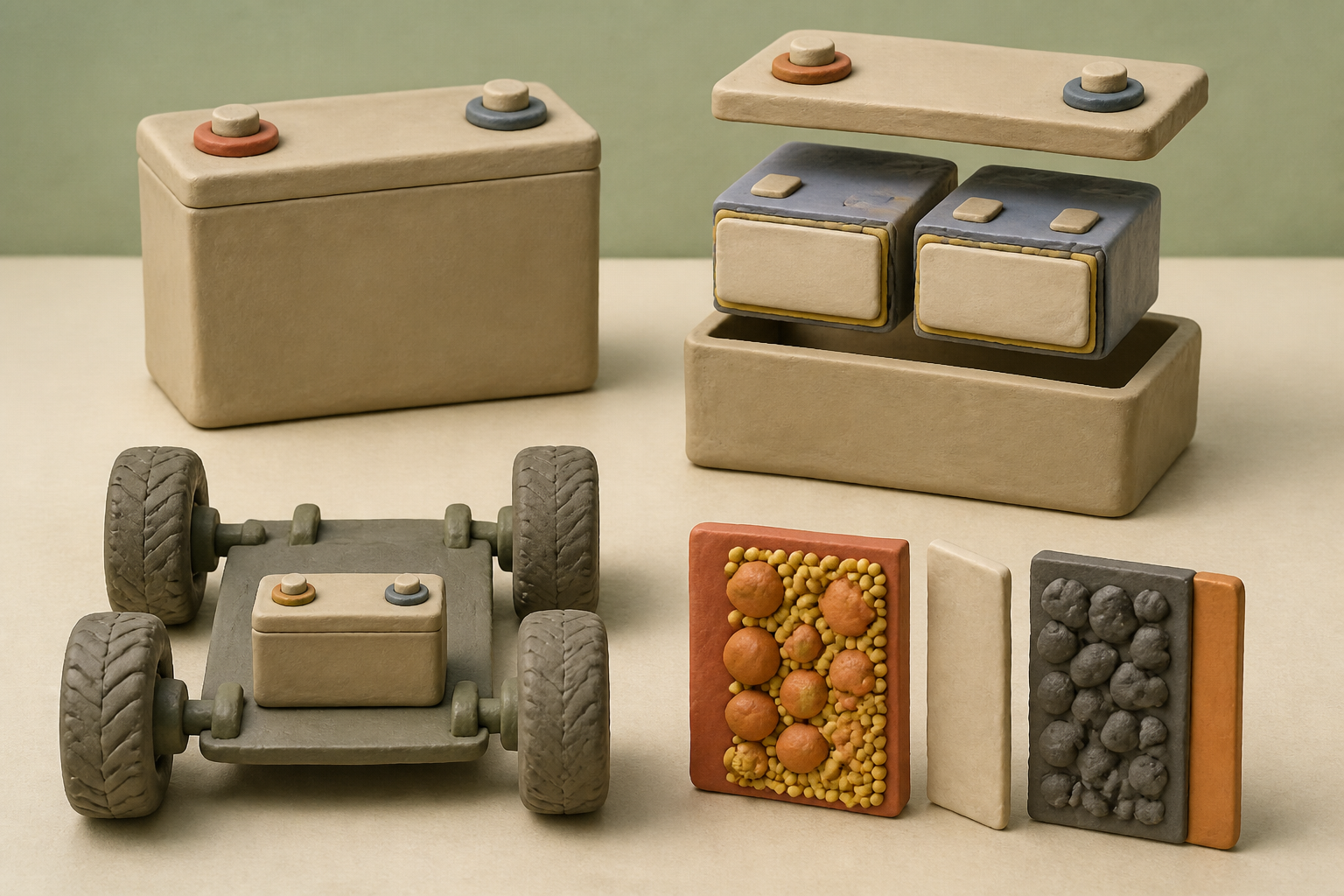
What do you look for when a battery description puts two particle scales beside a list of salts? Start with the task the published record actually names: a secondary battery, meaning a rechargeable battery, together with an electric apparatus. Then reduce the scene to its stated parts: a positive electrode plate, a negative electrode plate, and an electrolyte, the named battery part that includes lithium salts. The positive plate is where the filing directs attention. It includes lithium-containing transition metal phosphate, a phosphate material that contains lithium and a transition metal, meaning a class of metallic elements, with particles at two scales. Submicron means smaller than one micrometer, while micron-scale means described at the micrometer scale. The distinction that made me look twice is not a promised result; it is the decision to make both scales visible in the same positive plate. That is a practical signal because it tells you where to look before chemistry starts sounding like a cupboard full of labels.
Electrolyte Salts Beside the Plate
That two-scale clue makes the next picture manageable. Instead of treating the filing as a thicket of chemistry words, picture the positive plate as the location where smaller-than-a-micrometer particles and micrometer-scale particles are both specified, while the negative plate and electrolyte remain other named parts of the battery. The pair has the air of a restrained committee, with submicron particles and micron-scale particles both named for the positive plate. That image is not a claim about how the battery behaves; it is a way to keep the placement legible. The ordinary broad version of the task would be merely to mention a rechargeable battery with an electrolyte. This published arrangement draws a narrower line by also identifying the positive-plate material and two explicit size descriptions. That narrower line sets up a question that can be answered from the words on the page.
Once location and scale are in view, the electrolyte supplies the next observable. The filing includes lithium salts there, naming lithium hexafluorophosphate and specified bis(imide) salts. Lithium hexafluorophosphate is a lithium salt stated by its full chemical name; bis(imide) salts are a named group of lithium salts. The electrolyte list is less like a mystery drawer and more like a label-maker's deliberate row. At the level of detail provided, the mechanism worth following is an arrangement of named material in named places: two particle scales in the positive plate, and named lithium salts in the electrolyte. No outcome needs to be supplied for that arrangement to become a decision point. It invites you to note what is placed where, then ask whether another description makes the same placement explicit.
Comparable Positive-Plate Descriptions
Because placement is now the visible signal, a comparable description can be read as a before-and-after rather than a contest. Before the comparison, you have a battery description that names positive and negative electrode plates, an electrolyte, the lithium-containing transition metal phosphate in the positive plate, submicron and micron-scale particles, and lithium hexafluorophosphate plus specified bis(imide) salts in the electrolyte. After the comparison, the question is simply whether another battery description names the corresponding plate, particle scales, and electrolyte salts with that same level of placement. The filing has the air of a stage manager, placing the positive plate, negative plate, and electrolyte before the details begin. This is an observable contrast: a description can leave materials floating in a paragraph, or it can attach them to a named part of the arrangement. The first comparison does not decide which is better; it decides whether the signal is present.
Once that contrast is visible, the takeaway becomes portable. When you scan any technical description, circle the noun that names the place and the words that name the scale; this filing pairs the positive plate with two particle scales. Then underline named constituents attached to another part; here, the electrolyte includes lithium hexafluorophosphate and specified bis(imide) salts. Those are not performance conclusions. They are two concrete habits for turning a dense description into a decision about what to compare next. I think the bounded value lies in that discipline: attention moves from a pile of terms to a map of locations, scales, and named materials.
From that map, end with a small experiment: take a comparable battery description and make a three-column note with the labels positive plate, negative plate, and electrolyte. Under each label, copy only the materials and size terms that description expressly attaches to it. Then place the note beside this filing's visible pattern: lithium-containing transition metal phosphate with submicron and micron-scale particles in the positive plate, and lithium salts including lithium hexafluorophosphate and specified bis(imide) salts in the electrolyte. Leave blank any field the description does not state. The blank has the air of a quiet librarian's shelf, useful precisely because it refuses to lend you a fact that was never placed there. If the side-by-side notes show the same locations and terms, you have a defined comparison question; if they do not, you have learned exactly what to ask next.
The record, briefly. US20260260944A1, “Secondary Battery And Electric Apparatus” A secondary battery includes positive and negative electrode plates and an electrolyte. The positive plate includes lithium-containing transition metal phosphate with submicron and micron-scale particles; the electrolyte includes lithium salts including lithium hexafluorophosphate and specified bis(imide) salts.
More angles on this
- Carbon's Measured Line at the Electrode BoundaryAnother reading from the same H01M classification family, processes or means, e.g. batteries, for the direct conversion of chemical energy into electrical energy.
- Pores After Coating: The Boundary That Carries the Last ChangeAnother reading from the same H01M classification family, processes or means, e.g. batteries, for the direct conversion of chemical energy into electrical energy.
- CPC H01M: Processes or means, e.g. batteries, for the direct conversion of chemical energy into electrical energyThe official classification family this record was filed into, published in the USPTO Cooperative Patent Classification scheme.
- CPC B60L: Propulsion of electrically-propelled vehiclesThe official classification family this record was filed into, published in the USPTO Cooperative Patent Classification scheme.
- The Face a Radiation Window Names Before You ActAnother reading from the neighbouring H01J classification family, electric discharge tubes or discharge lamps.
Read around this one:Public patent recordUSPTO published figure