Field Notes
The Small After-Effect of a Bent Signal Pin
Start with Management System Structure and Conductive Signal: A battery management system structure has a housing.

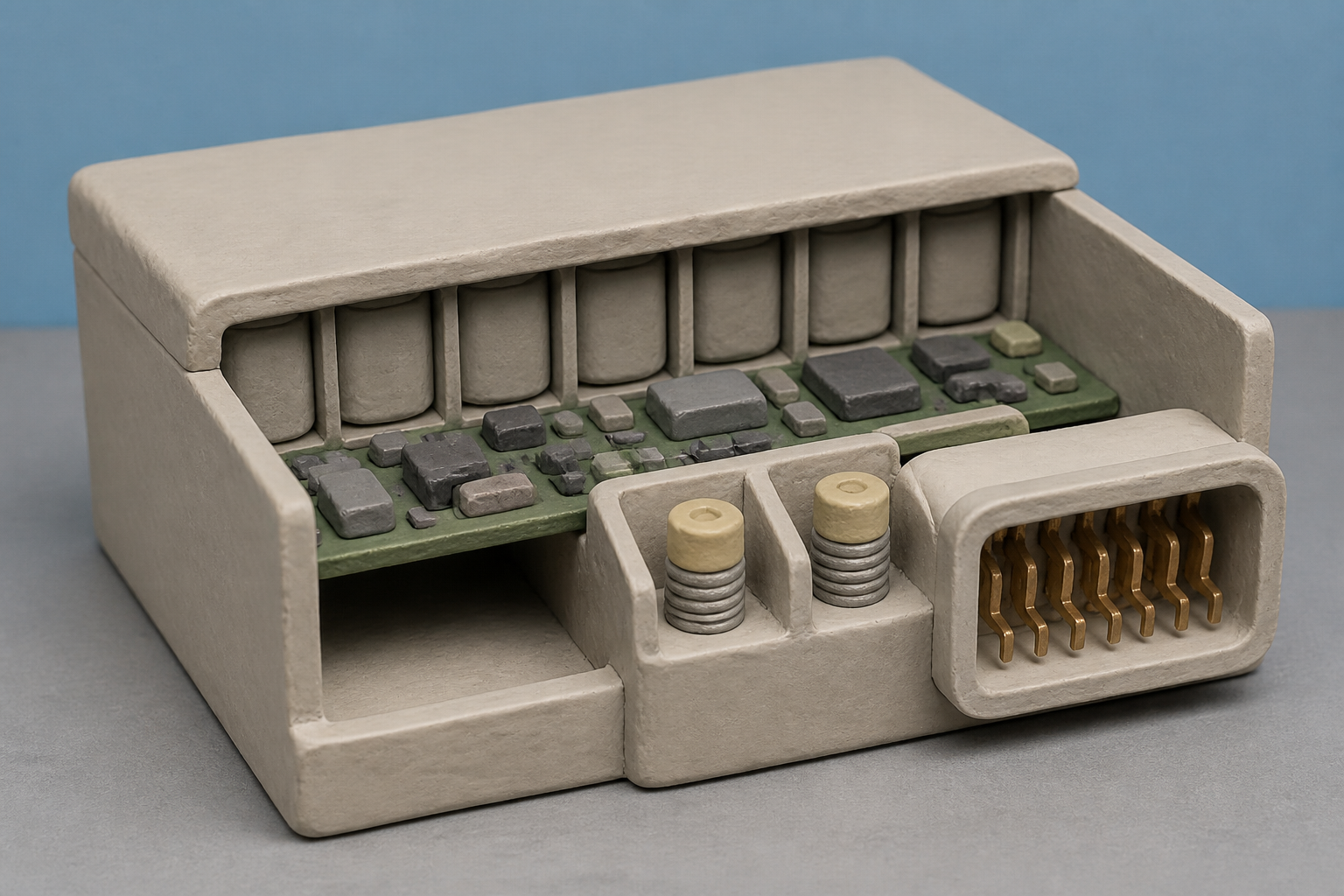
First, the setting
Everyday travel and portable equipment depend on stored electricity. As batteries charge, discharge, warm, and connect to other parts, people need the equipment around them to be assembled carefully and kept orderly. That practical work happens out of sight, supporting familiar moments such as leaving home, using a tool, or plugging something in.
A driver opens an electric vehicle's service area while a technician works near the battery pack, a protected case that holds stored energy. Inside are small connectors, metal pins, and wires linking the pack to equipment that watches its condition. Nearby, the driver may simply see a charge port, dashboard, and quiet vehicle waiting to move.
What changes in this design
A reader might otherwise picture a battery-management connection as a box with a connector mounted on it and straight metal contacts extending toward that connection.
Here, the connector shell is formed as part of the housing's exterior. The conductive pins have elongated portions, a shoulder, and a bend positioned roughly at a right angle.
The details show that the pins' shape is part of the physical construction. What that shape changes in use, or what it measures, is not stated.
Shell, Pins, and Turning Points
Cause: a connector is given a defined place on the outside of an ordinary object; effect: that decision leaves a pattern for the parts beside it; next choice: read the pattern in the order it asks to be seen. Ordinary objects earn their place in human routines when small arrangements feel settled, even when nobody pauses to narrate why. In US20260260953A1, published September 3, 2026, the title points to a battery management system structure and a battery comprising the same. The first picture is of a contained body with a connector shell on its exterior, a small threshold between an inside arrangement and the world around it. The exterior connector shell has the air of a stage manager standing quietly at the edge of the set, making sure the entrance is where everyone expects it. I looked twice because the filing makes that outside placement the beginning of the sequence, not background scenery.
That picture needs names before it can carry much meaning. A housing is the enclosing body of the system; a connector shell is the outer piece named for its connector role; and integrally formed means the shell is formed as part of that housing. The filing also describes conductive signal pins, a name that identifies pins by their signaling role and ability to conduct. Each has elongated portions, meaning longer runs; a shoulder portion, meaning a distinct change in the pin's profile; and a bend arranged substantially orthogonally, meaning approximately at a right angle. The elongated portions are less like wandering wires and more like a librarian's straightened row, quietly asking the rest of the arrangement to make sense. Those definitions do not settle an outcome, but they do make the next question more exact: what is the arrangement trying to keep from becoming a guess?
That question supplies the modest purpose worth attention. The supplied facts do not establish why this arrangement was selected or what result it produces, so the purpose here is editorial: to notice how a defined location and a defined shape leave an after-effect on the way you can understand a system. The patent's title links the structure to a battery management system and to a battery comprising it, while the described details stay focused on housing, exterior shell, and pin geometry. That narrowness is a useful discipline. It asks you to resist turning a precise arrangement into a broad story about capability. The substantially orthogonal bend arrives as if a patient committee had set down a small right-angle sign and moved on. With that restraint in place, the sequence can now move from the named parts to the mechanism they establish.
Defined Geometry Over Guesswork
With that restraint in place, the mechanism is best read as an order of relationships rather than a promise about what happens afterward. For this reading, first comes the housing, the enclosing body. On its exterior comes the integrally formed connector shell, the connection-point shell formed as part of the housing. From there come the conductive signal pins, described with elongated portions, a shoulder portion, and a bend arranged substantially orthogonally. The filing presents these features together, so their value here is the sequence itself: enclosure, exterior connection point, then named pin form. A stage direction is useful precisely because it tells a performer where to stand without pretending to write the whole play. In the same modest way, the layout gives you defined landmarks before you start imagining consequences.
A Portable Sequence for Interfaces
Once those landmarks are visible, the contrast is not between a proven winner and loser, but between a defined response and a loose guess. A broad mental picture of a battery-related structure might treat its housing, connector, and pins as neighboring items with no stated order. This filing replaces that guess with a defined response: the shell is on the housing exterior and integrally formed with it, while the conductive signal pins are described by their elongated portions, shoulder portion, and substantially orthogonal bend. That is a fact-bounded distinction, not a performance comparison. It is enough to tell you where the filing puts its attention, and not enough to tell you how any unstated alternative would behave. The shoulder portion, in that light, is less a decorative label than a reminder that a small contour can be part of a larger explanation.
For that reason, the after-effect travels beyond the patent without carrying along claims the published details do not make. When you face an everyday design or systems question, begin by asking which part establishes the boundary and which part meets the outside world; a desk drawer's handle and front panel can make the same question visible without turning the analogy into a claim about this structure. Then ask which features are merely nearby and which are specified in a sequence, because a named relation is more reliable than an assumption that parts will sort themselves out. You can also notice whether a small turn, step, or alignment has been given a role in the explanation. The consequence you can use elsewhere is simple: define the relationship first, then let the after-effect tell you what deserves the next choice.
The record, briefly. US20260260953A1, “Battery Management System Structure And Battery Comprising Same” A battery management system structure has a housing, an integrally formed connector shell on its exterior, and conductive signal pins with elongated portions, a shoulder portion, and a bend arranged substantially orthogonally.
More angles on this
- Carbon's Measured Line at the Electrode BoundaryAnother reading from the same H01M classification family, processes or means, e.g. batteries, for the direct conversion of chemical energy into electrical energy.
- Pores After Coating: The Boundary That Carries the Last ChangeAnother reading from the same H01M classification family, processes or means, e.g. batteries, for the direct conversion of chemical energy into electrical energy.
- CPC H01M: Processes or means, e.g. batteries, for the direct conversion of chemical energy into electrical energyThe official classification family this record was filed into, published in the USPTO Cooperative Patent Classification scheme.
- CPC B60L: Propulsion of electrically-propelled vehiclesThe official classification family this record was filed into, published in the USPTO Cooperative Patent Classification scheme.
- The Face a Radiation Window Names Before You ActAnother reading from the neighbouring H01J classification family, electric discharge tubes or discharge lamps.
Read around this one:Public patent recordUSPTO published figure