Machines
Under 55 mm, a Handoff Gets Its Place
Actuator plus Magnet Synchronous Motor carry the practical point: An electromechanical actuator includes a permanent magnet synchronous motor and motor control unit.

First, the setting
Many everyday objects need a small part to move on command: a latch must click, a valve must turn, or a machine must position a tool. People care because these motions should happen reliably, without making a distracting sound or taking up much room.
Inside a compact device, a round motor turns while connected parts push, pull, open, close, or adjust. A person may notice it when a door mechanism responds, equipment changes position, or a control moves quietly nearby. The motor is usually hidden behind a cover, doing its work out of sight.
What changes in this design
This record does not say how actuators are ordinarily built, so it does not establish a direct before-and-after comparison.
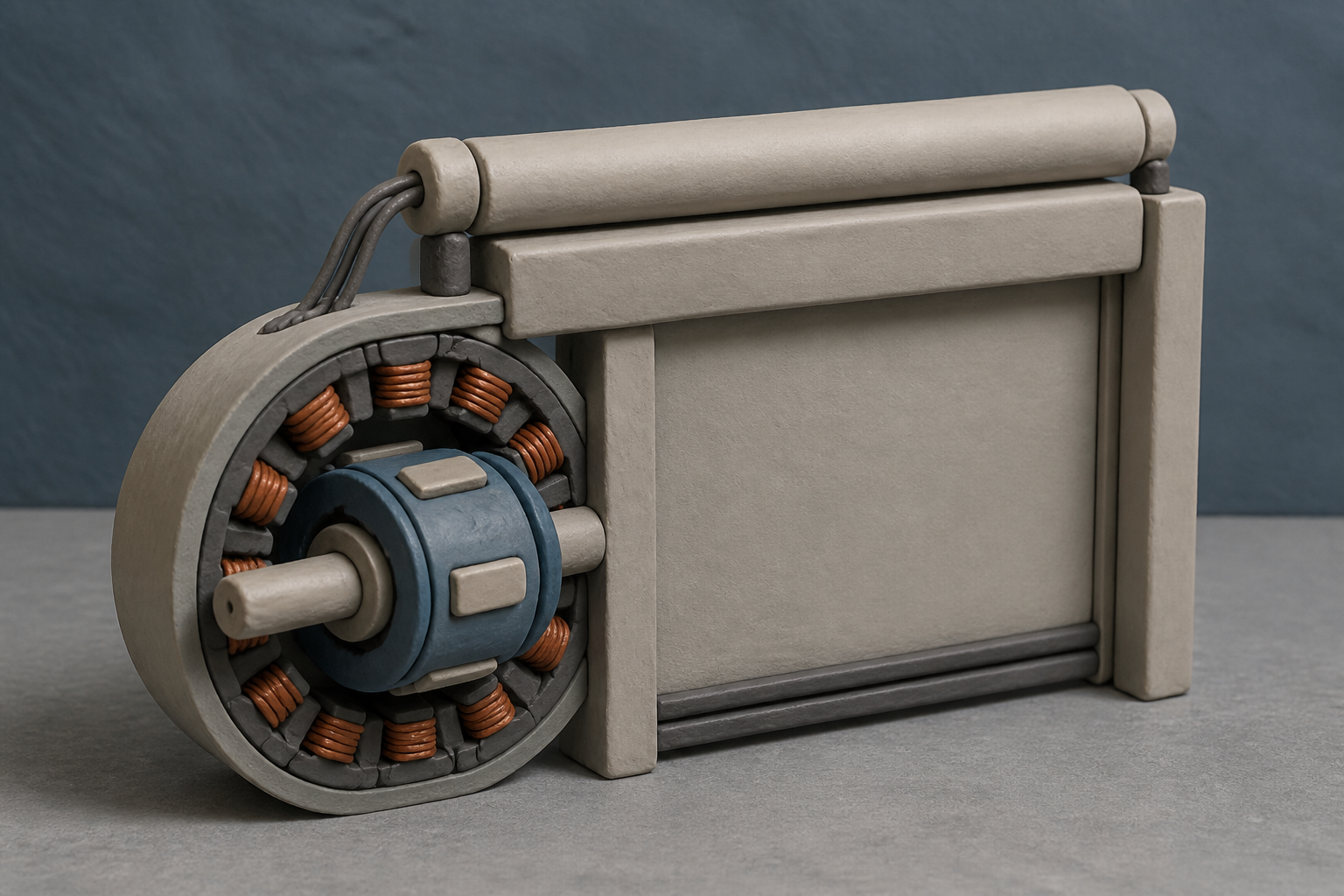
Here, the motor combines magnets embedded in a cylindrical rotating core with a ferrite-based stationary ring, coils carried by its teeth, and a motor control unit. The stationary ring’s outer diameter is under 55 mm.
The 55 mm limit gives a reader a concrete sense of scale. Beyond that size detail and the listed motor parts, what the actuator moves, how it is installed, and what it measures are not stated.
The Moment Between Motor and Control
Ordinary objects make instruction look like motion in one smooth gesture: press, turn, lift, done. This patent complicates that assumption by placing a handoff inside the picture. Not quite. US20260261188A1, published September 3, 2026, describes an electromechanical actuator, a device that joins electrical parts to motion, with a permanent magnet synchronous motor—an electric motor with permanent magnets operating in step with its electrical drive—and a motor control unit, the part that directs the motor. What made me look twice was the pause implied between those companions. Rather than presenting the motor as one finished answer, the published record lets their relationship enter the frame. If familiar routines hide the relay, this one asks you to notice who takes the cue. That narrow question is why ordinary objects can keep excellent poker faces.
That hidden relay needs names before it can be useful. The filing says the permanent magnets are embedded, or set within rather than simply placed on, a cylindrical rotor, the part that turns. It also identifies a ferrite-based stator, a stationary motor part using ferrite, whose teeth carry a winding coil, an electrical coil wound into place. The stator’s outer diameter is under 55 mm. That compact number has the air of a component that asked its clipboard for more room and received a very polite no. The number belongs to the stator, while the magnets, coil, motor, and control unit remain separately named. With those terms settled, the handoff comes into focus without pretending that a technical noun explains itself.
With the vocabulary settled, the mechanism reads less as a blur of hardware than as a set of addresses. The rotor holds the embedded magnets; the ferrite-based stator has teeth carrying the winding coil; and the motor control unit is included with the permanent magnet synchronous motor. In everyday language, those elements do not share one vague address. Each fact places something rather than promising a result. The arrangement is less like a suitcase full of loose responsibilities and more like a stage manager assigning each performer one cue. What I noticed is a disciplined placement of names: magnet location, coil location, stator material, stator size, motor, and control unit. The filing makes those locations legible before it asks the reader to take the arrangement as a whole.
Rotor, Stator, and Control Roles
Because those addresses are distinct, the purpose worth watching is the timing of the handoff. The filing names a motor control unit with the motor, then assigns magnets to the rotor and the winding coil to the stator teeth. It does not spell out a particular sequence of commands. It does give you a clean systems question: when a physical arrangement and a control role meet, which responsibility is named, and where? The division has the air of a committee that finally labelled its folders before the meeting began. One transferable observation follows: a boundary deserves a named owner, even when it is physically small. A second follows: a measurement must stay attached to the component it measures, here the stator’s outer diameter, rather than floating off as a general badge of smallness. Keep the control role visible, and keep dimensions loyal to their specified part.
Once purpose is held to that scale of attention, the comparison becomes modest. An ordinary picture of a motor can blur control, moving part, stationary part, magnets, and coil into one neat noun. This filing makes a specific revision: it names the motor control unit with the permanent magnet synchronous motor, locates magnets within the cylindrical rotor, and describes a ferrite-based stator under 55 mm whose teeth carry the winding coil. The arrangement is more like revising a handoff form than announcing a brass-band overhaul. The contrast stays where the published record keeps it: named elements, stated material, stated magnet placement, coil-bearing teeth, and an outer-diameter figure. It is a modest correction to treating the motor as the whole story.
A Modest Motor Comparison
That restraint leads to the takeaway. You can let ordinary objects retain their mystery, but you need not let them hide every transfer of responsibility behind a single broad label. The patent leaves you with a small, durable challenge: when motion, control, material, and dimension appear together, look for the moment one role passes the cue to the next. The question does not demand that you predict what the actuator will do; it asks you to notice what the filing bothers to separate. I think that question travels well, from a compact motor arrangement to any everyday system that treats a handoff as invisible. Do not let a precise detail swell into a story about everything around it. The old default is to call it a motor and move on. Let the handoff earn its place.
The record, briefly. US20260261188A1, “Electromagnetic Actuator Comprising A Compact And Silent Synchronous Motor With Embedded Permanent Magnets” An electromechanical actuator includes a permanent magnet synchronous motor and motor control unit, with magnets embedded in a cylindrical rotor and a ferrite-based stator under 55 mm in outer diameter having teeth carrying a winding coil.
More angles on this
- CPC H02K: Dynamo-electric machinesThe official classification family this record was filed into, published in the USPTO Cooperative Patent Classification scheme.
- CPC E06B: Fixed or movable closures for openings in buildingsThe official classification family this record was filed into, published in the USPTO Cooperative Patent Classification scheme.
- When an Energy Bin Stops Short and Alignment Starts SpeakingAnother reading from the wider H01M classification family.
- Pores After Coating: The Boundary That Carries the Last ChangeAnother reading in the same Machines category on this site.
Read around this one:Public patent recordUSPTO published figure