Machines
When an Energy Bin Stops Short and Alignment Starts Speaking
System and Key detail are the useful handles: An energy storage apparatus includes at least one energy bin and control bin.

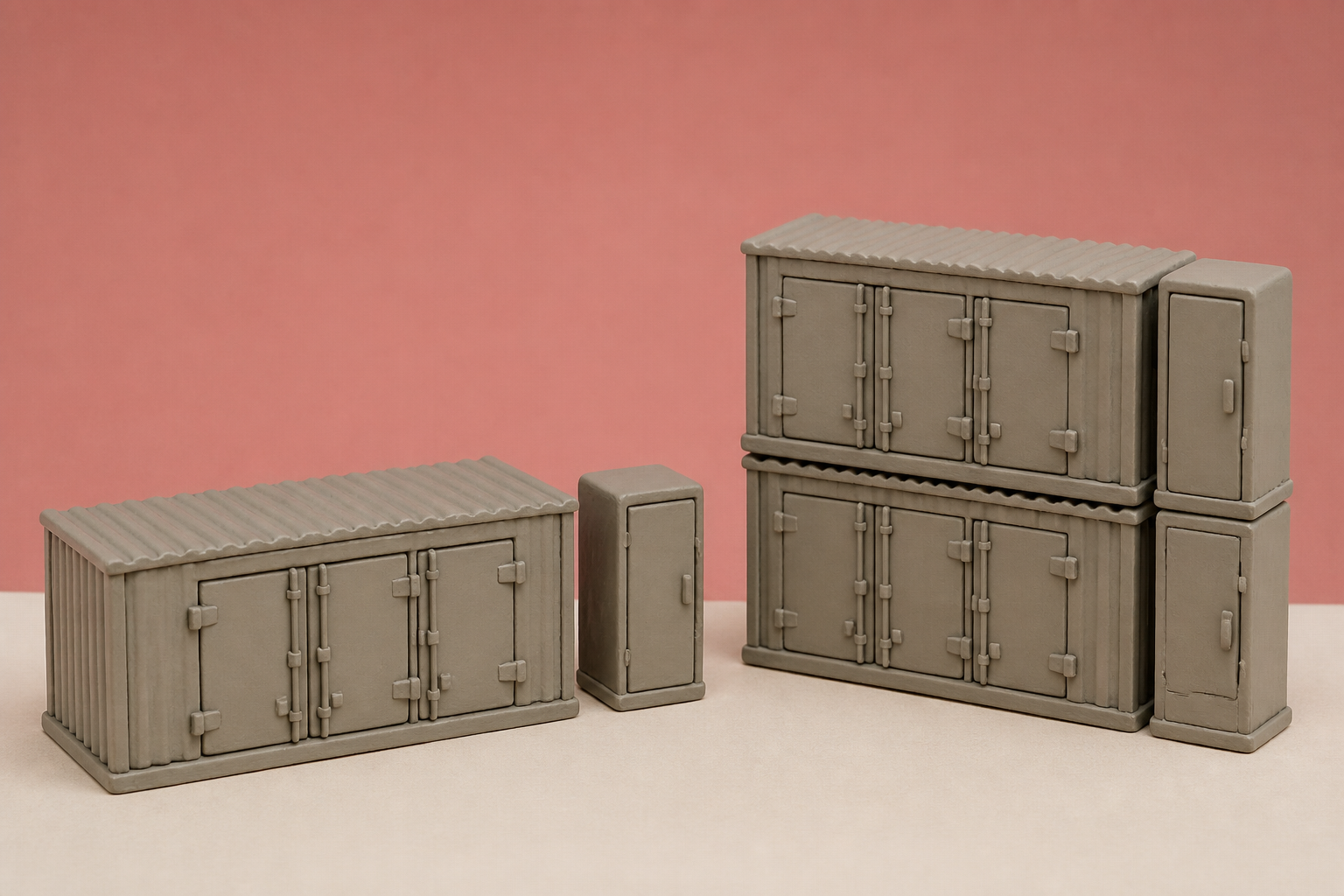
First, the setting
Homes, workplaces, and public services rely on electricity arriving when it is needed. Some power sources change with weather and daily routines, while demand rises and falls as people cook, travel, work, and turn on lights. Storing electricity helps people manage those mismatches and keep essential equipment available when conditions change.
Near a building, a charging area, or electrical equipment behind a fence, a person may see sturdy container-like units connected by cables and safety hardware. Inside, stored-energy equipment and controls work alongside cooling and monitoring systems. A nearby driver, worker, or resident may simply notice charging activity, a quiet service area, or power remaining available during changing conditions.
What changes in this design
A reader might expect the energy unit and the electronics that control it to be together in one container, perhaps one of standard height.
Instead, the energy unit is housed in an energy bin whose body is shorter than a standard container, while a separate control bin contains the module that electrically controls that unit.
That split gives a reader a clear way to recognize the apparatus: the energy unit is in the shorter bin, while control is elsewhere. No storage capacity, charging process, or operating result is stated.
One Shorter Bin, Two Roles
You might assume that, when an energy storage apparatus is first set in place, one full-height container is all the scene requires. The published record complicates that ordinary picture at the moment two bins enter the frame: an energy bin contains an energy unit, while its first bin body has a height less than a standard container's height. Not quite. Instead of treating the bins as merely present, the moment asks the eye to register a departure from a familiar silhouette before it decides why. The detail is small on paper, yet it makes the arrangement feel less like a single object that happens to hold energy and more like a set of parts that must acknowledge different jobs. The arrangement has the air of a restrained committee that moved one chair and then asked everyone to notice the aisle. That is not a claim about what the apparatus achieves; it is the visual question the described proportions invite you to notice.
That initial picture deserves a slower look because the terms do the quiet work. The filing, published as US20260260994A1 on September 3, 2026, calls the first part an energy bin, meaning a bin with a first bin body that contains an energy unit. It specifies only the height relationship placed in view: that energy unit is shorter in height than a standard container. No more has to be assumed. A standard container here is simply the comparison named by the published record, not a universal template you need to import from elsewhere. That restraint matters because exact nouns prevent a reader from turning a bounded description into a vague category of apparatus. By keeping the measurement tied to that comparison, the description turns an apparently bland dimension into a prompt to ask what each bin body is there to accommodate.
With that language in place, the second part stops looking like surplus packaging. The filing calls it a control bin, with a second bin body and a control module, where control module means the component configured to electrically control the energy unit. That division is precise. It is not a general promise about every container system. The published description supplies a role for the control module and a height condition for the energy unit; it does not ask you to supply a story about results beyond them. The value of preserving that separation is clarity, not an implied hierarchy of importance. The control bin has the air of a stage manager's station: it is described with the control module, which the filing says is configured to electrically control the energy unit. The scene now has its essential contrast: an energy bin contains the named energy unit, while the control bin is described with the module configured to electrically control that unit.
Height as a Design Signal
That contrast brings the alignment into focus. The precise statement is that the energy unit's height is less than the height of a standard container. The correction is shorter: height matters here. This is a modest but specific revision of the broad habit of treating a container's outside dimension as background scenery while attention rushes to whatever sits inside it. The filing instead places the size relation beside a distinction in description: an energy bin contains the energy unit, and a control bin is described with a module configured for electrical control. The structure is less like a suitcase selected off a rack and more like a label-maker that insists the size belongs on the tag. That is the difference between a measurement that recedes from attention and one that frames how the parts are understood. Nothing in that contrast establishes a wider outcome, but it gives you a sharper way to look at the arrangement the patent describes.
From there, two transferable observations surface without stretching the facts. When a design depends on a dimensional relationship, say which dimension is doing the work and what it is compared with; 'smaller' alone would leave the reader guessing. The first observation travels to any process where a label, an envelope, or a clearance is specified. And when a system separates roles, name both the housing and the controlling relationship, so the connection is visible rather than implied. The second travels to any arrangement that divides containment from control. The energy bin and control bin offer that bounded lesson in everyday terms: the first contains the energy unit, and the second is described with the module configured to electrically control it. You need not imagine a grand machine to appreciate the discipline. A simple arrangement can be politely insistent, as if the labels arrived before the furniture and declined to leave until every part had a place.
Questioning the Passive Box
That insistence makes me look twice at this September 3 publication. The patent's interest, for an editor, lies in how little it needs to announce: a height below a named standard, a bin for the energy unit, and a bin for the module that electrically controls it. The careful reader's task is not to promote those facts into a verdict. It is to keep them aligned. I think that question is useful precisely because it is small enough to hold onto without pretending to know more than the published material makes clear. The next time an ordinary description makes a container sound like a passive box, ask which measurement has been named, which component it shelters, and which separate part carries control. That is a portable design habit, not a conclusion about this apparatus. Question the default that treats the container as merely a box.
The record, briefly. US20260260994A1, “Energy Storage Apparatus, Energy Storage System, And Charging Network” An energy storage apparatus includes at least one energy bin and control bin. The energy bin has a first bin body containing an energy unit whose height is less than a standard container's height. The control bin has a second bin body and a control module configured to electrically control the energy unit.
More angles on this
- The Small After-Effect of a Bent Signal PinAnother reading from the same H01M classification family, processes or means, e.g. batteries, for the direct conversion of chemical energy into electrical energy.
- Where Structural Battery Assembly Hands Off ForceAnother reading from the same H01M classification family, processes or means, e.g. batteries, for the direct conversion of chemical energy into electrical energy.
- CPC H01M: Processes or means, e.g. batteries, for the direct conversion of chemical energy into electrical energyThe official classification family this record was filed into, published in the USPTO Cooperative Patent Classification scheme.
- A Port, Two Gloves, and the Quiet Work of AlignmentAnother reading from the neighbouring H01J classification family, electric discharge tubes or discharge lamps.
- Pores After Coating: The Boundary That Carries the Last ChangeAnother reading of a record filed by the same applicant, CONTEMPORARY AMPEREX TECHNOLOGY CO..
Read around this one:Public patent recordUSPTO published figure