Field Notes
When a Game Character Crosses Servers, Who Supplies the Rest of the Scene?
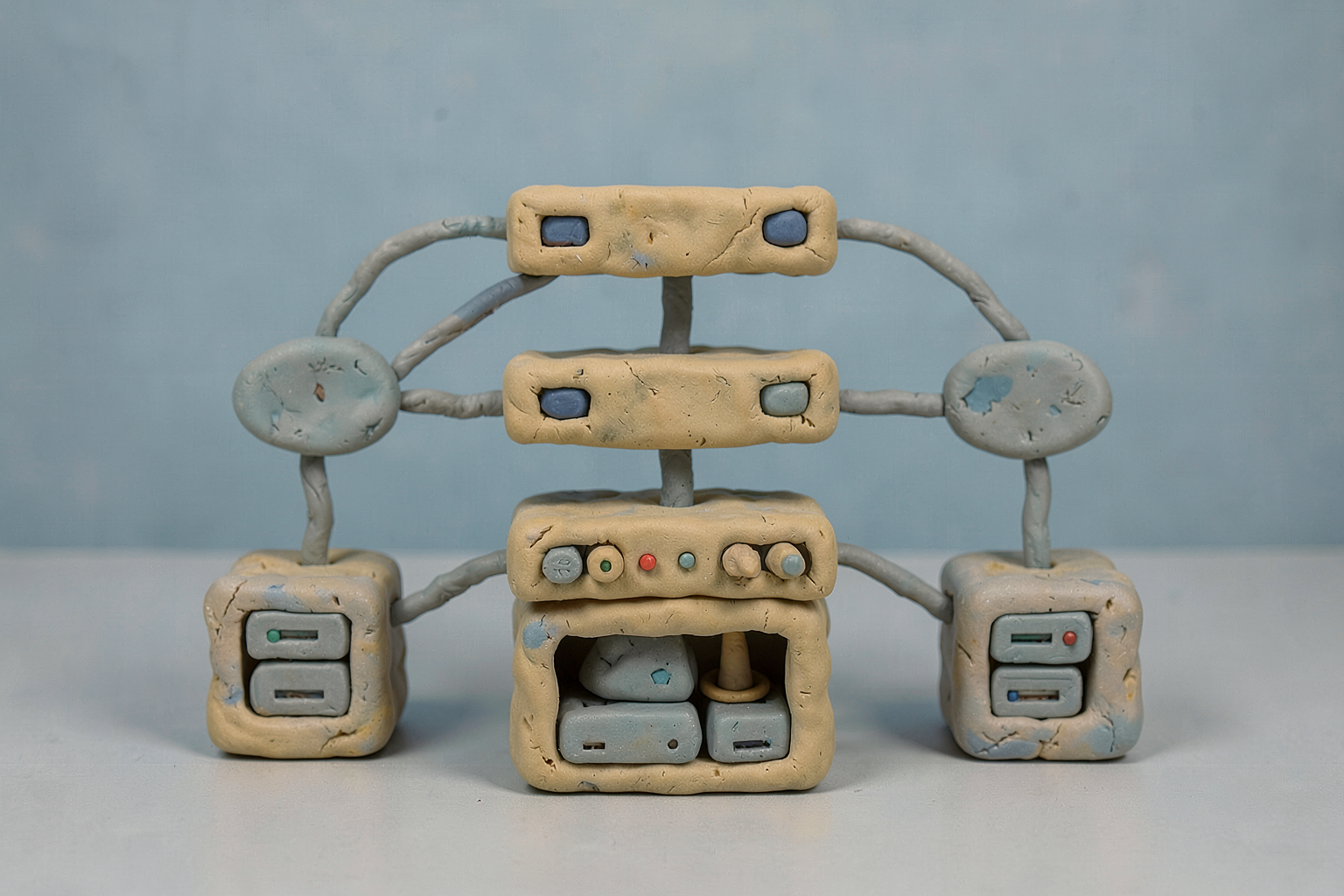
System and Synchronize Data: A multiplayer game system uses game servers that accept player-terminal connections and process player-character operations.

First, the setting
Playing a shared video game can feel like sitting at the same table even when people are elsewhere. Each person expects the on-screen world to respond to their choices and to show what other players are doing, so the experience feels like one shared activity.
Someone holds a controller or taps a phone while a character moves through a digital world. On another screen elsewhere, another player sees that character arrive, turn, or act. Behind the scenes, computers exchange the changing game information that keeps the shared scene moving.
What changes in this design
A reader might assume people who need to see one another's game characters are all connected to the same game server, which handles their character operations and sends relevant information to their terminals.
Here, several game servers communicate to synchronize data. A server can cause terminals connected to another server to display character information it receives, while each server accepts player-terminal connections and processes character operations.
It focuses attention on the behind-the-scenes task of keeping character information visible to players attached to different servers.
Context at the Other Terminal
At a player terminal, a player-character can come into view after character information arrives from a different game server. You might assume the visible character belongs, in every meaningful sense, to the system attached to that screen. That ordinary picture is too neat. Publication US20260263921A1, dated September 10, 2026, sets up a multiplayer arrangement that makes the assumption worth questioning: when a character appears elsewhere, which part of the system supplies the missing context? The question is not legal ownership. Here, ownership means responsibility for the context that makes a visible character intelligible. The question changes the scale of the scene. What looks like one character on one screen becomes a small audit of where information came from and what each server does with it.
That question needs ordinary names before it gets grander than the facts. A player terminal is the endpoint through which a player connects; a game server is the part of this system that accepts those terminal connections and processes operations involving player characters. Synchronization, in this setting, means game servers communicate so data is brought into correspondence. The patent's title is Game System, Method For Distributed Data Processing, And Program For Distributed Data Processing. Its detail is still concrete: a server can be responsible for processing a connection while another server is involved in making received character information visible. The point where a system changes ownership is therefore a handoff of context, not a courtroom transfer. Familiar words can make a divided system sound like a single room with several doors. They are not the same thing here.
With those terms settled, the picture is easier to hold. One game server accepts player-terminal connections and processes player-character operations. Game servers also communicate with one another to synchronize data, and a terminal on another server can display received character information. The arrangement is less like a lone host calling every cue and more like a small stage crew passing a prompt across the wings. That image does not add hidden machinery; it simply keeps the visible moment tied to the sequence the filing describes. Your screen is not the whole scene. The question is not whether the scene feels seamless to a player. The published material gives no basis for that claim. It asks a structural question instead: which server handles which portion of the path to display?
Evidence for a Server Handoff
That picture earns attention only if its evidence stays stacked in the right order. The published patent identifies the publication number, date, and title; its description then supplies the mechanism: servers accept player-terminal connections, process player-character operations, communicate with other servers for data synchronization, and cause terminals on another server to display received character information. Each part limits the next. The terminal display matters because it follows received information; the communication matters because it links the servers; the processing matters because player-character operations occur at a game server. Synchronization has the air of a careful librarian sliding a card to the next desk before the reader looks up. The image is playful, but its discipline is useful: keep the displayed result, the received information, and the server-to-server communication distinct. Reducing the sequence to a general display statement erases the changing roles that carry the point.
That discipline produces a modest but specific revision to the ordinary multiplayer picture. A character on a terminal need not be treated, for purposes of interpreting this filing, as a complete story authored by the server attached to that terminal. The patent supports something narrower: information about that character can be received across game servers and then displayed at a terminal on another server. The displayed character is less like a flag planted by a single server and more like a visible result of information arriving across a boundary. This is not a claim about speed, authority, or superiority. It is a way to notice that processing, synchronization, and display occupy different places in the stated arrangement. That is the modest revision: visibility can depend on a handoff without turning the handoff into a claim that everything else moves with it. The published description is clearer when its pieces remain separate.
A Reader's Ownership Test
That smaller distinction is the reader's field test. I looked twice because it travels well beyond games without pretending this patent answers every systems question. When a distributed system shows you something local, ask what context may have crossed a boundary before the display happened. When separate components share data, ask separately who processed an operation, who communicated the data, and who made it visible. Those are two concrete checks against the habit of collapsing every visible result into one owner. That habit is portable precisely because it asks about roles, not brand names or imagined architecture. The filing keeps the lesson modest: it describes connections, player-character operations, data synchronization, and display across another server, not the whole life of a multiplayer world. Stop treating a displayed character as proof that one place owns its whole story.
The record, briefly. US20260263921A1, “Game System, Method For Distributed Data Processing, And Program For Distributed Data Processing” A multiplayer game system uses game servers that accept player-terminal connections and process player-character operations, communicate with other game servers to synchronize data, and cause terminals on another server to display received character information.
More angles on this
- A Punching Bag Is Not Yet a PromiseAnother reading from the same A63F classification family, card, board, or roulette games.
- A Small Condition Inside the HostAnother reading from the same A63F classification family, card, board, or roulette games.
- CPC A63F: Card, board, or roulette games; indoor games using small moving playing bodies; video games; games not otherwise provided forThe official classification family this record was filed into, published in the USPTO Cooperative Patent Classification scheme.
- When Golf Tape Hands Context to the ReaderAnother reading from the neighbouring A63B classification family, apparatus for physical training, gymnastics, swimming, climbing, or fencing; ball games; training equipment.
- The Signal Inside a Niraparib TabletAnother reading from the wider A61K classification family, preparations for medical, dental or toiletry purposes.
Read around this one:Public patent recordUSPTO published figure