Machines
A Punching Bag Is Not Yet a Promise
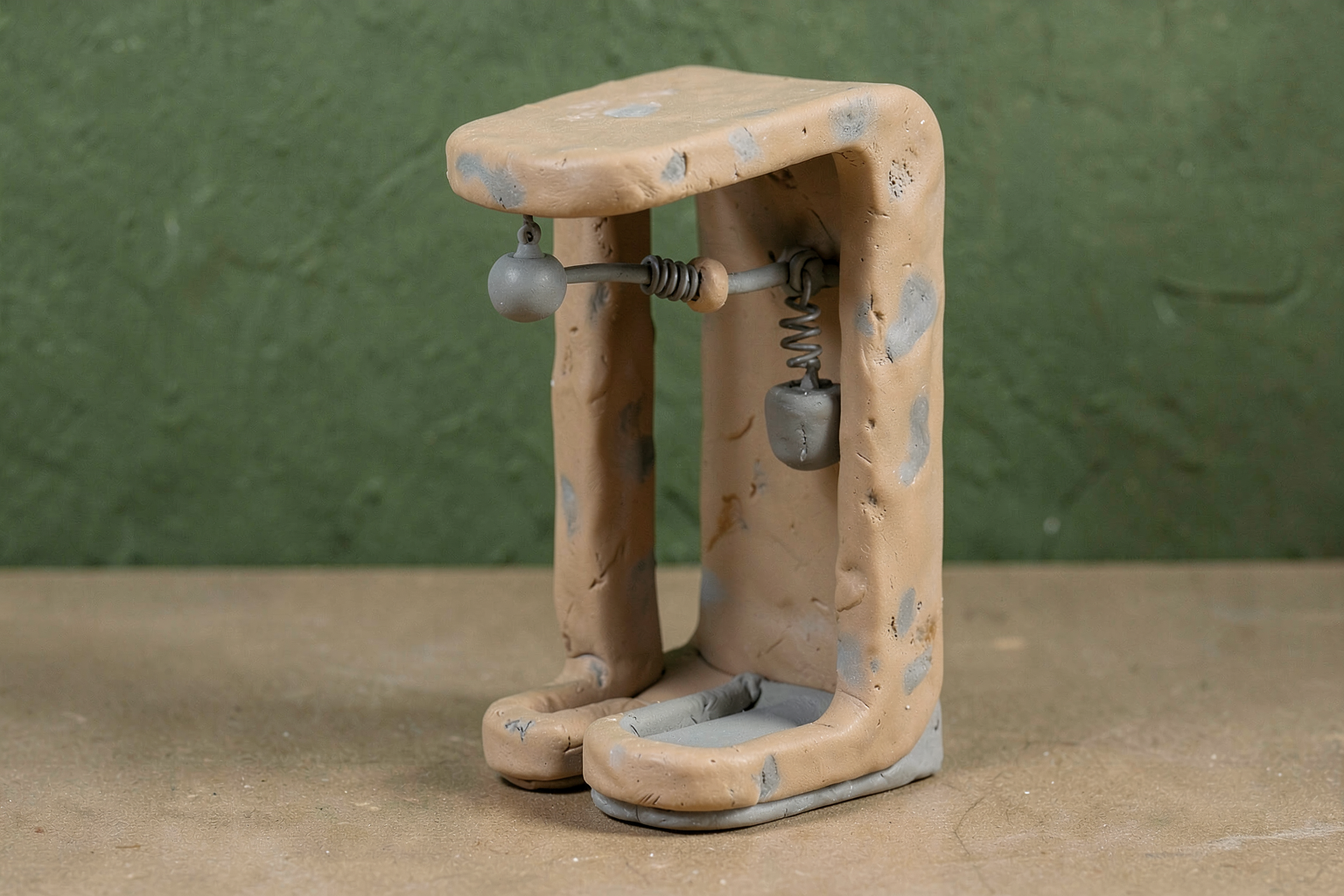
System and Housing form one stated connection: An arcade punching system includes a housing. It keeps the central design choice visible.

First, the setting
Arcades and other shared entertainment spaces give people a quick, physical way to step away from routine. Hitting a padded target can feel energetic and playful, while a screen or nearby crowd turns a simple action into a small moment of competition, curiosity, or celebration.
On a busy arcade floor, a visitor stands before a tall cabinet and swings at a hanging padded bag. The bag moves, parts inside respond, and a display changes after the hit. Friends may watch from beside the machine, waiting for a turn or reacting to the result.
What changes in this design
A reader may picture a simple punching bag: hit it and watch it move. Its result might otherwise be judged by feel or by watching the bag, without several measurements appearing on a screen.
This arcade setup pairs a movable bag with support and retraction mechanisms, a rotating shaft, and an impact-responsive spring. Sensors detect movement or impact, while a controller calculates and displays several punch measurements.
The machine is not only something to punch. It also turns each hit into on-screen numbers. What it measures is identified, but how those values are measured or how accurate they are is not stated.
The Bag's Quiet Script
The obvious headline is an arcade punching bag that reports punch numbers; the more useful question is what the surrounding arrangement does before a number appears. It is easy to assume the bag is the whole event and the housing is simply its address. Not quite. The September 10, 2026 publication of US20260263950A1, titled Immersive Punching Arcade System, describes both a housing and a movable punching bag, so the picture is of a bounded scene rather than a bag left to improvise in open space. That distinction matters because a setting can shape an event without claiming to settle what the event means. The housing is not a verdict; it is part of the frame in which the bag can be moved, noticed, and answered by the game.
That frame leads to the machinery behind the scene. The filing describes support and retraction mechanisms, a rotating shaft, and an impact-responsive spring alongside the bag. These names matter less as a catalog than as a chain: support holds or guides, retraction brings something back, a shaft turns, and the spring responds when impact occurs. A spring that responds to impact is less like a silent cushion and more like a restrained committee taking note of the moment. The exact motion or sequence is not stated in what I read, and it would be a mistake to supply it. Still, the listed parts make the setting feel active: the punch meets a bag, and the equipment has named means of responding around it.
Once the physical response is in view, the language on the screen needs its own inspection. Sensors detect bag movement or impact, and a game controller calculates and displays punch metrics: speed, force, PSI, kinetic energy, and momentum. Speed describes how fast movement occurs; force measures a push or pull; PSI is pressure expressed in pounds per square inch; kinetic energy is energy of motion; momentum relates mass and motion. Those definitions do not turn every reading into a universal account of a punch. They tell you what sort of labels the controller is described as producing. The screen enters after the sensing chain, not as a floating scoreboard that somehow knows the plot.
Metrics Need a Stage
That order suggests the purpose worth noticing. The system does not stop at detecting that something happened; its controller calculates and displays several ways of describing that happening. The screen is less like a victory trumpet and more like a label-maker for a passing event. That is a narrower promise than an arcade atmosphere may tempt you to infer. It does not promise what the numbers say about a person, or what any one punch ought to achieve; it presents a system in which movement or impact can be sensed and rendered as named metrics. For you, the everyday systems question is whether feedback belongs only at the end of an experience or whether the environment has already prepared the conditions for it. Here, the patent puts that preparation inside the arrangement.
From there, the contrast is modest but specific. An ordinary view of an arcade punching setup may divide the scene into two jobs: the bag receives the action, then the display announces a result. This application asks you to see a linked arrangement instead, in which housing, bag, support and retraction mechanisms, rotating shaft, impact-responsive spring, sensors, and controller belong to the same route from event to displayed terms. The setting is not merely decoration. It is part of the arrangement. That revision travels well beyond this filing: when a system reports a physical event, keep the event, the responsive mechanism, and the feedback legible as one sequence; when it uses technical labels, define them before asking readers to trust the display. A metric without a visible path has the air of a librarian asked to shelve a book with no title.
Promises Beyond the Score
That is why the difference between a setting and a promise deserves your attention. A setting gives an event shape: here, the listed physical elements establish a movable bag with mechanisms that respond around impact or motion. A promise is smaller and stricter: the described system senses bag movement or impact and displays calculations named speed, force, PSI, kinetic energy, and momentum. What makes me look twice is the restraint required by that split. The patent does not need the bag to become a grand oracle, complete with a brass band and a clipboard, for the design question to be useful. It asks for a better default whenever you encounter a responsive display: look for the hinge between what is staged and what is actually being said. Stop treating the setting as scenery.
The record, briefly. US20260263950A1, “Immersive Punching Arcade System” An arcade punching system includes a housing, movable punching bag, support and retraction mechanisms, a rotating shaft and impact-responsive spring. Sensors detect bag movement or impact, and a game controller calculates and displays punch metrics including speed, force, PSI, kinetic energy, and momentum.
More angles on this
- The Signal Behind a Disappearing Lottery CodeAnother reading from the same A63F classification family, card, board, or roulette games.
- The Quiet Boundary Between a Tabletop Game and Its MemoryAnother reading from the same A63F classification family, card, board, or roulette games.
- CPC A63F: Card, board, or roulette games; indoor games using small moving playing bodies; video games; games not otherwise provided forThe official classification family this record was filed into, published in the USPTO Cooperative Patent Classification scheme.
- A Weightlifting Machine’s Setting Is Not Yet a PromiseAnother reading from the neighbouring A63B classification family, apparatus for physical training, gymnastics, swimming, climbing, or fencing; ball games; training equipment.
- Fire Retardant That Holds Still: A Thixotropic Binder at the Edge of Water and LeafAnother reading from the wider A62D classification family, chemical means for extinguishing fires or for combating or protecting against harmful chemical agents.
Read around this one:Public patent recordUSPTO published figure