Objects
The Quiet Boundary Between a Tabletop Game and Its Memory
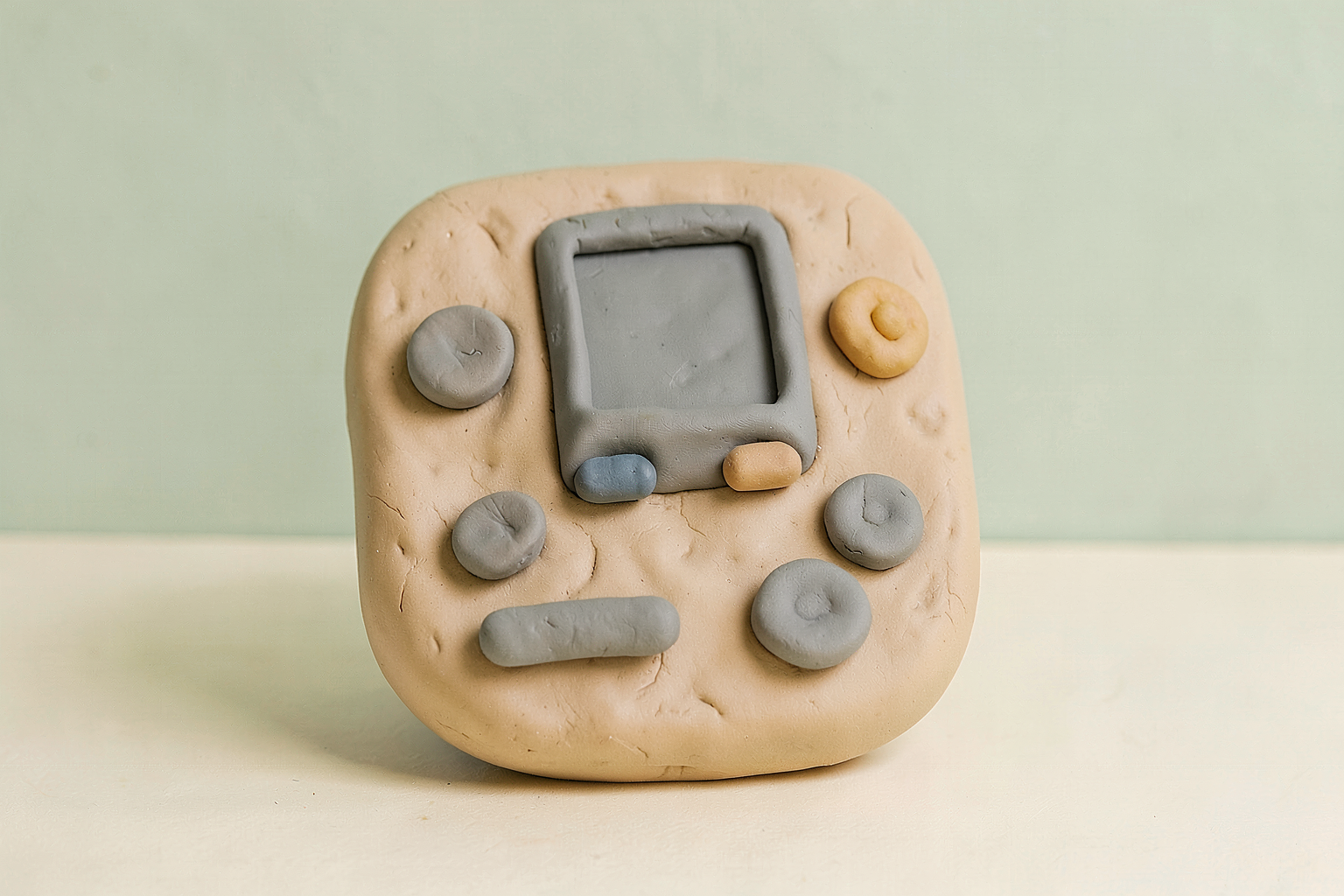
Memory Selection Interface and Value Selection Input form one stated connection: A tabletop game progress monitoring system includes a housing with an output display.

First, the setting
Tabletop games bring people together around shared rules, pieces, cards, and friendly decisions. As play unfolds, people often need to remember changing scores, turns, or other parts of the game so they can stay focused on the table and the people around it.
A small electronic tracker sits beside a game board while players handle cards and move pieces. Someone presses its controls between turns, and its display changes where everyone at the table can see it. It may be passed around or remain near the person keeping track.
What changes in this design
A reader may expect game progress values to be written down, remembered, or entered again after a device has been turned off.
This system puts a display, controls for choosing values and saved memory, a processor, and power-retaining storage in one tabletop housing.
It clarifies that the device is meant to preserve updated game values through a power-off period, not merely display a temporary change.
Where Progress Lands
Picture a tabletop game paused between turns: you reach toward a housing, and its output display holds a value for reference at the table. The practical question is not whether a game can have a number, but where that number goes after someone changes it and before the table needs it again. Is the result only shown for the moment, or does it have a place to remain once attention moves elsewhere? Published on September 10, 2026, as US20260263904A1, Tabletop Game Progress Monitoring System frames that familiar pause with user input on one side, an updated value on the display, and stored values behind them. The display has the air of a restrained committee chair, keeping the current value visible without demanding a speech.
Inputs, Display, and Memory
That picture needs a few ordinary definitions before it needs any grand language. In this published filing, a value is the information the system stores and updates; the available details do not identify it as necessarily a score, a timer, or another particular game measure. That restraint is useful because the arrangement concerns maintaining values without asking you to pretend that every table tracks the same thing. An output display is the part that presents an updated value for people to see. A memory selection interface is the part named for selecting memory, while nonvolatile storage means memory that retains stored values after power is switched off. Value controls and a value selection input are also named in the arrangement, establishing that people have a way to provide the input on which updates depend.
With those terms settled, the mechanism stays reassuringly short, and its order deserves attention. A processor - the component that performs the described updating - changes stored values based on user input and presents updated values through the output display. The factual arrangement therefore links three jobs: a person supplies input, stored information is updated, and the updated information is presented. The processor is less like a commentator and more like a stage manager, receiving the input, updating the stored value, and returning the revised value to the display. Nothing in the published information specifies what kind of value is selected or how the controls look, so the point here is not to invent a fuller device. It is to notice that nonvolatile storage retains the stored values after power is off.
That link between selection and persistence clarifies the boundary worth watching. An ordinary vague handoff can leave a person to change a value, a display to catch up somehow, and later continuity as an unasked question. Against that vague handoff, the filing describes a clearer alternative: value controls, a value selection input, a memory selection interface, a processor, an output display, and nonvolatile storage are each part of the arrangement. What made me look twice was not a promise of a more dramatic game, which the published material does not make, but the effort to keep the passage intelligible. The persistence has the air of a librarian who stays at the desk after the lights go out. In that modest image, a changed value is not merely announced; stored values remain after power off. The contrast is bounded, but it makes the responsibility for retaining progress easier to see.
The Handoff Worth Noticing
Because that responsibility is explicit, the arrangement offers a design lesson beyond the particular tabletop setting without pretending to settle every design question. One transferable observation is concrete: when people coordinate around changing information, the passage from input to visible result should be intelligible enough that the group does not have to supply its own invisible bridge. Another is equally concrete: deciding what remains after power off is a separate task from presenting what has changed now. I think those observations matter because they direct attention to a handoff and a retained value, rather than to decorative certainty around the object. The filing's arrangement is a small workbench lamp, aimed at the place where a choice becomes a displayed and stored result. It does not illuminate every detail, but it keeps the essential join from disappearing into the table.
That lamp leaves one bounded reason for attention: progress monitoring is not only about having values, but about managing the passage between a person's action, the visible update, and the stored continuation. The point is modest. No claim needs to be made about what any game ought to track for the distinction to be useful. The published arrangement simply makes its boundary available for consideration: input affects stored values, updated values are presented, and stored values persist after power off. When you next look at a shared display and its controls, ask whether you can point to the moment the choice becomes both visible and retained after power off.
The record, briefly. US20260263904A1, “Tabletop Game Progress Monitoring System” A tabletop game progress monitoring system includes a housing with an output display, value controls, memory selection interface, and value selection input. A processor updates stored values based on user input and presents updated values; values persist in nonvolatile storage after power off.
More angles on this
- When a Rounded Base Takes the HandoffAnother reading from the same A63F classification family, card, board, or roulette games.
- When the Board Carries the MoveAnother reading from the same A63F classification family, card, board, or roulette games.
- CPC A63F: Card, board, or roulette games; indoor games using small moving playing bodies; video games; games not otherwise provided forThe official classification family this record was filed into, published in the USPTO Cooperative Patent Classification scheme.
- When Green Measurements Leave Room for JudgmentAnother reading from the neighbouring A63B classification family, apparatus for physical training, gymnastics, swimming, climbing, or fencing; ball games; training equipment.
- The Parallel-Sidewall Condition Inside a Floor NozzleAnother reading from the wider A62C classification family, fire-fighting.
Read around this one:Public patent recordUSPTO published figure