Field Notes
When the Board Carries the Move
A new patent for a self-moving game board arrives after a real chess board proved both the pull and burden of making pieces move.

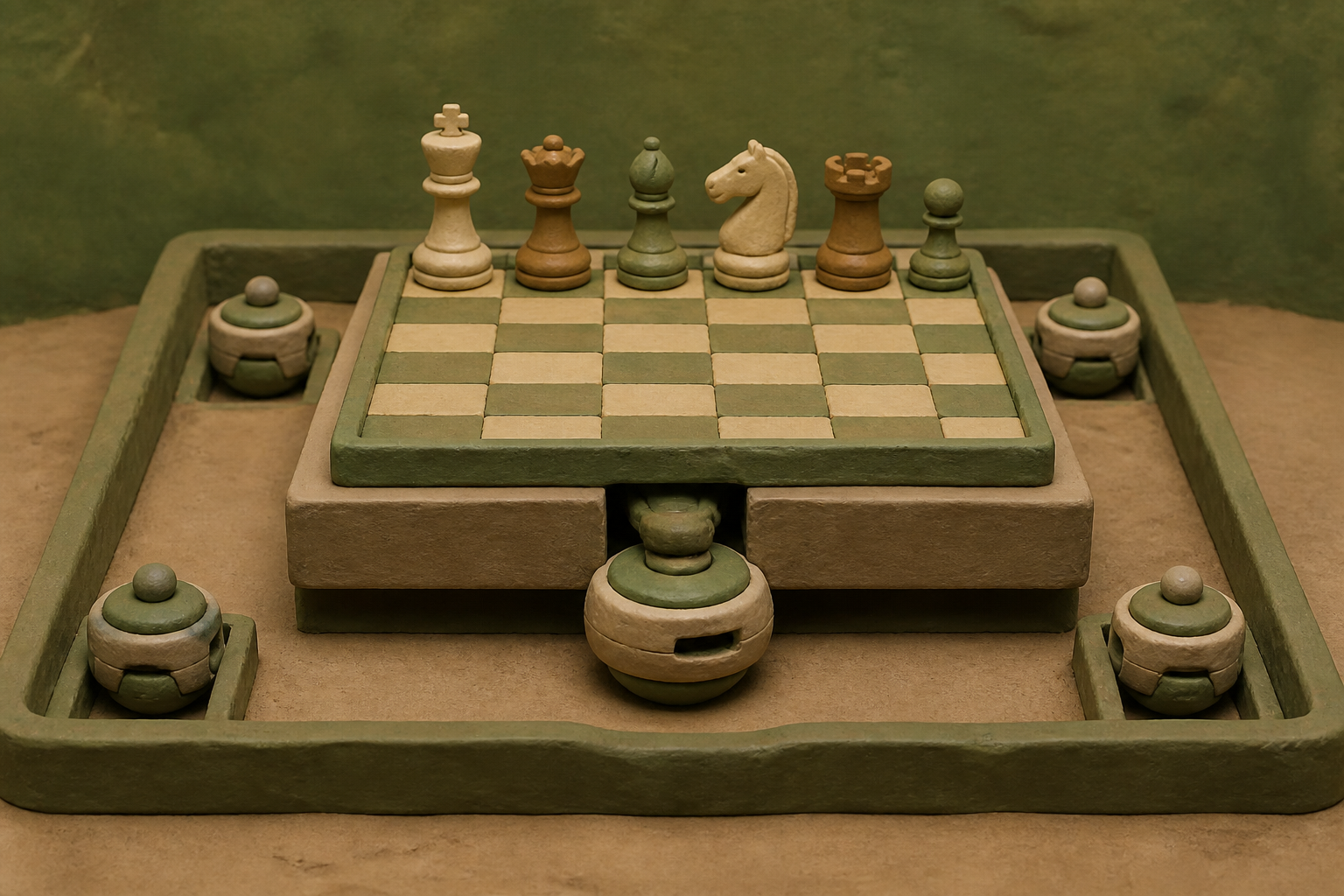
What changes in this design
In a familiar board game, people normally move each piece by hand on the board in front of them. If playing from a distance, a reader might expect the other player’s move to be reported rather than physically shown.
Here, game pieces rest on one side of a platform. One or more robots use an invisible push or pull from the other side to move them, and a remote player may operate the setup. Opposing moves are displayed by rearranging physical objects nearby.
It gives the reader a concrete picture of how remote play and a physical game display are brought together: one side has the pieces, while robots work from the opposite side. The record does not state what game, distance, or controls are involved.
5,500 backers
On October 16, 2020, Square Off's crowdfunding campaign for two self-moving chess boards raised $1 million from more than 5,500 backers in 70-plus countries. The Neo cost $169 and the Swap $229. The number that caught my eye was not the dollar total. It was the crowd willing to pay for a stubborn promise: a move made far away should cause a piece on the table to slide into place.
Square Off had pursued that promise before. After its CES 2017 attention, the startup planned an initial run of 2,000 boards, priced at $250 to $300 and made in Shenzhen. Its older board later added video calling for remote games, alongside 20 solo difficulty levels and online challenges. A physical board asks us to care about more than magnetic force. It has to travel well, stay aligned, communicate with software, and keep working after the novelty of its first moving pawn has passed.
The board stays physical
US20260257126A1 enters that already-lived story. It describes a platform with movable game objects on one side and one or more robots applying magnetic force from the other. A player can operate the system remotely, while an opposing move is represented by the rearrangement of nearby physical objects.
That is a modest but important choice. The filing is not proposing a screen that resembles a board. It keeps the board as the interface and treats the movement of pieces as the message. Reading the filing after Square Off, I don't take the mechanism beneath the board as the hard part. The difficult question is whether the physical result remains valuable when everything required to produce it has to be maintained.
After the acquisition
In October 2022, a robotics toymaker acquired a 70 percent stake in Square Off and publicly targeted more than $100 million in combined 2023 revenue and 10 million homes. At that point, Square Off had four products in more than 50 countries and partnerships offering access to more than 100 million online users. Those are real signs that the category got beyond a prototype table at a trade show.
Then comes the less tidy record. Owners posting in a Chess.com forum describe minimal support after the acquisition, moves that fail to register, pieces disappearing from the app, and promised updates that did not arrive. I can't turn a forum thread into a market measurement, and neither should you. Still, the complaints identify the weak point I would worry about most: a remote physical board depends on hardware, magnets, software, accounts, and support all holding together.
Magnets and the small-parts cylinder
Sony holds a 2022 patent for a different approach: an electromagnet grid below the board, selectively energized to move pieces while planning paths to avoid collisions. Neither that patent nor this new application proves a consumer product will succeed. Together, though, they show that the basic idea of an invisible magnetic machine moving game pieces is established territory, not a newly discovered trick.
The safety burden is established too. The CPSC reported average annual emergency-department injuries from magnet ingestion of about 2,300 in 2010 through 2013, about 1,300 in 2014 through 2016 under its original magnet rule, and about 2,400 in 2017 through 2021 after a 2016 court ruling vacated that rule. U.S. rules identify a hazardous magnet by a flux index of 50 kG2mm2 or more when it fits the small-parts cylinder; children's toy standards use that threshold, while adult magnet sets have a separate standard. Not every game piece reaches it, and I cannot determine from the published filing description whether any proposed component would.
What the filing is really betting on
The filing is betting that remote play feels meaningfully different when a real object moves in front of you. Thousands of customers have already shown that this can be an attractive proposition, and existing patents show there are several ways to build it. But the category's history also says that the moving piece is only the visible part of the product.
To my reading, the real wager is not on a magnet. It is on long-term care: safe components, reliable motion, durable software, and someone still answering when the board stops behaving. I think that is a reasonable thing to bet on, but it is a much harder promise than making a rook glide across a square.
Sources
Reporting for this piece drew on the published filing and the references below.
- US20260257126A1 - A System For Moving Objects Suitable For A Robotic Board Game
- The Square Off robotic chess board gets a video calling component for remote games
- Square Off - World's Smartest Chess Board Kickstarter aftermath
- Square Off Raises $1 Million via Crowdfunding on Kickstarter & Indiegogo
- Miko Acquires Robotic-Based Chess Game Startup Square Off, Eyes $100 Million Revenue by Next Year
- Miko Expands Consumer Robotics Portfolio With Square Off Acquisition
- Whatever happened to Square Off?
- US11351443B2 - Electromagnetic game board
- New Safety Standard for Small Powerful Magnets Will Save Kids from Life Threatening Ingestions Again
- Magnet Safety Standards and Regulations in the United States: An Overview
The record, briefly. US20260257126A1, “A System For Moving Objects Suitable For A Robotic Board Game” The system moves objects such as game pieces with a platform whose one side contacts movable objects; one or more robots use magnetic force on the other side, and a player may operate it remotely while opposing moves are displayed by rearranging nearby physical objects.
More angles on this
- When a Basketball Court Becomes a MessageAnother reading from the same A63F classification family, card, board, or roulette games.
- CPC A63F: Card, board, or roulette games; indoor games using small moving playing bodies; video games; games not otherwise provided forThe official classification family this record was filed into, published in the USPTO Cooperative Patent Classification scheme.
- A Bat Cavity and the Quiet Work of AlignmentAnother reading from the neighbouring A63B classification family, apparatus for physical training, gymnastics, swimming, climbing, or fencing; ball games; training equipment.
- When a Ramp Turns Containment Into a Checkable SequenceAnother reading from the wider A62C classification family, fire-fighting.
- The Interface Before the PromiseAnother reading in the same Field Notes category on this site.
Read around this one:Public patent recordUSPTO published figure