Field Notes
When a Rounded Base Takes the Handoff
An old marble-and-wobble trick reaches the patent office again, as toy makers face tight prices and a crowded online shelf.

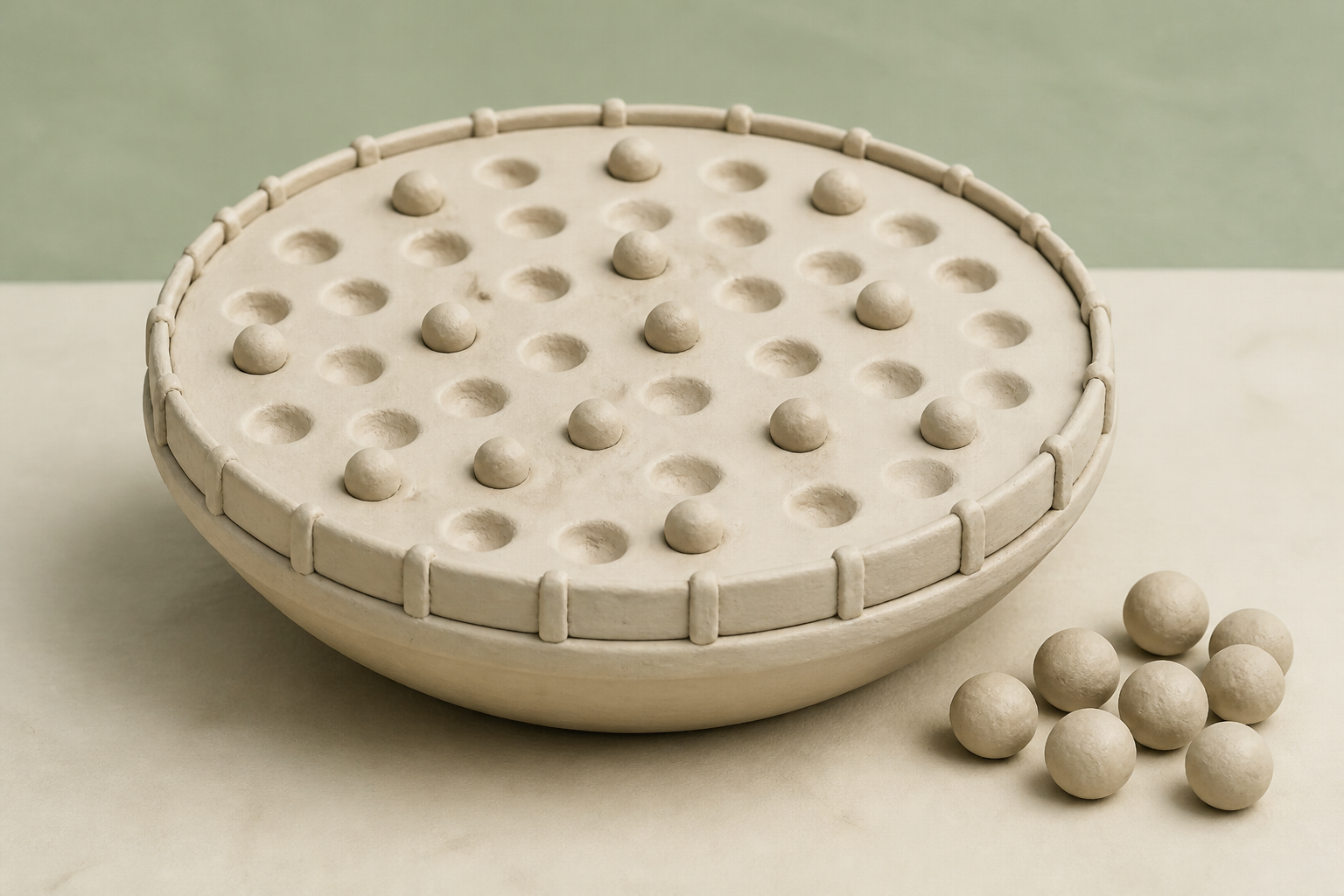
What changes in this design
A reader might expect game pieces to sit on a fixed, level board that does not respond much when one side gets heavier.
Here the pieces sit in indentations on the flat top, while the base has a hemispherical underside. Uneven weight on top lets that base tilt in more than one direction.
The board itself becomes part of the balancing challenge, since where pieces are placed can affect how the surface leans. That helps explain why the base is flat on top and rounded below.
Fifty marbles in a box
Fifty marbles are what the Funwares brand puts in a WobbleBall box, enough loose pieces to make a coffee table feel briefly high-stakes. Players place them in shallow dimples on a board. Uneven weight makes the rounded underside tip, so every new marble changes the problem for the next player.
That familiar tension is why I kept looking at the product behind a newly published patent application. WobbleBall is sold for ages six and up, described as having a tilting base, and marked patent pending. Its maker, UT Brands, filed the application on January 16, 2026, claiming priority to a provisional application filed the previous March.
The product arrives at an awkward moment for this corner of toys. Global toy sales reached $123 billion in 2025, up 8 percent, but the reported growth came from collectibles, licensed goods, and buyers aged 15 and older. A marble-balancing game is not in that winning cluster. It has to earn its place the old-fashioned way: by being easy to understand, cheap enough to buy, and hard enough to put down.
The wobble underneath
US20260257128A1, titled Game System And Pieces, describes spheres or other pieces resting in indentations on a planar top surface. Below it sits a hemispherical bottom that lets the whole base tilt in many directions when weight shifts. The application’s background contrasts the idea with Jenga and KerPlunk, arguing that conventional dexterity games can be cumbersome to carry and unnecessarily heavy.
The version I can identify is not a paper exercise. It is an attempt to connect a retail product to a legal asset, which is a sensible thing for a small novelty-goods seller to try. With the product already on a shelf, I find the filing more interesting as commercial positioning than as a claim to have discovered an unfamiliar physical principle.
Its eventual claims, rather than the broad description, would decide whether there is a protectable construction here. A patent can sometimes cover a particular arrangement even when its broad mechanic is old. I cannot resolve that question from the high-level published description alone, and neither should a reader mistake a publication for a granted right.
A 1998 token game
The core motion has a conspicuous predecessor. In 1998, Mattel filed a patent for a multiple-tier token balance game with an upper surface and a convex lower surface. Tokens placed unevenly made the base tilt. It was granted in 1999 and has since expired, but its description sounds uncomfortably close to the basic action WobbleBall depends on.
A second patent, filed the same year for balance-training equipment, claimed a substantially hemispherical base that pivots in multiple directions. That device was not a toy, yet it confirms how old the hemisphere-and-tilt mechanism is across product categories.
The historical parallel I found reaches still further back. Brio’s Labyrinth, a Swedish marble maze introduced in 1946, built its challenge around controlling a marble through a tilting board. The history makes me reluctant to treat wobble plus marbles as the invention. What may be new is only the particular package of dimples, pieces, proportions, and presentation.
The price of plastic
That distinction matters because price pressure is unusually direct for a game made from molded plastic parts and many loose spheres. A February report on the U.S. toy trade said that more than 85 percent of toys are imported and average toy tariffs run around 20 percent, with some importers facing about 25 percent. One cited toy moved from $29.99 to $39.99 at retail.
A game cannot easily absorb that kind of increase by becoming more elaborate. The patent application itself stresses portability and lighter materials, but shipping, tariff exposure, packaging, and safety compliance still remain. The pressure is what I think gives even a modest construction patent some value: it may help a seller defend a recognizable version of a game when cutting price is difficult.
Loose marbles bring a separate obligation. Federal small-parts rules prohibit them in products intended for children under three, and marble-containing toys require choking-hazard warnings. WobbleBall’s six-plus age label keeps it outside the under-three category, but these are facts I would expect any maker of such a game to build into its packaging and product decisions from the start.
The part worth watching
The patent is not evidence that the old balancing-game idea has suddenly become scarce. Mattel’s expired token game, the balance-board patent, and decades of marble mazes point the other way. The broad physical premise has been available for a long time.
What this application may reveal is a tougher business calculation. UT Brands has a real product tied to the priority filing, in a market where the fashionable money is moving toward collectibles and licensed properties, while import costs make an inexpensive tabletop game harder to price. The filing gives the company a chance to define what, if anything, is distinct about its own construction.
I do not see a grand invention in a board that wobbles under marbles. I see a company trying to make a small, understandable game hold its ground in an unforgiving retail category. Whether the application earns a patent will depend on details beyond the old physics. Whether the game earns attention will depend on the much simpler question the patent cannot answer: does one more marble feel worth placing?
Sources
Reporting for this piece drew on the published filing and the references below.
- Game System and Pieces - US20260257128A1
- US5954340A - Multiple Tier Token Balance Game
- US6019712A - Dynamic Variable Resistance Balance Board
- Labyrinth (marble game)
- KerPlunk
- Global Toy Market Hits $123B as Play Expands Across Ages and Markets
- Feature: Tariff hikes continue to bite into U.S. toy industry, consumers
- Small Parts for Toys and Children's Products
- Funwares WobbleBall Marble Balance Game
The record, briefly. US20260257128A1, “Game System And Pieces” A balancing game includes spheres or other game pieces and a base whose planar top has indentations to receive and cradle the pieces. The base also has a hemispherical bottom that enables multidirectional tilting when weight is unevenly distributed on the top surface.
More angles on this
- When a Basketball Court Becomes a MessageAnother reading from the same A63F classification family, card, board, or roulette games.
- CPC A63F: Card, board, or roulette games; indoor games using small moving playing bodies; video games; games not otherwise provided forThe official classification family this record was filed into, published in the USPTO Cooperative Patent Classification scheme.
- Golf Swing Evidence, Carried by a WearableAnother reading from the neighbouring A63B classification family, apparatus for physical training, gymnastics, swimming, climbing, or fencing; ball games; training equipment.
- Method For Treating Cancer By Anti-B7H3 Antibody-Drug Conjugate Makes a Small Case for Better TimingAnother reading from the wider A61K classification family, preparations for medical, dental or toiletry purposes.
- The Interface Before the PromiseAnother reading in the same Field Notes category on this site.
Read around this one:Public patent recordUSPTO published figure