Machines
Golf Swing Evidence, Carried by a Wearable
Wearable Device and Sensor form one stated connection: A system analyzes a golf swing using a wearable device's IMU sensor.

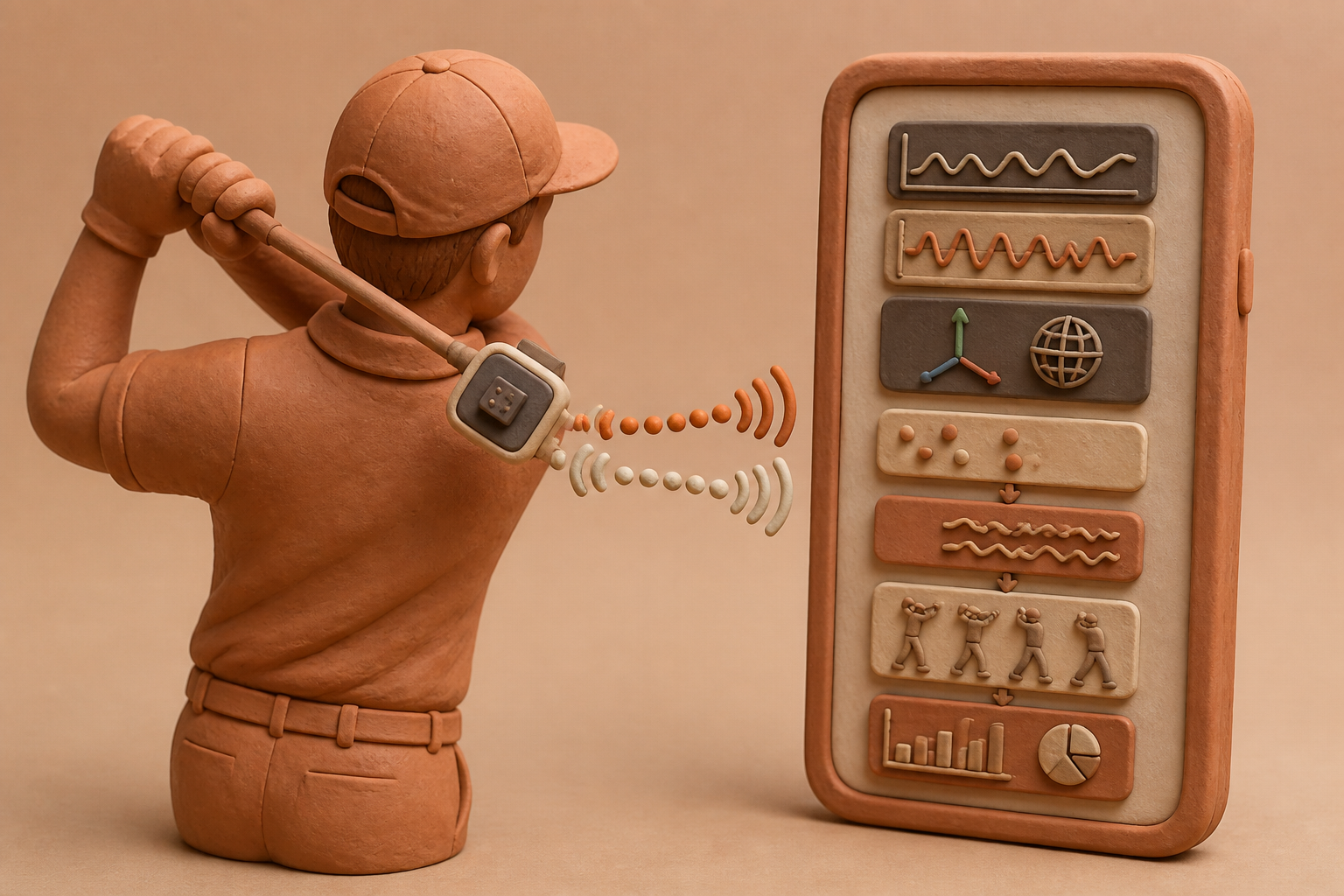
First, the setting
Golf is a sport where a small change in posture, balance, or timing can alter where the ball goes. Players often practice at driving ranges, courses, and indoor training spaces because repeating a swing can help them notice how their body moves.
At a practice mat or on a course, a player wears a small device on the body while lifting a club and swinging through the ball. The device contains a motion sensor, a part that notices movement. A nearby screen or phone may show the path of the motion afterward.
What changes in this design
The record does not state how golf swing analysis is ordinarily done, what equipment it commonly uses, or whether results are reviewed later.
It identifies a wearable device's IMU sensor as part of the system. That sensor is used to recognize and technically analyze various golf swings with low delay.
For a golfer, the practical point is that swing information comes from something worn during the activity. Exactly what the analysis reports, how it is presented, and how accurately it works are not stated.
Wearable Evidence at Swing Time
What I noticed first was a simple sequence: a wearable device sits beside the golf swing so the system has motion information to inspect. You can picture a golfer beginning a swing while the device's IMU sensor, a motion-sensing component, registers movement before the action has faded into recollection. The patent frames that scene around high-efficiency operation recognition, or identifying the sensed swing-related operation, and technical analysis, or examining the swing through sensor information, with low delay.
That sequence made me look twice because the filing does not present sensing as the destination. Published September 3, 2026 as US20260257119A1, System And Method For Analyzing Golf Swing Using Wearable Device describes a system that analyzes a golf swing using the wearable device's IMU sensor. The arrangement feels less like a wearable issuing orders and more like a quiet stage manager preparing the next cue. For you, the point worth inspecting is the order of events: motion information is gathered and examined close to the swing rather than treated only as an afterthought.
IMU Signals and the Burden
That order needs a little more attention because technical labels can make a simple arrangement seem sealed away. The IMU sensor has the air of a small librarian, attending to movement while the larger system does the reading. Yet the filing gives it a limited role: it is the sensor the system uses to analyze a golf swing. What the published record supports is that arrangement and its stated emphasis on efficient recognition, technical analysis of various golf swings, and low delay.
With the role set out, the described mechanism stays admirably narrow: the system uses the wearable device's IMU sensor to analyze a golf swing and provide the stated recognition and analysis. The sequence is less like a quiz after the fact and more like a label-maker working while the moment is still in view. That wording establishes the intended arrangement and its stated qualities, but it does not tell you how any particular swing would be judged or what result an individual would receive.
That boundary changes who carries the burden. A broad version of golf-swing analysis can leave a person to reconstruct a movement after it happens; this filing instead puts a wearable IMU sensor at the center of the system's evidence for recognition and technical analysis. Low delay has the air of a restrained committee, keeping the analysis from being framed as a meeting scheduled for later. One transferable observation is that decisions benefit when relevant evidence stays near the event, while another is to decide plainly whether the person or the system bears the first burden of gathering it.
A Modest Low-Delay Lesson
That is why this published record deserves attention, not as a verdict on golf technology, but as a compact design question with a clear edge. The filing suggests an arrangement in which a wearable sensor helps make the first task less about reconstructing a swing and more about having motion-based evidence ready for examination. I would keep the conclusion there: the patent offers a bounded case for arranging evidence before action, and its value is the clarity of that question rather than any promise beyond the published page.
The record, briefly. US20260257119A1, “System And Method For Analyzing Golf Swing Using Wearable Device” A system analyzes a golf swing using a wearable device's IMU sensor, providing high-efficiency operation recognition and technical analysis of various golf swings with low delay.
More angles on this
- A Bat Cavity and the Quiet Work of AlignmentAnother reading from the same A63B classification family, apparatus for physical training, gymnastics, swimming, climbing, or fencing; ball games; training equipment.
- When a Sensor Racket Hands Context to a ReportAnother reading from the same A63B classification family, apparatus for physical training, gymnastics, swimming, climbing, or fencing; ball games; training equipment.
- CPC A63B: Apparatus for physical training, gymnastics, swimming, climbing, or fencing; ball games; training equipmentThe official classification family this record was filed into, published in the USPTO Cooperative Patent Classification scheme.
- When a Basketball Court Becomes a MessageAnother reading from the neighbouring A63F classification family, card, board, or roulette games.
- When a Ramp Turns Containment Into a Checkable SequenceAnother reading from the wider A62C classification family, fire-fighting.
Read around this one:Public patent recordUSPTO published figure