Machines
When a Sensor Racket Hands Context to a Report
Sensor and Computing Device form one stated connection: An intelligent motion analysis system includes a sensor racket with wireless.

First, the setting
Many people play racket sports for exercise, competition, or time with friends. Learning a swing can take practice because the racket, ball, body position, and timing all move quickly. Players and coaches often watch, repeat motions, and talk through what happened during a shot.
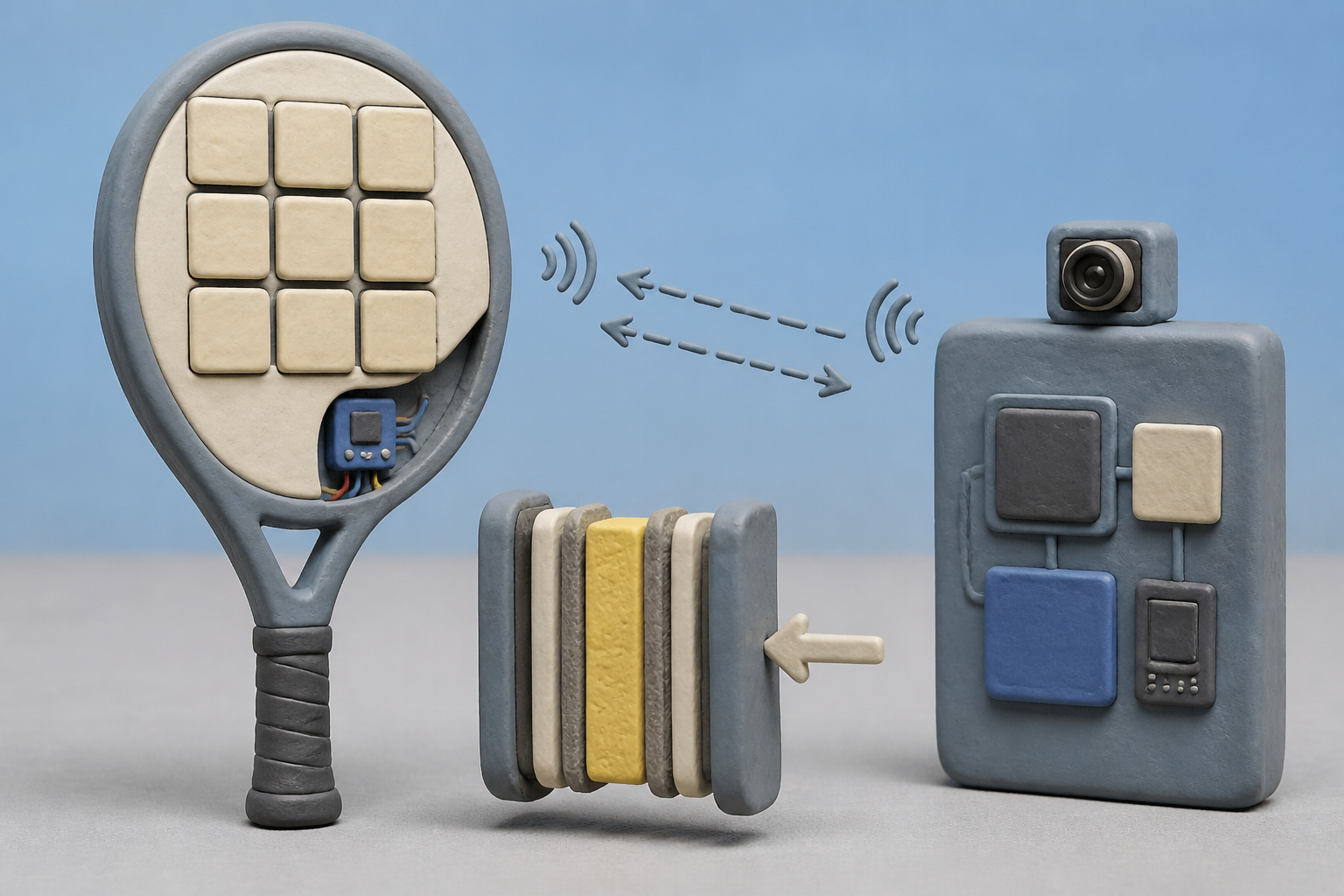
On a court or practice area, a player swings a racket that carries small components in its handle or frame. A nearby phone, tablet, or computer receives signals as the ball is struck. A camera may be aimed at the action while a coach, teammate, or player looks over the captured motion afterward.
What changes in this design
How motion is ordinarily reviewed without this kind of setup is not stated. The record does not give a before-and-after workflow for reviewing racket movement.
Rather than only a racket, this system includes a racket with wireless, pressure-sensing, and accelerometer modules, plus a computing device with a camera, memory, a processor, and wireless communication. The device captures video and generates a motion-event analysis report.
It is worth knowing that the system includes both the racket and a separate camera-equipped device. That makes its parts easier to picture: hardware on the racket, video capture, and a report made by the computing device.
The Racket's Context Hand-Off
At the moment a camera captures video, this reading begins with a cause, an effect, and a next choice: a sensor racket has pressure-sensing and accelerometer modules, the computing device generates a motion-event analysis report, meaning a report about a moment of motion, and you must ask where a motion event changes hands. The patent places these pieces in one intelligent motion analysis system, so the point worth your attention is not merely that there are parts, but which part is asked to turn traces into an account you can inspect. I looked twice because that hand-off makes context a design responsibility rather than a decorative extra.
That responsibility needs ordinary language before it needs lofty language. Pressure sensing means detecting pressure; an accelerometer measures acceleration, or change in speed or direction; and wireless means sending information without a physical cable. The patent assigns pressure-sensing, accelerometer, and wireless modules to the sensor racket, while the computing device includes a processor, wireless transceiver, memory, and camera modules. A processor handles information, a transceiver both sends and receives wireless signals, and memory stores information for later use.
With those terms grounded, picture the narrow scene: the racket bears the listed sensor modules, the camera captures video, and the computing device is the place named for producing the motion-event analysis report. The camera has the air of a quiet stage manager: it captures video while the sensor racket carries its listed modules. It is that placement that makes the ownership question worth holding onto.
How the Report Gets Its Frame
From that picture, the mechanism stays usefully bounded. US20260257113A1, published September 3, 2026, is titled Intelligent Motion Analysis System And Associated Sensor Racket And Intelligent Motion Analysis Method. The filing describes a computing device with processor, wireless transceiver, memory, and camera modules that captures video and generates a motion-event analysis report. The arrangement has the air of a restrained committee: the racket, camera, and computing device each have a seat, while the published record identifies the computing device as the one that generates the report.
A Test for Context Ownership
Once the report-generation point is clear, the contrast is defined rather than guessed. A broad setup of a racket, camera, and computer can leave the question of context open; the described setup gives a defined response: the computing device captures video and generates the motion-event analysis report. It is less like a pile of notes awaiting a verdict and more like a label-maker that marks where interpretive responsibility is placed.
Because that response replaces a guess, your field test becomes practical. When you encounter a system with sensing, recording, and reporting pieces, separate what is observed from what is reported, then locate the component assigned to make the report. The wireless element is less like a brass-band entrance and more like a small cue that connection belongs in the picture. That consequence travels elsewhere: you can look for the point where context is assigned instead of granting every device equal authority.
The record, briefly. US20260257113A1, “Intelligent Motion Analysis System And Associated Sensor Racket And Intelligent Motion Analysis Method” An intelligent motion analysis system includes a sensor racket with wireless, pressure-sensing, and accelerometer modules, and a computing device with processor, wireless transceiver, memory, and camera modules that captures video and generates a motion-event analysis report.
More angles on this
- What an Anchored Exercise Bike Lets You SeeAnother reading from the same A63B classification family, apparatus for physical training, gymnastics, swimming, climbing, or fencing; ball games; training equipment.
- When a Basketball Court Becomes a MessageAnother reading from the same A63B classification family, apparatus for physical training, gymnastics, swimming, climbing, or fencing; ball games; training equipment.
- CPC A63B: Apparatus for physical training, gymnastics, swimming, climbing, or fencing; ball games; training equipmentThe official classification family this record was filed into, published in the USPTO Cooperative Patent Classification scheme.
- An Inflatable Costume Prepares for Lift-OffAnother reading from the neighbouring A63H classification family, toys, e.g. tops, dolls, hoops or building blocks.
- When Pressure Meets Video, the Quiet Work of AlignmentAnother reading of a record filed by the same applicant, VINCENT LEE SMITH II.
Read around this one:Public patent recordUSPTO published figure