Objects
When Pressure Meets Video, the Quiet Work of Alignment
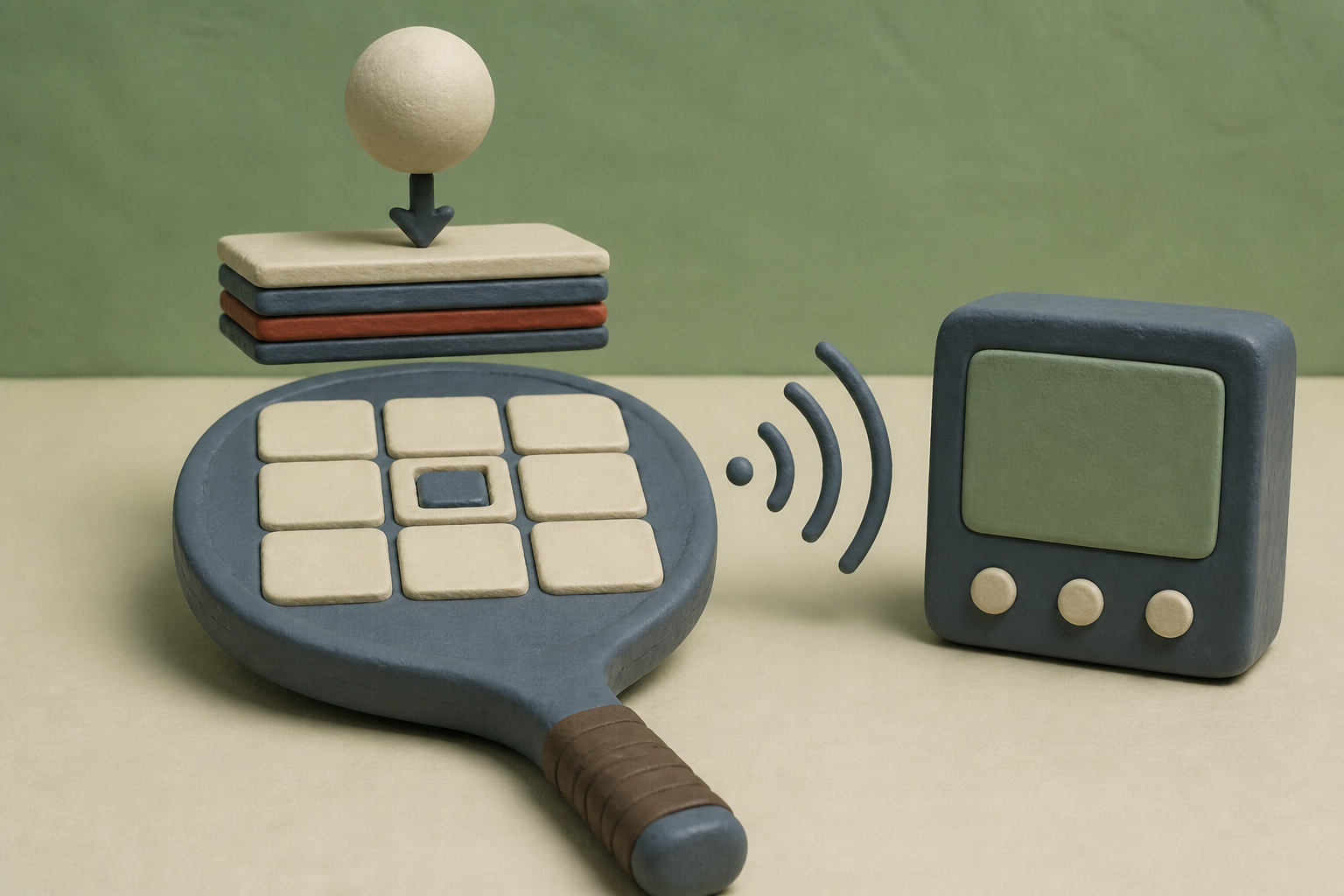
Pressure Sensing Device and Computing Device are the useful handles: An intelligent motion analysis system includes a pressure sensing device and a computing device.

First, the setting
People who exercise, practice a sport, or recover from an injury often want to understand how their bodies move. A coach, therapist, or the person exercising may watch a step, swing, jump, or balance attempt, looking for patterns that are hard to notice in the moment. Careful observation can make training and guidance more informed.
In a training room, clinic, or practice space, someone may stand, walk, jump, or make a sports movement while a small pressure-sensing item rests under a foot or in footwear. A camera records the movement nearby. A coach or clinician later looks at the video alongside information from the item to discuss the motion.
What changes in this design
A reader might expect movement to be viewed only through camera video, or pressure and motion information to be considered separately.
Here, a computing device uses camera video alongside pressure and acceleration signals generated by a sensing device, then generates an operation result and a motion-event analysis report.
It is worth knowing because the record centers on combining visual footage with two kinds of device-generated information. What the operation result contains and how the inputs are combined are not stated.
Signals, Video, and One Question
When pressure and acceleration signals meet camera video, the effect is an operation result and a motion-event analysis report; the next choice is whether their alignment answers the question you actually have. The published record for US20260257104A1, released September 3, 2026, describes an intelligent motion analysis system built around that relationship. Pressure sensing means the device generates pressure signals, while acceleration signals concern acceleration; the filing gives those inputs a place beside camera video. That restraint made me look twice, because attention belongs not to a grand promise but to the handoff between observations.
From there, picture the arrangement at table height: a pressure sensing device generates pressure and acceleration signals, while a computing device uses camera video with those signals. The computing device then generates both an operation result and a motion-event analysis report. That pairing is less like a solo instrument and more like a stage manager quietly cueing two inputs toward the same moment. The practical test begins here: can each input be named, and can you state the shared question that brings them together?
That picture keeps the technical nouns on a short leash. Camera video is the visual sequence, an operation result is one stated output, and a motion-event analysis report is the other stated output concerning a motion event. Camera video has the air of a librarian setting the visible sequence on the table while the signals take their marks beside it. Within the published description, the mechanism is a computing device using camera video, pressure signals, and acceleration signals together to generate those outputs.
Computing Device as the Meeting Point
With those terms settled, the contrast becomes useful. An ordinary account might leave you to choose between what a camera shows and what a sensor produces; this arrangement instead describes a defined response generated from camera video, pressure signals, and acceleration signals. The defined response is less like a guess offered across the room and more like a stage manager's marked cue for what comes next. I think that is the quiet work of alignment: separate observations arrive at one meeting point, and the system produces an operation result and a motion-event analysis report.
A Reusable Alignment Test
That sequence gives the title, Intelligent Motion Analysis System And Associated Pressure Sensing Device, a reason to hold your attention without asking it to promise more than it says. The filing describes a pressure sensing device and a computing device, then gives the latter camera video plus pressure and acceleration signals to use together. The question you can borrow is small and exact: have the parts been arranged to create one defined response, or merely set nearby like folders awaiting a label-maker?
From that question, two observations travel well. Make the meeting point explicit: here, the computing device is where camera video and both signal types are used together. Define the output before admiring the inputs: here, it is an operation result and a motion-event analysis report. The consequence is portable: when you encounter any system assembled from separate evidence, look for the condition that turns those pieces into one answer.
The record, briefly. US20260257104A1, “Intelligent Motion Analysis System And Associated Pressure Sensing Device” An intelligent motion analysis system includes a pressure sensing device and a computing device. The device generates pressure and acceleration signals, while the computing device uses camera video and the signals to generate an operation result and a motion-event analysis report.
More angles on this
- A Flywheel's Answer From Two Moving MembersAnother reading from the same A63B classification family, apparatus for physical training, gymnastics, swimming, climbing, or fencing; ball games; training equipment.
- Ambient Light's Quiet Job in Facial VideoAnother reading from the same G06T classification family, image data processing or generation, in general.
- CPC A63B: Apparatus for physical training, gymnastics, swimming, climbing, or fencing; ball games; training equipmentThe official classification family this record was filed into, published in the USPTO Cooperative Patent Classification scheme.
- CPC G01L: Measuring force, stress, torque, work, mechanical power, mechanical efficiency, or fluid pressureThe official classification family this record was filed into, published in the USPTO Cooperative Patent Classification scheme.
- Timing at the Kilogram-Scale Mushroom HandoffAnother reading from the neighbouring G01N classification family, investigating or analysing materials by determining their chemical or physical properties.
Read around this one:Public patent recordUSPTO published figure