Machines
A Flywheel's Answer From Two Moving Members
Follow Physical Exercise Device alongside Device: An upper body exercise apparatus has a frame body and a physical exercise device with a flywheel.

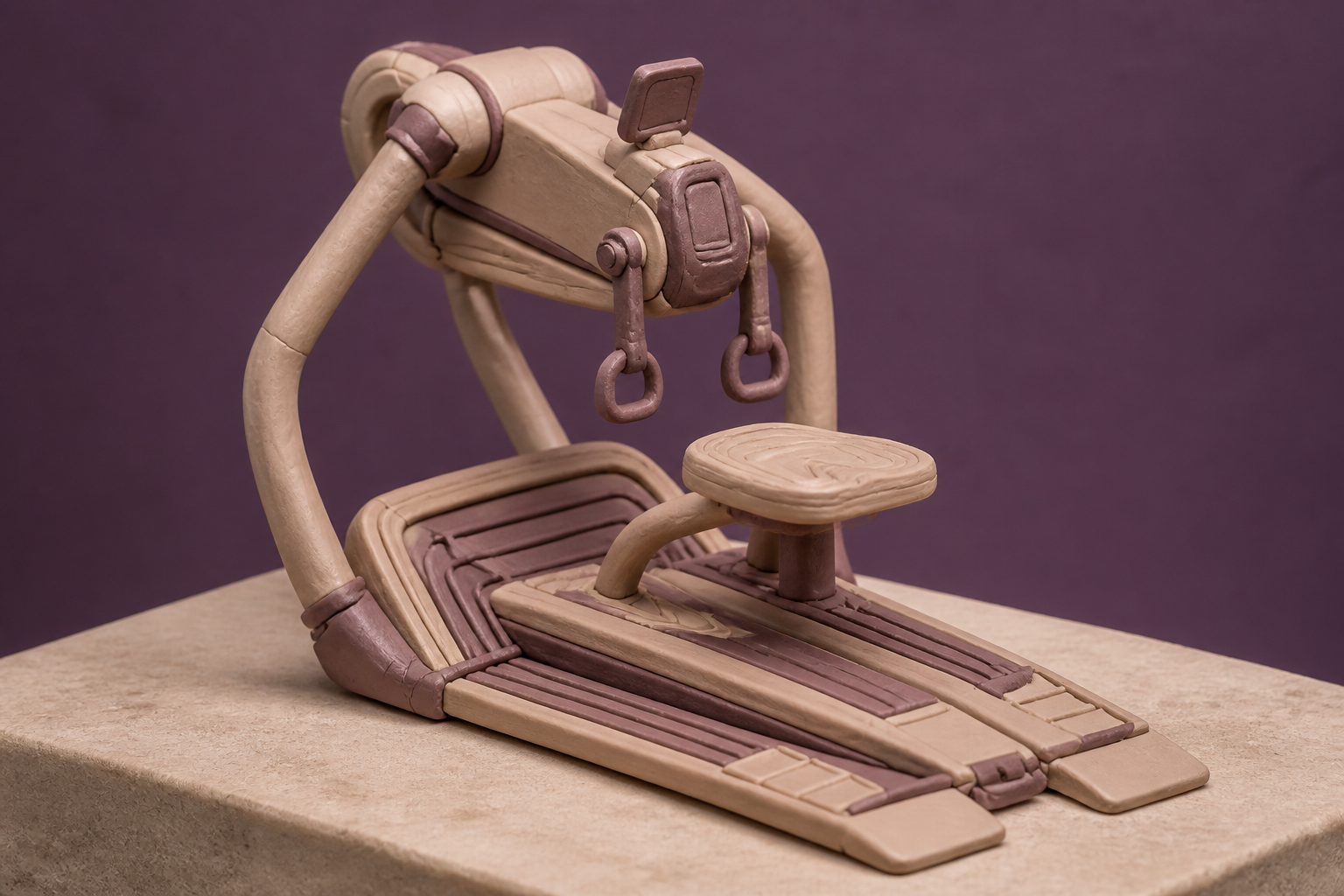
First, the setting
Many people look for ways to stay active when work, weather, or daily routines keep them indoors. Exercise spaces give them room to move, repeat a motion, and focus on how their body feels. Equipment exists because a steady, guided movement can make a workout feel more deliberate and manageable.
In a home workout corner or shared fitness room, someone stands or sits at a sturdy machine and grips its handles. Their arms move through a repeated path while a wheel inside turns and the frame stays planted. Nearby, another person may hear the soft mechanical motion and wait for a turn.
What changes in this design
A reader might expect an exercise machine to have one moving control that turns one wheel in one direction.
Here, the machine has left and right moving members, each with its own mechanism between the member and flywheel. During exercise, each mechanism rotates the flywheel forward or reverse.
That makes the layout easier to picture: movement from both the left and right sides is connected to the same flywheel. What kind of movement the members make is not stated.
Flywheel Direction at the Moment
A left or right moving member connects through its driving mechanism; the flywheel turns forward or reverse during exercise, and the next choice is to follow the stated path rather than guess at it. The scene has the air of a stage manager quietly cueing the flywheel from either side. That is what made me look twice, because the effect is named before the frame body gets asked to mean more than it does.
From that moment, the September 3, 2026 publication, US20260257099A1, calls itself Upper Body Exercise Apparatus. It pairs a frame body with a physical exercise device: a flywheel, meaning the wheel named as rotating; left and right moving members, meaning the two identified parts that move; and left and right driving mechanisms, meaning the mechanisms mounted between a moving member and that flywheel. The stated purpose of each mechanism is to rotate the flywheel forward or reverse during exercise.
With the parts now named, the mechanism becomes the point worth attention: each left or right driving mechanism is placed between its associated moving member and the flywheel. The filing names forward and reverse rotation but does not, in the details given, identify what selects one direction at a given moment. That boundary matters, while the linked placement remains clear. The arrangement is less like a single vague instruction and more like a label-maker keeping left and right connections legible.
Driving Links Set the Sequence
Because the connection is specified before broader interpretation, you can walk the sequence in order: moving member, its driving mechanism, then flywheel rotation forward or reverse. Only the level of description is at issue here: an ordinary shorthand might merely point to a flywheel, while this filing names two moving members and a mechanism between each member and the wheel. That defined response replaces a guess about how each moving member relates to it. The practical test arrives as if a librarian were checking whether each part has a clear place in the sequence.
A Transferable Flywheel Test
That test travels beyond exercise equipment without carrying along any claim about the apparatus itself. When you face an everyday control or system, ask whether each input has a named link to an outcome, then ask whether the outcome is explicit enough to distinguish direction from assumption. A control map with missing links can feel like a committee that forgot to bring the agenda.
From there, the consequence you can use elsewhere is modest but durable: put the cause before the effect, then make the next choice testable by checking the link between them. In US20260257099A1, that chain is a moving member, its driving mechanism, and a flywheel turning forward or reverse; in your own systems question, the transferable observations are the clear handoff and the explicitly named response. The result is less like navigating by a shrug and more like reading a well-labeled sign.
The record, briefly. US20260257099A1, “Upper Body Exercise Apparatus” An upper body exercise apparatus has a frame body and a physical exercise device with a flywheel, left and right moving members, and left and right driving mechanisms. Each mechanism is mounted between its moving member and the flywheel to rotate the flywheel forward or reverse during exercise.
More angles on this
- A Glove With a PortfolioAnother reading from the same A63B classification family, apparatus for physical training, gymnastics, swimming, climbing, or fencing; ball games; training equipment.
- CPC A63B: Apparatus for physical training, gymnastics, swimming, climbing, or fencing; ball games; training equipmentThe official classification family this record was filed into, published in the USPTO Cooperative Patent Classification scheme.
- An Inflatable Costume Prepares for Lift-OffAnother reading from the neighbouring A63H classification family, toys, e.g. tops, dolls, hoops or building blocks.
- A Lanyard System That Waits for EvidenceAnother reading from the wider A62B classification family, devices, apparatus or methods for life-saving.
- The Quiet Work of Alignment at HeightAnother reading in the same Machines category on this site.
Read around this one:Public patent recordUSPTO published figure