Machines
A Weightlifting Machine’s Setting Is Not Yet a Promise
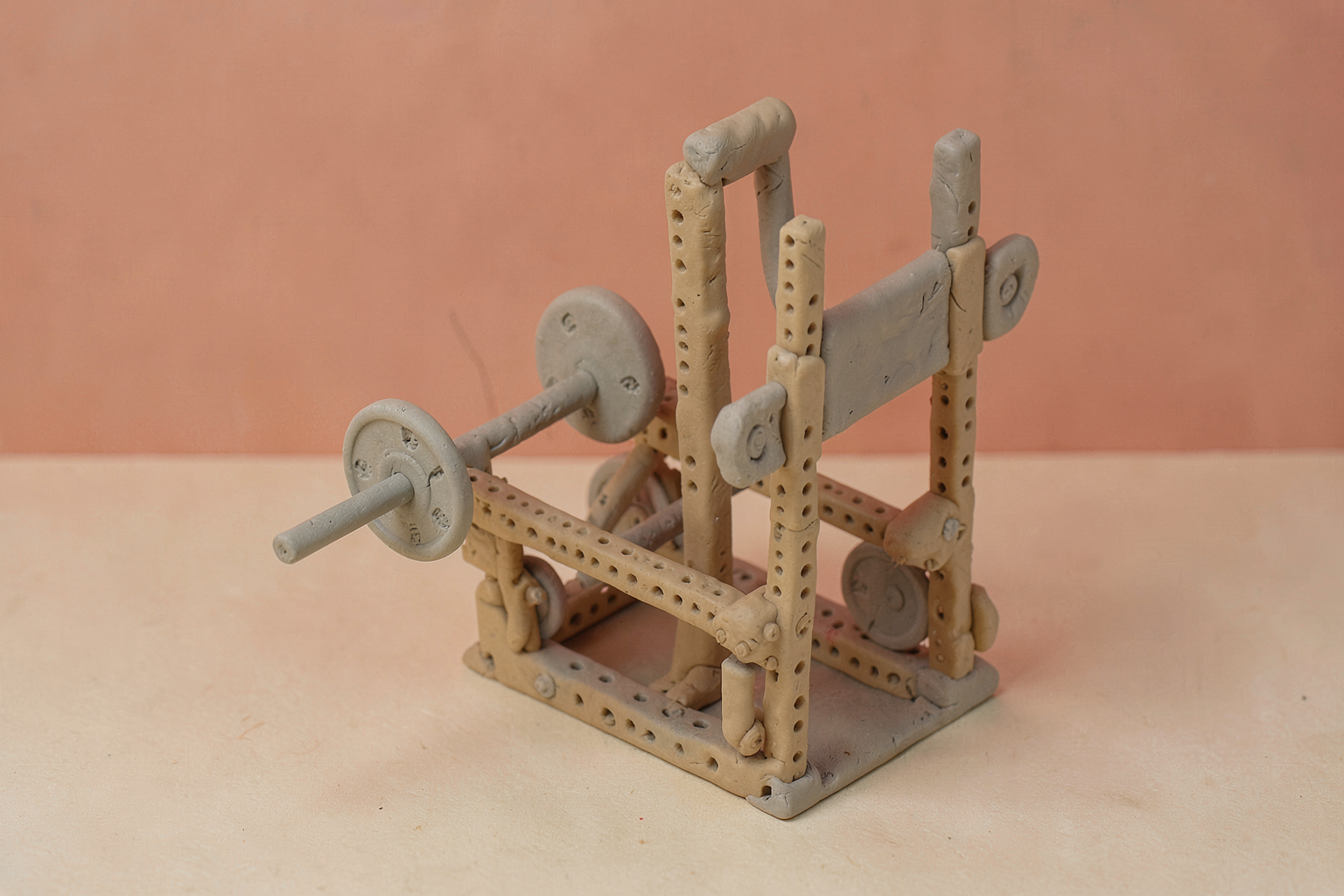
Pivot and Adjustable Pivot Member form one stated connection: A weightlifting machine includes a ground-resting frame.

First, the setting
People use gyms, rehabilitation spaces, and home exercise areas to practice lifting and controlled movement. They may want a stable place to push, pull, or raise weight while keeping their body positioned comfortably. Equipment in these spaces is built around repeatable motions, clear setup, and a floor that can handle active use.
In a gym, someone adjusts a padded or metal support, grips a handle or bar, and moves through a lifting motion. A nearby arm, leg, or bracket may swing into place and settle against the frame. Other people hear small mechanical movements as they wait, train, or walk past the equipment.
What changes in this design
Without more detail, a reader might expect a machine's support legs to stay put once it is set on the floor.
Here, the floor-resting frame has support legs that swing around joints. A component moves a leg between stop and free positions, and two legs may swing at the same time.
That detail makes clear the setting involves leg motion, not just a fixed base. The record does not say how the two positions change a workout, safety, or stability.
Ground Frame, Moving Legs
Picture a weightlifting machine at rest on the floor while you pause before the next part of a familiar routine. Ordinary objects earn their place in human routines when a setting can be understood before anyone has to rely on a promise. That modest distinction is the hinge that made me look twice at US20260263861A1, published September 10, 2026, under the title Weightlifting Machine. The filing describes a ground-resting frame, pivoting support legs, an adjustable pivot member, an actuator, and a coupling member. It also describes the actuator moving a support leg between stop and free positions, while two legs may pivot together. This is not a grand tableau of strength or certainty. It is a floor-level arrangement asking whether a leg is at one named condition or another, which is already more interesting than a mechanism that merely looks busy.
Pivot Settings and Their Terms
From that floor-level picture, the terms deserve to stay close to ordinary language. A ground-resting frame is the part described as resting on the ground. Pivoting support legs are legs that turn around a point rather than remaining fixed in one orientation. An adjustable pivot member is the identified part whose pivot arrangement can be adjusted. The actuator is the part described as moving a support leg, and the coupling member is the named joining part within the arrangement. The filing calls the two positions stop and free, names that are useful precisely because they do not pretend to explain everything else. The actuator enters as if it were a patient librarian, moving a support leg between its stop and free positions without asking the reader to supply the middle.
Once the parts have been given their plain names, the difference between a setting and a promise comes into focus. A setting is what the arrangement specifies: support legs pivot, an actuator moves a leg between two positions, and two legs may pivot together. A promise would be a larger assurance about what the arrangement will mean in every circumstance for every reader. Nothing in this editorial needs that larger assurance. The point worth holding is narrower and more durable: the published record gives the movement a vocabulary, so you can see where the description ends before expectation begins.
That boundary leads to a useful everyday design question. When a routine depends on a change of position, does the object make the change legible, or does it leave the user to infer what is happening from a vague handoff between parts? One transferable observation is that named states can reduce needless guesswork even when they do not settle every question. Another is that coordinated movement needs an understandable relationship, not merely several components placed near one another. The adjustable pivot member has the air of a label-maker: it makes the idea of a chosen setting more concrete without issuing a promise about what that setting will mean for you. I think that restraint is worth your attention because it lets the mechanism remain specific without becoming theatrical.
Clear Cues Before a Handoff
That restraint makes the comparison clearer. A broad version of this task might simply ask a machine to have supports and somehow change their condition. This filing instead describes a frame, pivoting support legs, an adjustable pivot member, an actuator that moves a leg between stop and free positions, and a coupling member, with two legs able to pivot together. The distinction is not an argument that one arrangement is better than every other arrangement. It is an argument for legibility inside the description itself. The result is less like a vague handoff and more like a stage manager giving each leg its cue. Even the possibility of two legs pivoting together reads as coordination with a stated role, not an invitation to imagine a whole unspoken performance.
From that comparison, the takeaway stays calm. The interesting thing here is not an oversized promise attached to a weightlifting machine, but a small insistence that positions, movement, and coordination can be described separately enough for you to keep track of them. That is useful beyond this one published record: settings are often where ordinary objects tell the truth most clearly, while promises are where readers can accidentally add more than the mechanism has actually said. Can you point to the setting, name the movement it controls, and leave the broader promise unassigned?
The record, briefly. US20260263861A1, “Weightlifting Machine” A weightlifting machine includes a ground-resting frame, pivoting support legs, an adjustable pivot member, an actuator, and a coupling member. The actuator moves the support leg between stop and free positions, and two legs may pivot together.
More angles on this
- The Small Condition Beneath a Cycling System's Big SwitchAnother reading from the same A63B classification family, apparatus for physical training, gymnastics, swimming, climbing, or fencing; ball games; training equipment.
- A Cart Container at the Moment of HandoffAnother reading from the same A63B classification family, apparatus for physical training, gymnastics, swimming, climbing, or fencing; ball games; training equipment.
- CPC A63B: Apparatus for physical training, gymnastics, swimming, climbing, or fencing; ball games; training equipmentThe official classification family this record was filed into, published in the USPTO Cooperative Patent Classification scheme.
- Inside toolAnother reading from the neighbouring A63H classification family, toys, e.g. tops, dolls, hoops or building blocks.
- The Fuse That Gets Told When to Blow: A Fire Prevention Filing for Electronic Control UnitsAnother reading from the wider A62C classification family, fire-fighting.
Read around this one:Public patent recordUSPTO published figure