Field Notes
Inside tool
A new patent revives the tactile art of spherical geometry, but cognitive science shows that physical tools need structured curricula to teach real math.

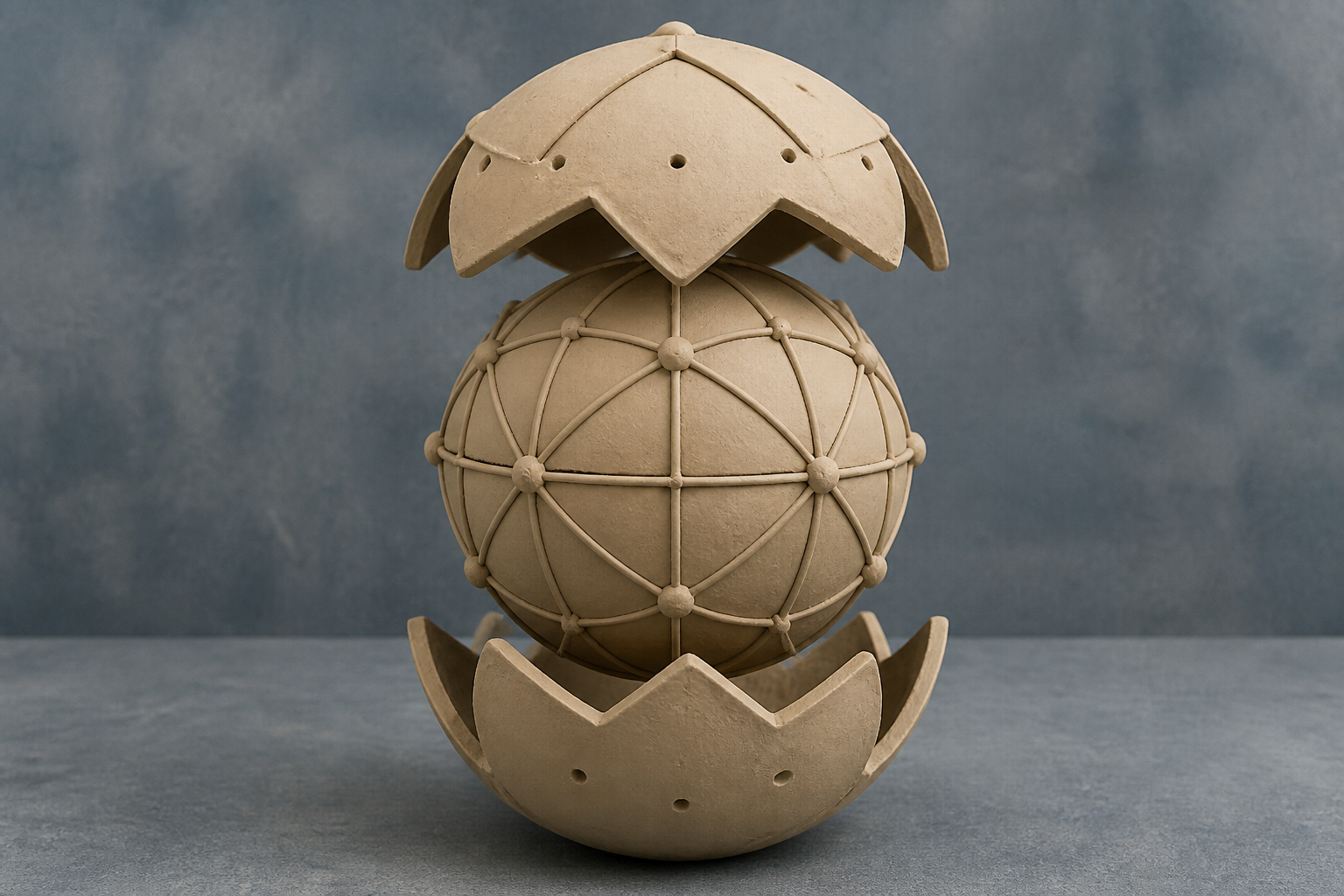
What changes in this design
Students usually encounter complex three-dimensional geometry through flat textbook drawings or abstract mathematical formulas that can feel disconnected from physical space.
This record presents an educational instrument designed to teach regular polyhedra using decorative, interlocking surface patterns, alongside instructions for producing and operating it.
Blending artistic tiling with geometry helps learners develop spatial reasoning and creative problem-solving skills simultaneously, offering a more engaging way to grasp difficult mathematical principles.
Carving symmetry into beechwood
In 1940, M.C. Escher took a solid ball of beechwood and began carving interlocking fish across its surface, aligning their fins and tails to the regular tetrahedral symmetry of a Platonic solid. Two years later, he carved angels and devils into maple. He was working out an old geometric truth by hand: repeating shapes do not tile across a curved surface the way they do across a flat sheet of paper. For over two thousand years, that curved geometry had belonged to astronomers, navigators, and cartographers. Yet as Glen Van Brummelen documented in his 2013 study Heavenly Mathematics, spherical trigonometry and spherical geometry vanished from secondary and undergraduate curricula during the twentieth century as electronic computing replaced manual calculation.
When I first looked into that disappearance, the sheer speed of the erasure felt startling. A mathematical discipline that guided ships across oceans for millennia simply dropped off the syllabus once machines could process the coordinates. What remained in schools was flat Euclidean geometry, leaving generations of students with little physical intuition for how curved surfaces behave.
Clear plastic and sixty-two pins
Inventors have spent decades trying to put that spatial intuition back into students' hands. In Hungary during the early 1990s, István Lénárt built the Lénárt sphere, an eight-inch clear plastic ball equipped with spherical straightedges and compasses, formalized in a 2003 Key Curriculum Press text to replace flat blackboards with hands-on non-Euclidean constructions. Around the same time, Steve Baer, Marc Pelletier, and Paul Hildebrandt commercialized Zometool using a 62-pin hydraulic mold. By color-coding struts whose lengths scaled by powers of the golden ratio, their system encoded icosahedral symmetry and sixty-one zone directions to let children construct regular polyhedra in three dimensions.
Other kits followed, from the hinged plastic panels of Polydron in the 1970s to recent craft experiments documented at the 2019 Bridges conference by Hall, Brás, and Pais, who taught wallpaper symmetry groups through spherical ceramic glazing and patchwork. What we see across these designs is a shared faith in the physical object. Developmental research shows that assembling structured blocks and polyhedra directly predicts spatial visualization abilities.
A patent for tessellated spheres
That tactile tradition has resurfaced in a recent patent application, US20260260580A1, titled "Tool For Learning Spherical Design, And Methods For Using And Manufacturing Same." The published record outlines an educational tool and manufacturing methods designed to teach regular polyhedra through artistic spherical tessellations. By having users construct and arrange repeating patterns across a three-dimensional curved surface, the filing aims to cultivate both geometric understanding and spatial creativity.
Looking at the filing, what I find striking is how directly it echoes Escher's woodcarvings: rather than wrestling with textbook proofs, a learner discovers polyhedral geometry by fitting interlocking tiles across a spherical shell. A flat drawing of an icosahedron in a workbook is static, whereas manipulating curved polygons by hand lets a student feel how angular deficits force a two-dimensional pattern to close into a sphere.
The friction inside working memory
The trouble is that physical objects do not teach mathematical abstraction on their own. A 2022 review in npj Science of Learning evaluated a 29-study meta-analysis of 3,765 students and confirmed that concrete 3D spatial manipulatives generate genuine mathematical gains, with an effect size of g = 0.28, aligning with a 2013 Uttal meta-analysis of 206 studies showing g = 0.47. Concrete tools consistently outperform digital software in building spatial skills. Yet spatial visualization remains completely absent from the US Common Core, and England excised it from its Early Years standards in 2021.
Even when these tools reach a desk, cognitive science reveals a deeper roadblock. Writing for the American Federation of Teachers, cognitive psychologist Daniel Willingham reviewed a 2013 meta-analysis by Carbonneau and colleagues covering 55 studies and 7,237 students. While manipulatives aided retention (d = 0.59) and geometry performance (d = 0.72), their effect on transferring knowledge to abstract concepts dropped to a meager d = 0.13. That low transfer score is what should temper our optimism. As Willingham explained, physical manipulatives trigger dual-representation interference. A student focuses so intently on the sphere as a physical craft that their mind fails to extract the abstract polyhedral symmetry governing it.
The open question
To overcome that cognitive interference, research shows instructors must use explicit concreteness fading: beginning with a physical manipulative, transitioning to structured two-dimensional diagrams, and finally arriving at symbolic mathematical notation. Without that deliberate instructional scaffolding, a physical tool remains an engaging craft session rather than a mathematical bridge.
My worry is that the hardest part of reviving spherical geometry was never engineering the physical tool. The hardest part is finding a curriculum ready to support it. When schools have spent decades sidelining curved geometry, an educational manipulative is left to do the teaching alone. We can design all the beautiful tessellated spheres we want, but whether our classrooms still possess the instructional framework to turn tactile art into lasting mathematical insight remains an open question.
Sources
Reporting for this piece drew on the published filing and the references below.
- Tool For Learning Spherical Design, And Methods For Using And Manufacturing Same
- Lénárt sphere - Wikipedia
- Zometool - Wikipedia
- The Polyhedra of M.C. Escher
- Heavenly Mathematics | Princeton University Press
- Spatial thinking as the missing piece in mathematics curricula | npj Science of Learning
- Ask the Cognitive Scientist: Do Manipulatives Help Students Learn?
- Construction set - Wikipedia
The record, briefly. US20260260580A1, “Tool For Learning Spherical Design, And Methods For Using And Manufacturing Same” The publication describes a tool and associated methods for learning, using, and manufacturing spherical designs. The educational tool allows users to learn the mathematical concept of regular polyhedra through artistic tessellation, enhancing both spatial abilities and creativity.
More angles on this
- The Light That Follows a Magnetic SignalAnother reading from the same A63H classification family, toys, e.g. tops, dolls, hoops or building blocks.
- When Sensor Data Takes the Handoff in Modular Sound SynthesisAnother reading from the same A63H classification family, toys, e.g. tops, dolls, hoops or building blocks.
- CPC G09B: Educational or demonstration appliancesThe official classification family this record was filed into, published in the USPTO Cooperative Patent Classification scheme.
- CPC A63H: Toys, e.g. tops, dolls, hoops or building blocksThe official classification family this record was filed into, published in the USPTO Cooperative Patent Classification scheme.
- When a Rounded Base Takes the HandoffAnother reading from the neighbouring A63F classification family, card, board, or roulette games.
Read around this one:Public patent recordUSPTO published figure