Machines
The Light That Follows a Magnetic Signal
A light-up magnetic block enters a toy category shaped by swallowed magnets, familiar electronics, and patents that may not hold.

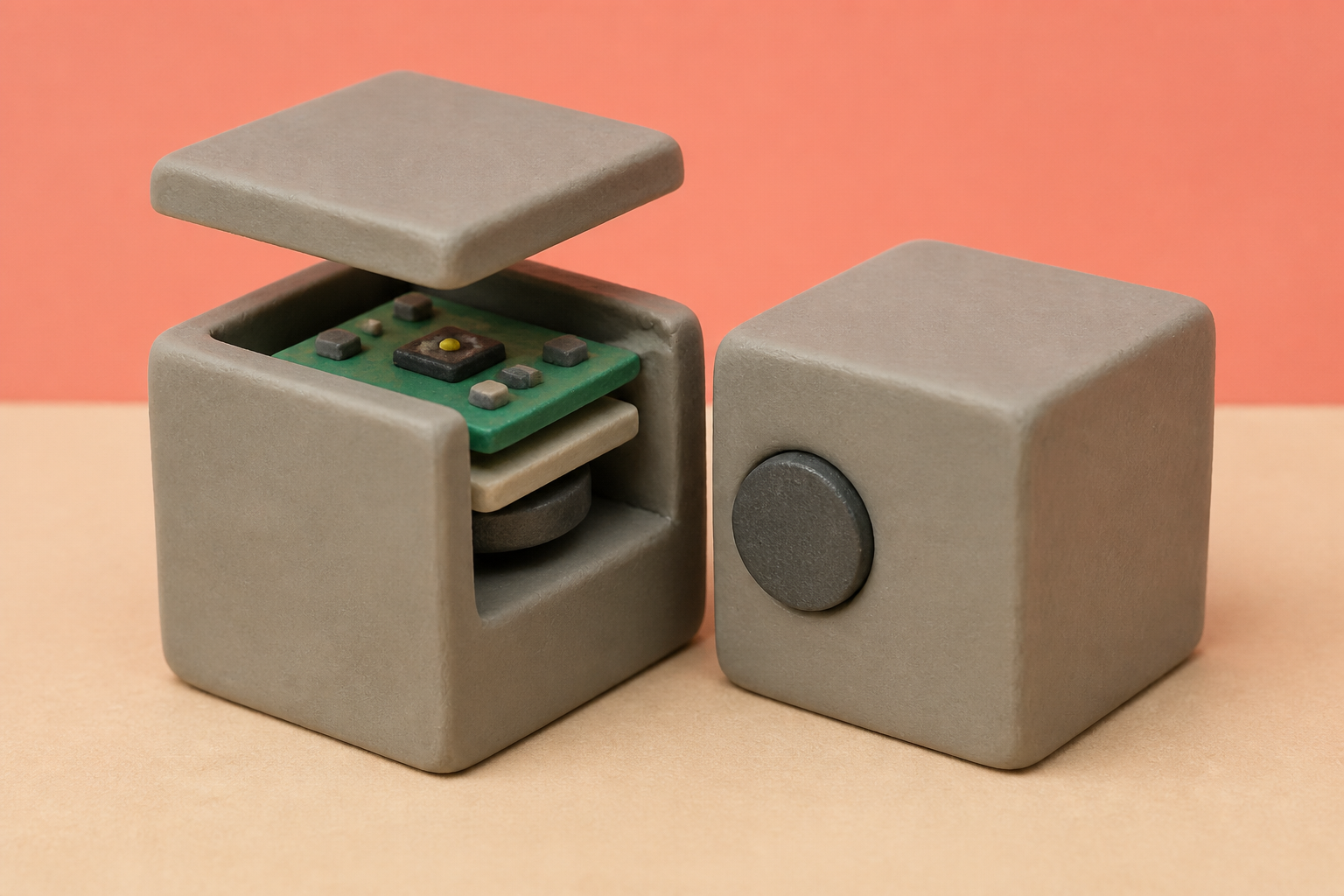
What changes in this design
A reader might picture magnetic building pieces as blocks that simply attach when brought near one another, with no light response tied to their approach.
Here, a first block senses a magnetic cue from an approaching second block. That sensing action triggers a circuit board in the first block to emit light.
The blocks are not only brought together by magnetism. Their approach is also connected to a visible response, so light becomes part of the building-play interaction.
Thirteen loose magnets
In late 2018, a Wisconsin child swallowed 13 loose magnets from a counterfeit magnetic-tile toy sold online. The toy had been falsely labeled as safety-compliant. That episode makes it hard for me to treat a glowing magnetic block as just another tidy bit of playroom engineering.
Magnetic construction toys carry an unusual burden: each new version must make connection feel fresh while keeping the force behind it safely contained. The stakes are not theoretical. In 2022, the Consumer Product Safety Commission adopted a federal rule for loose or separable magnets small enough to swallow, linking hazardous magnets to seven deaths and estimating 26,600 magnet-ingestion emergency-room visits from 2010 through 2021. The contrast should make us pause before calling any magnetic feature a small detail.
A block that notices
Into that category comes US20260257141A1, titled “Magnetic Building Block And Magnetic Building Block Toy.” Its central move is simple: a sensor in one block detects a magnetic signal from an approaching companion block, then prompts a circuit board to emit light. The effect is meant to happen at the moment the pieces come near one another.
That is a pleasing interaction, but it does not by itself establish a breakthrough. I cannot tell from the published description how narrowly the invention is claimed, how the sensing is implemented, or how the blocks would be built for safety. Those details matter. A 2022 rule does not automatically determine whether this toy complies, but a product with small, powerful, loose or separable magnets would plainly enter regulated territory.
Lights before contact
The idea has a family history. A 2016-filed patent, granted in 2019, describes a light-emitting magnetic toy block in which magnetic connector pins also serve as electrical contacts, completing a circuit when blocks connect. That is not the same arrangement as detecting an approaching magnetic field, yet it puts light at the center of magnetic assembly.
A second patent, granted in June 2023, describes a brick that detects nearby objects through a capacitive electric-field sensor and triggers an LED or speaker without physical contact. Its example is a finger within about 50 millimeters. The new filing changes the signal being sensed, but the broader sequence - something approaches, a sensor notices, electronics respond - is already familiar. What I find interesting is the particular trigger, not the claim that responsive toys have suddenly arrived.
littleBits made that larger idea visible years earlier with electronic modules joined by magnetic snap-connectors. Founded in 2011, it built a business around making circuit behavior part of construction play, raised substantial funding, and was acquired by a robotics-toy company in 2019. Its standalone identity was later retired. This does not prove that the new filing lacks value, but it does show that a strong idea and a substantial patent portfolio do not guarantee an independent company or a lasting product line.
Bakugan at the tribunal
There is also a harder patent lesson in this aisle. An administrative patent tribunal invalidated Spin Master’s Bakugan patent for obviousness after a challenge argued that the magnetic transformation technology was already known. That outcome concerned its own claims and prior art, not this light-up block. Still, the warning travels well: changing the packaging around a known magnetic mechanism can be less important than it first appears.
The question we should ask is not whether a child would notice the light. Of course they would. The question is whether the claimed magnetic sensing arrangement is sufficiently specific and different from contact-powered light blocks, proximity-triggered bricks, and the long run of magnet-linked electronics that came before it. It leaves me skeptical of breakthrough language, especially in a category where safety redesigns and counterfeit failures have already shaped the products on shelves.
What would have to be true
For this application to become more than another entry in a crowded toy category, its eventual claims would need to draw a meaningful technical boundary around the magnetic sensing and lighting arrangement. They would also need to survive comparison with the earlier inventions that already connect magnets, sensors, circuits, lights, and nearby objects in various combinations.
A real product would have another test beyond patentability: its magnets and enclosure would need to hold up under the federal safety rules designed around ingestion risk. Until those questions have answers, we can see the filing for what it is: not a new world of magnetic toys, but a careful attempt to find room inside one that has been inventive, dangerous, commercially unstable, and legally unforgiving for a long time.
Sources
Reporting for this piece drew on the published filing and the references below.
- Magnetic Building Block And Magnetic Building Block Toy - US20260257141A1
- CPSC Approves New Federal Safety Standard for Magnets to Prevent Deaths and Serious Injuries from High-Powered Magnet Ingestion
- Magnetic Positioning Light-Emitting Toy Block - US10376804B2
- Toy brick with capacitive proximity switch - US11666834B1
- littleBits
- Sphero Just Bought littleBits to Become One of the Largest Makers of Educational Toys
- ‘Obviousness’ Is Not So Obvious: How to Make Sure Your Patent Will Hold Up in Court
- Toy Industry Responds to Counterfeit Magnetic Toys
The record, briefly. US20260257141A1, “Magnetic Building Block And Magnetic Building Block Toy” A magnetic building block toy includes groups of first and second magnetic building blocks. A sensor in the first block senses a magnetic signal from an approaching second block and triggers a circuit board to emit light.
More angles on this
- An Inflatable Costume Prepares for Lift-OffAnother reading from the same A63H classification family, toys, e.g. tops, dolls, hoops or building blocks.
- CPC A63H: Toys, e.g. tops, dolls, hoops or building blocksThe official classification family this record was filed into, published in the USPTO Cooperative Patent Classification scheme.
- A Golf Trainer's Space for JudgmentAnother reading from the neighbouring A63B classification family, apparatus for physical training, gymnastics, swimming, climbing, or fencing; ball games; training equipment.
- Method For Treating Cancer By Anti-B7H3 Antibody-Drug Conjugate Makes a Small Case for Better TimingAnother reading from the wider A61K classification family, preparations for medical, dental or toiletry purposes.
- Golf Swing Evidence, Carried by a WearableAnother reading in the same Machines category on this site.
Read around this one:Public patent recordUSPTO published figure