Field Notes
A Golf Trainer's Space for Judgment
Start with Support Base and Key detail: A golf trainer includes a support base and adjustable indicators. It keeps the central design choice visible.

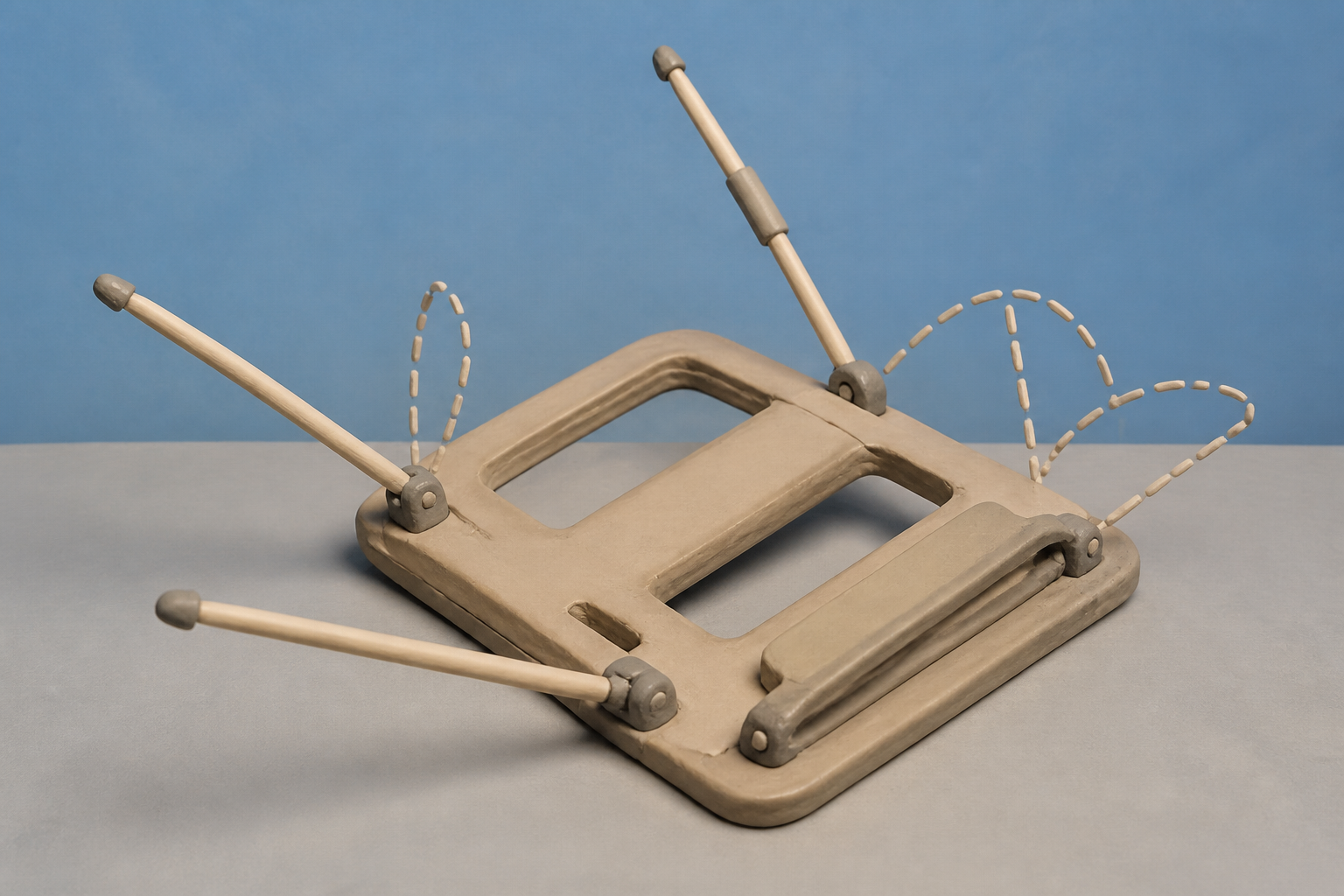
First, the setting
Golf is often learned in open practice areas, backyards, or quiet corners of a course. Players try to notice how their stance, club path, and aim relate to the ball. Simple physical reference points can make those movements easier to see while someone practices a swing.
On a practice mat or grass, a golfer sets guide pieces near the ball and along the intended direction. The pieces may stand upright, fold down, or shift position as the player addresses the ball and swings. A coach, friend, or passerby can see the layout around the player.
What changes in this design
A reader might expect a golf trainer to remain full-sized between practice sessions and need its own storage space.
Here, the trainer uses a support base with adjustable indicators. Each indicator has a shaft and base, attaches to the support base, turns at least 90 degrees, pivots at least 90 degrees, and has two length settings.
The movable pieces are central to understanding it. This is not simply a fixed practice object: its parts are made to change position and length while the trainer is put away or set up.
Golf Trainer Parts Before Judgment
When a trainer's indicators both connect to a support base and need room to turn, what should you notice before deciding what matters? The published record, US20260257121A1, titled Golf Bag Storable Golf Trainer and dated September 3, 2026, offers a narrow contrast to an ordinary fixed reference: its indicators are adjustable. A support base is the part to which the indicators connect; an indicator here is one of those adjustable parts. The arrangement sounds less like a fixed marker and more like a small stage manager allowing several positions without announcing which one is right. That contrast made me look twice, because motion is stated while a preferred setting is not.
Angles and Lengths Made Visible
That absence of a prescribed setting gives the picture useful boundaries. Each indicator is described with a shaft, a long narrow member, and a base, its named companion part; it also connects to the support base. You can picture the parts gathered around a shared supporting element rather than scattered across an imagined practice scene. The support base has the air of a restrained committee chair: it connects the indicators while their adjustments remain available.
From that picture, the mechanism becomes inspectable. Rotation means turning, and the filing says each indicator can rotate at least 90 degrees. Pivoting means changing angle relative to its base, and each can pivot at least 90 degrees in that relationship. Those are separately stated movements, so it is worth resisting the temptation to collapse them into one vague idea of adjustability.
Judgment Left by Adjustment
That separation carries into length. Each indicator adjusts between a first length and a second length, naming a change without selecting either length for you. The before-and-after is therefore visible in the description itself: one stated length, then another, in addition to the separately described turning and pivoting. The patent gives you boundaries to inspect, not a single frozen arrangement to accept.
Because the stated facts name movements and two lengths but no selected placement, the point I think is worth your attention is the space left for judgment. You can inspect which changes are named, which relationships are explicit, and which selection remains yours to consider. That distinction is less like a command from a clipboard and more like a labeled set of options awaiting a human decision.
That is why two transferable observations matter beyond this named trainer. When parts connect yet still move, inspect the relationship before assigning importance to any one position. When a description supplies ranges or endpoints, distinguish those visible boundaries from a decision someone must make. The idea has the air of an adjustable bookmark: sketch one support base, an indicator, two lengths, and two 90-degree movements, then circle the choices the filing leaves open.
The record, briefly. US20260257121A1, “Golf Bag Storable Golf Trainer” A golf trainer includes a support base and adjustable indicators. Each has a shaft and base, connects to the support base, rotates at least 90 degrees, pivots at least 90 degrees relative to its base, and adjusts between first and second lengths.
More angles on this
- A Bat Cavity and the Quiet Work of AlignmentAnother reading from the same A63B classification family, apparatus for physical training, gymnastics, swimming, climbing, or fencing; ball games; training equipment.
- When a Sensor Racket Hands Context to a ReportAnother reading from the same A63B classification family, apparatus for physical training, gymnastics, swimming, climbing, or fencing; ball games; training equipment.
- CPC A63B: Apparatus for physical training, gymnastics, swimming, climbing, or fencing; ball games; training equipmentThe official classification family this record was filed into, published in the USPTO Cooperative Patent Classification scheme.
- When a Basketball Court Becomes a MessageAnother reading from the neighbouring A63F classification family, card, board, or roulette games.
- When a Ramp Turns Containment Into a Checkable SequenceAnother reading from the wider A62C classification family, fire-fighting.
Read around this one:Public patent recordUSPTO published figure