Field Notes
When Flexible Light Guides Meet at the Seam
Valeo holds 33,000 patents and cuts 1,000 European jobs while filing narrow fixes for a thirty-year-old light-guide problem that cheaper OLED was supposed to solve.

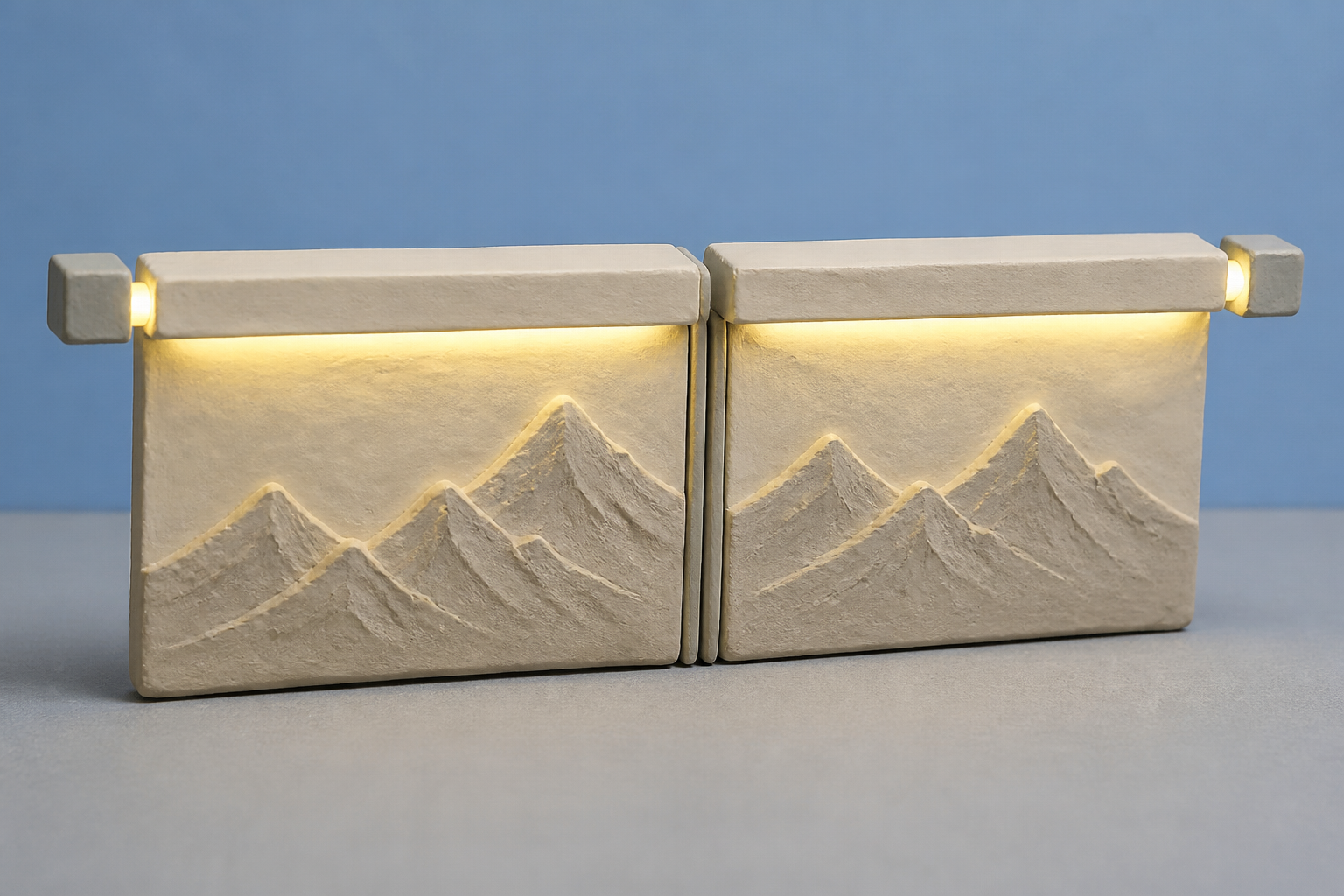
What changes in this design
Someone looking at a lit surface might expect a single solid panel or ordinary flat panels placed together without special treatment along the borders.
Here, two or more flexible sheets sit side by side, each receiving light from its own injector. Along the seam where adjacent edges face one another, the sheet material is either turned inward or shielded with reflective material.
The approach illustrates how neighboring flexible sheets can fit together in a single lighting unit. Treating the adjacent borders helps manage light right where two pliable sheets meet side by side.
Thirty years of point sources
The first mass-production cars with light-emitting diode taillights hit the road in 1993. The appeal was practical. A tiny diode lights up almost instantly, cutting driver response time by several hundred milliseconds compared to an incandescent bulb and shortening a following car's braking distance by several meters. But diodes are point sources. They cast bright, concentrated dots of glare, whereas drivers and car designers want smooth, uniform ribbons of red that stretch unbroken across a tailgate.
To turn scattered points of light into solid bars, automotive suppliers turned to light guides. These transparent plastic tubes and sheets use internal reflection to catch beams from an edge and bounce them out evenly across an etched surface. When we look at the rear of a modern car, we do not see raw diodes. What glows back is an optical illusion engineered out of plastic slabs and scattered micro-patterns.
Bending the dark line
The engineering breaks down whenever a lamp gets wide or curved. A single rigid guide sheet cannot wrap neatly around modern body panels, so suppliers place multiple smaller sheets side by side. Where two guide sheets meet, however, physics gets messy. Light leaks out the sides, the injection points fail to overlap cleanly, and a visible dark line appears right down the middle of the illuminated shape.
I spent time reviewing US patent application 20260259361A1, titled "Lighting Module Comprising A Plurality Of Flexible Guide Sheets," to see how suppliers are still tackling this defect. Assigned to French automotive supplier Valeo, the filing describes a module with at least two flexible light-guide sheets placed edge-to-edge. Light from dedicated injection elements feeds into each sheet. To hide the gap between them, the edges are either bent inward away from the outer lens or coated in a reflective layer. The goal is simple: eliminate the dark joint without forcing automakers to buy a massive, complex optical mold.
An old seam across two industries
The detail that caught my attention is how long this specific flaw has troubled engineers. In 2011, a rival German supplier named Odelo filed its own patent to combat light leakage and inhomogeneous appearance in multi-piece light guides, trying to avoid the expense of adding brighter diodes just to overpower dark spots. Odelo traced its roots back to 1935, and yet its engineers were wrestling with the exact same edge defects over a decade ago.
This optical headache is not even confined to cars. In 2014, a display developer named Miortech patented a technique for optical seam reduction to hide the visible joints between tiled video-wall panels. Whether an engineer is building an outdoor video display or an automotive brake light, placing two glowing panels next to each other creates an awkward boundary. Valeo's filing is simply the latest entry in a long lineage of mechanical patches for a shared optics problem.
The patent factory meets the shop floor
I find it difficult to look at this filing without noticing the machinery behind it. GlobalData recorded Valeo's patent grant share at 52 percent as of February 2024. In 2023 alone, the company filed 1,666 priority patent applications worldwide, ranking as the top patent applicant in France for the second year in a row and building an intellectual property portfolio of over 33,000 rights.
Yet that relentless filing pace contrasts sharply with the state of European manufacturing. Valeo announced plans to cut roughly 1,000 jobs across Europe, including over 800 positions in France and the closure of two domestic facilities, among them an R&D site at La Verrière. Facing reduced European vehicle production and intensifying competition from Asian manufacturers, the company is trimming its physical footprint while keeping its patent pipeline running on full throttle.
What the filing is really betting on
There was supposed to be a cleaner way around this entire problem. A decade ago, organic light-emitting diodes, or OLEDs, promised to make light guides obsolete. Because OLED panels emit light uniformly across their entire surface, they require no internal reflection, no etching, and no bulky guide sheets. But the OLED revolution that industry observers predicted failed to materialize. High production costs kept surface-emitting panels confined to niche luxury trims, leaving conventional diodes and light guides as the default hardware for high-volume vehicles.
Valeo's thin light modules are already rolling out on 2024 production models across Europe and Asia. That leaves our reading with a clear verdict: this patent is not an opening salvo into futuristic lighting, but a defensive maintenance filing. As long as cheaper alternative emitters remain out of reach, what we will get from suppliers are incremental fixes for thirty-year-old hardware.
Sources
Reporting for this piece drew on the published filing and the references below.
- Patent US20260259361A1: Lighting Module Comprising A Plurality Of Flexible Guide Sheets
- Valeo is the number 1 patent applicant in Europe and the number 3 patent applicant in France
- Valeo to slash 1,000 jobs across Europe – report
- Future LED and OLED automotive lighting
- Valeo SA Patent: Vehicle Interior Lighting System with Concave Light Guide
- US9885826B2 - Optical seam reduction
- EP2587120B1 - Light guide and automotive vehicle equipped with such a light guide
- odelo company history
- LED rear lighting: reducing response time
- Automotive lighting
- Valeo supplies lighting systems to several OEMs in 2024
The record, briefly. US20260259361A1, “Lighting Module Comprising A Plurality Of Flexible Guide Sheets” A luminous module includes at least two flexible guide sheets configured to reflect light rays according to etched patterns, with light distributed by first and second light-injection elements into the respective sheets. The sheets are arranged side-by-side with adjacent edges facing each other, where parts along these edges are either bent inward or covered with a reflective material.
More angles on this
- Polarization Conversion Element Makes the Next Move Easier to SeeAnother reading from the same G02B classification family, optical elements, systems or apparatus.
- Antireflective Glass Ceramic Articles And Methods Of Making The Same Makes a Small Case for Better TimingAnother reading from the same G02B classification family, optical elements, systems or apparatus.
- CPC G02B: Optical elements, systems or apparatusThe official classification family this record was filed into, published in the USPTO Cooperative Patent Classification scheme.
- CPC F21V: Functional features or details of lighting devices or systems thereofThe official classification family this record was filed into, published in the USPTO Cooperative Patent Classification scheme.
- Inside methodAnother reading from the wider G01V classification family, geophysics; gravitational measurements; detecting masses or objects; tags.
Read around this one:Public patent recordUSPTO published figure