Objects
A Beverage Package and the Evidence Before Action
A spare patent filing for a handled cup and straw lands as drinkware's viral boom cools and familiar details become the subject of lawsuits.
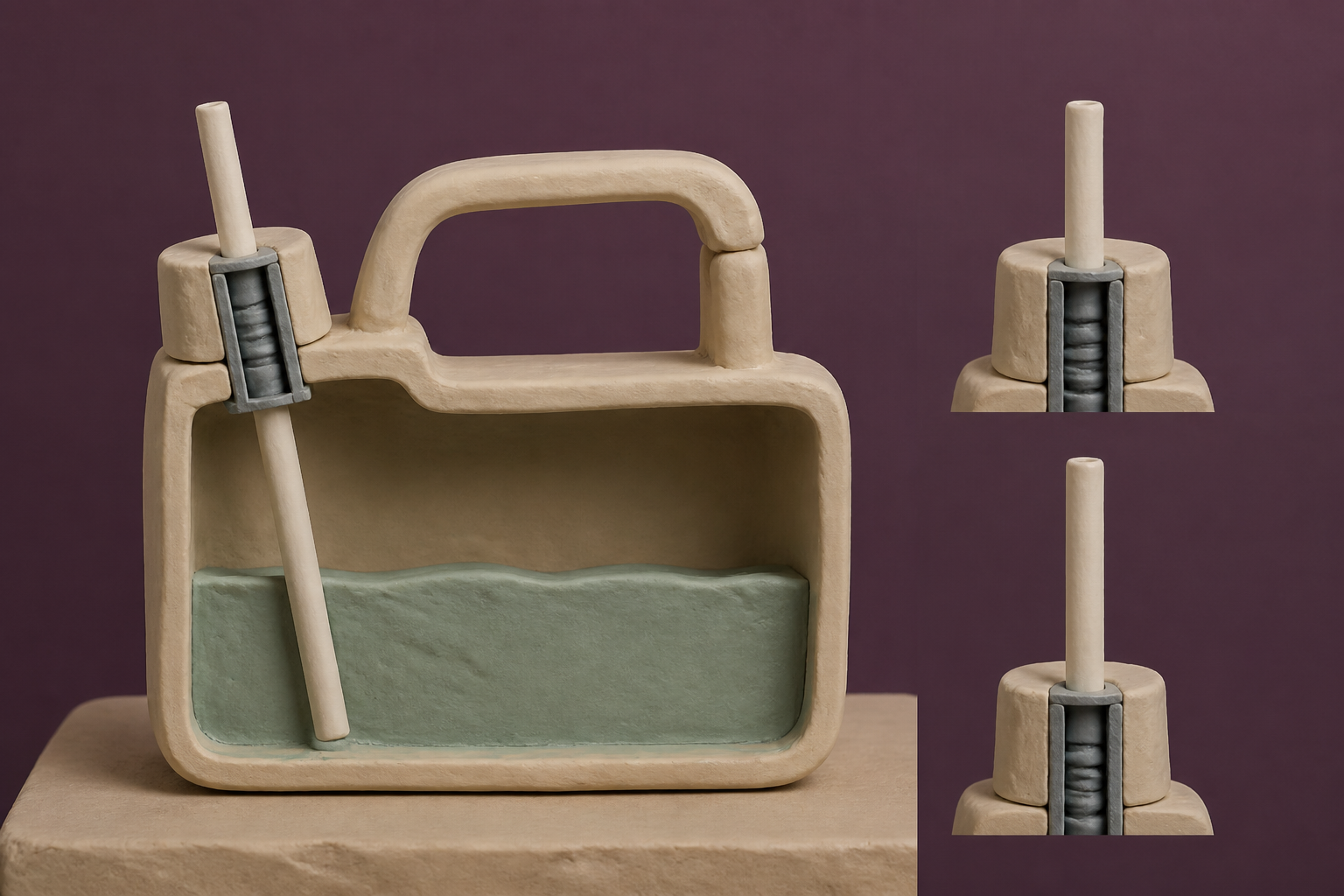
What changes in this design
A reader may picture an ordinary drink container as something you tip to pour or sip from directly. A straw, if there is one, can offer another path to the liquid.
This package brings together a container with a floor, sidewall, and handle, a closure, and a straw. The straw extends into the liquid-holding space, where suction can draw out liquid.
Knowing that layout makes the object easier to understand at a glance: the straw is not merely nearby; it reaches down into the space where the drink is stored.
Ten thousand tumblers
In 2019, a reseller ordered 10,000 units of a tumbler that had nearly been discontinued. The first 5,000 of Stanley's Quenchers sold in roughly four days; the next 5,000 were gone in an hour. The product had launched in 2016 with a handle and a straw lid, two features that now look ordinary. The number that stayed in my notes was 10,000, because it marks the moment a familiar cup stopped being a sleepy product and became an object of serious attention.
By 2023, Quencher sales had risen 275% year over year, and the brand became North America's No. 1 drinkware brand within six months, according to Retail Dive. Then the rush lost speed. At sporting-goods retailers, category growth slowed from 38% in 2023 to 14% in 2024, followed by year-over-year declines every month from September 2024 through February 2025. A cup boom cooled quickly, but the value assigned to its visible parts did not.
The spare new filing
Into that cooling market arrives US20260256307A1, titled simply Beverage Package. It describes a container with a closure and straw, a liquid space with a floor and sidewall, and a handle. The straw reaches into the liquid space and lets its user withdraw drink by suction. On its face, this is the everyday arrangement that helped make big handled tumblers recognizable at a glance, not an extravagant new kind of vessel.
That plainness is the point of interest. I could not verify the filer from public material available to me, so I cannot responsibly tie this application to a particular brand or strategy. Nor does a published application establish that a patent will issue. What it shows, at minimum, is that the handle, closure and straw are still being put into formal technical language while their commercial meaning has grown far beyond a drinking aid.
A 1969 sipping tube
This is not a category born with viral drinkware. A 2006 application, Beverage Containers with Integrated Straw, was published in 2007 and is now abandoned. Its own citation trail reached a 1969 disposable beverage container with a built-in sipping tube. The old record makes the central caution clear: the presence of an integrated straw, by itself, is a decades-old idea.
An even broader reminder sits in a 1986 filing for a two-chamber can intended to induce foam. It, too, was called Beverage Package, though its concern was nothing like a handled cup. That history does not decide what US20260256307A1 may later be allowed to claim, and I won't pretend it does. It does stop me from treating a spare title or a recognizable silhouette as proof of technical novelty.
Handles in court
Once demand softens, visual sameness can become a legal argument. The timing of recent suits does not prove why they were brought, but it does show where companies are placing weight. In October 2024, Yeti sued a rival in Texas, asserting more than 80 design patents and trade dress claims over tumblers, bottles, mugs and lids, and sought a recall. Its complaint ran 192 pages.
A year later, Stanley's maker sued Five Below over low-cost lookalike tumblers. The suit specifically identified an IceFlow flip-straw feature and the Quencher's handle-and-band design as alleged protected trade dress. I read neither allegation as proof that an ordinary handle belongs to anyone. Their significance is narrower, and more revealing: a category built from familiar pieces is now being fought over at the level of the lid, the band and the way a straw moves.
The part worth watching
Those parts also have consequences beyond the shelf. A physician writing for a major medical center warns that bottles with straws and sliders can collect mold and bacteria in hard-to-reach crevices; reported effects can include gastrointestinal upset, allergic reactions and respiratory symptoms. This is where I become less interested in the latest contour of a lid. A reusable bottle is only as appealing as its ordinary care allows it to be.
Material choice is unsettled too. A March 2025 federal fact sheet reversing the plastic-straw-ban era cited research finding a 70% to 90% loss of paper-straw compressive strength within 30 minutes of wetting, as well as research finding 21 PFAS compounds in paper or plant straws and none in plastic ones. The same fact sheet cited 400 documented choking incidents in the Netherlands and polling in which 59% of Americans preferred plastic straws. Those figures are arguments in a policy fight, not a full safety verdict on every straw.
US20260256307A1 does not settle any of that. A published application isn't a verdict, and we shouldn't treat it as one. But its handle-and-straw arrangement belongs to a product category in which convenience, cleaning, material policy and legal ownership are now tangled together. The later record may reveal a sharper distinction, or it may not. Until then, the filing matters less as a promise of a new cup than as a quiet sign that the ordinary cup is still a contested product.
Sources
Reporting for this piece drew on the published filing and the references below.
- US20260256307A1 - Beverage Package
- The rise of the Stanley tumbler: How a 110-year-old brand achieved viral success
- Stanley shares its playbook for growth as sales overall cool in the once-booming drinkware sector
- US20070029334A1 - Beverage Containers with Integrated Straw
- US4832968A - Beverage package
- Mold in Water Bottle? Health Facts and How To Clean It
- National Strategy to End the Use of Paper Straws
- Yeti Invokes Dozens of Design Patents in New Drinkware Lawsuit
- Stanley Maker Sues Five Below Over Alleged 'Dupe' Tumblers
The record, briefly. US20260256307A1, “Beverage Package” A beverage package has a container, closure, and straw. The container defines a liquid-storage space with a floor, sidewall, and handle, and the straw extends into that space to withdraw liquid when suction is applied.
More angles on this
- The pocketed corner that answers where a rug belongsAnother reading from the same A47G classification family, household or table equipment.
- Aerosol-Generating Article And An Assembly Thereof Questions the Default ArrangementAnother reading from the same B65D classification family, containers for storage or transport of articles or materials.
- CPC A47G: Household or table equipmentThe official classification family this record was filed into, published in the USPTO Cooperative Patent Classification scheme.
- CPC B65D: Containers for storage or transport of articles or materialsThe official classification family this record was filed into, published in the USPTO Cooperative Patent Classification scheme.
- A chair with a battery, a column, and a pedal that never touches itAnother reading from the neighbouring A47C classification family, chairs; sofas; beds.
Read around this one:Public patent recordUSPTO published figure