Field Notes
A Catalyst’s Purpose Before the Heat Arrives
A new platinum-and-strontium catalyst filing shows why the dirty first minutes of driving still matter in an electric future.

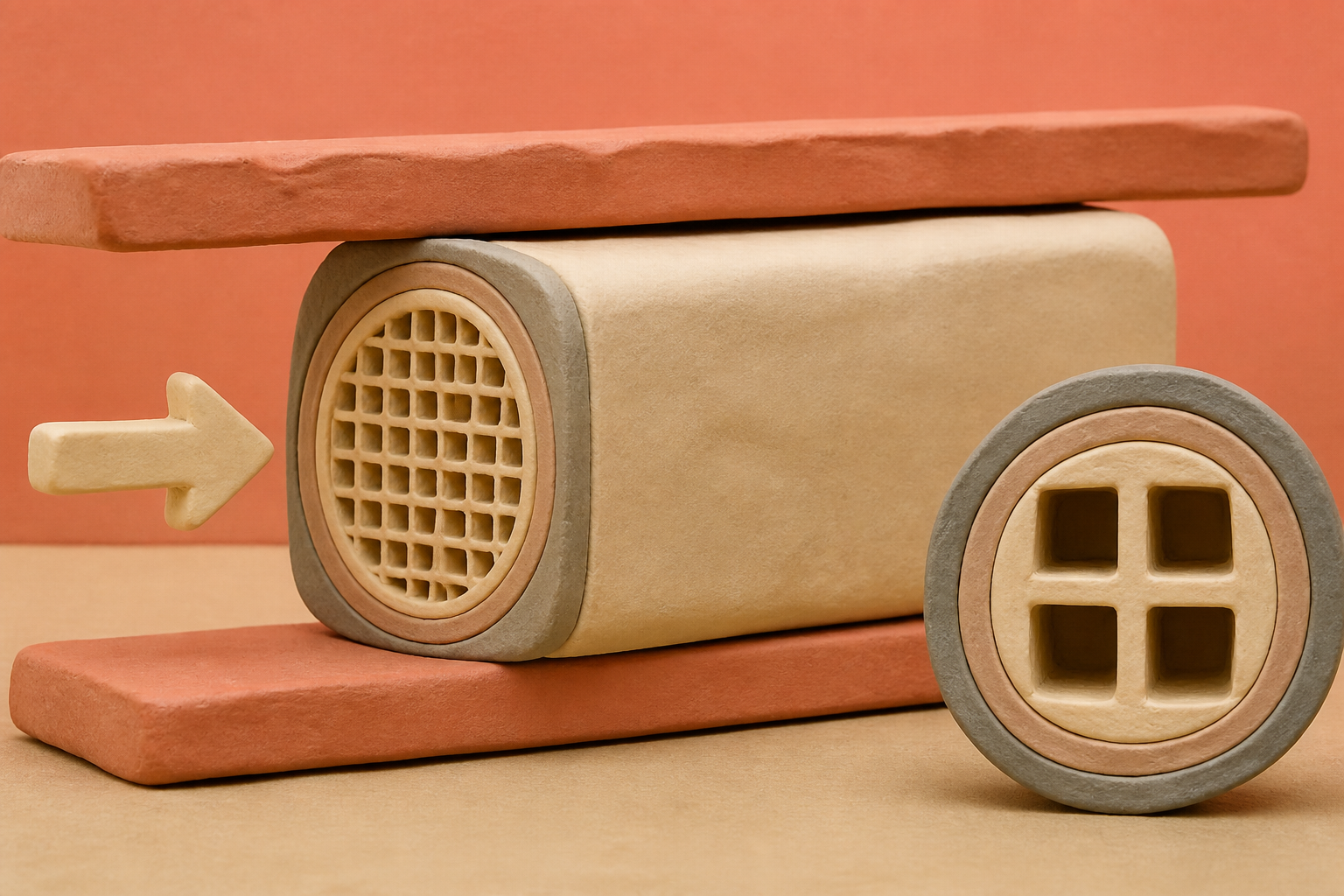
What changes in this design
A reader might expect exhaust cleanup to matter mainly after gases reach high temperatures. No ordinary alternative material or process is stated.
It specifies a material containing platinum and strontium, with strontium making up 0.1% to 9.0% by mass. It is intended to keep nitrogen oxides held on to, or adsorbed, at low temperature until a high-temperature environment.
The focus is the cooler period before high temperature. That makes the purpose easier to see: the material is intended to keep handling NOx during that transition. What it measures is not stated.
The first 200 degrees
An exhaust system has its hardest job before it is hot. In a just-started vehicle, the chemistry intended to clean nitrogen oxides, or NOx, has not yet reached its working temperature. A competing passive-NOx-adsorber patent puts the threshold for selective catalytic reduction at roughly 180 to 200 C. Until then, pollution has to be caught somewhere else.
That short interval has outsized regulatory weight. The cold-start phase of the U.S. FTP-72/-75 light-duty test carries a 0.43 weighting factor, according to a technical review of passive NOx adsorbers. I keep returning to that number because it explains why a component hidden beneath a car can remain commercially important even as the vehicle market shifts around it.
The cold-start gap
A passive NOx adsorber stores NOx while the exhaust is cold, then releases it when downstream chemistry can deal with it. The approach is not new: the modern burst of work followed widely cited 2013 and 2014 cold-start catalyst papers. Research has explored platinum or palladium on alumina, platinum or palladium on ceria, and palladium on zeolites.
The field has increasingly settled on palladium as the precious metal of choice. Umicore's 2021 patent takes that route, using palladium and platinum on a zeolite to store NOx at low temperature and release it later. I don't mean that as a verdict against platinum. It establishes the direction against which the newer application is making its case.
Strontium beside platinum
That case appears in US20260257173A1, published as “Exhaust Gas Purification Catalyst Composition, Exhaust Gas Purification Catalyst And Exhaust Gas Purification System.” It describes a composition containing platinum and strontium, with strontium at 0.1 to 9.0 percent by mass, intended to retain NOx adsorption from low-temperature conditions into a high-temperature environment.
Its Japanese priority patent, in the same family, identifies platinum at 0.05 to 5.0 percent by mass and defines low temperature as 330 C or below and high temperature as 540 C or above. It is assigned to Mitsui Kinzoku. The family presents strontium, rather than barium or magnesium, as supplying the base-point strength needed to hold NOx across that temperature span.
A patent claim is a proposal for a technical solution, not proof that it has won in production vehicles. Although I cannot tell from this record whether the material will outperform the palladium-zeolite route in use, the choice is plainly distinct: it tries to extend platinum's usefulness with strontium instead of following the material combination that has drawn much of the field's attention.
The catalyst ledger
Platinum is not a neutral foundation for that choice. A January 2026 market report put automotive use at roughly 80 percent of platinum-group-metal demand, said platinum gained more than 126 percent during 2025, and noted three preceding years of supply deficit. Bank forecasts for 2026 ranged from about $1,375 to $2,000 per ounce. The range itself is a reminder that the metal's cost is hard to treat as settled.
Mitsui Kinzoku's own results point in the opposite direction from a simple story of catalyst retreat. For the fiscal year ending March 2026, its Catalysts line reported ordinary income up 6.1 billion yen year on year, attributing the change to higher sales volume and a favorable platinum-group-metal price swing. I read those indicators as evidence that the business is active now, not as a prediction that it will stay that way.
A separate market forecast projects global catalytic-converter revenue falling from $18.096 billion in 2025 to $12.286 billion in 2034, a projected 5.7 percent annual decline, as electric vehicles gain share. That forecast also expects emissions rules and hybrid demand to sustain near-term pressure on catalyst performance. Both propositions can be true: the long-run installed market can shrink while makers still have a reason to improve the hardware sold into today's fleet.
The open question
The question for us is not whether a single patent can reverse electrification. It cannot. The more defensible reading, to my mind, is that the transition has a long middle: combustion vehicles and hybrids still face cold-start emissions requirements, while the materials that meet them remain costly and contested.
US20260257173A1 is one data point from that middle, and a revealing one. Its answer is not to abandon platinum, but to ask strontium to make platinum work longer across a difficult temperature range. Whether that answer proves durable, economical, and preferable to palladium-zeolite systems remains open. The filing does not settle the argument, but it shows that incumbent catalyst chemistry is still being actively argued over.
Sources
Reporting for this piece drew on the published filing and the references below.
- US20260257173A1 - Exhaust Gas Purification Catalyst Composition, Exhaust Gas Purification Catalyst And Exhaust Gas Purification System
- JP7519555B2 - Exhaust Gas Purification Catalyst Composition, Exhaust Gas Purification Catalyst, and Exhaust Gas Purification System
- Passive NOx Adsorber: An Overview of Catalyst Performance and Reaction Chemistry
- Cold Start Concept (CSC) - A Novel Catalyst for Cold Start Emission Control
- Platinum poised for strong 2026 as supply constraints offset EV headwinds
- Vehicle Catalytic Converter Market Outlook 2026-2034
- Mitsui Kinzoku - Record of Briefing Session Concerning FY2025 Results
The record, briefly. US20260257173A1, “Exhaust Gas Purification Catalyst Composition, Exhaust Gas Purification Catalyst And Exhaust Gas Purification System” The invention provides an exhaust gas purification catalyst composition containing Pt and Sr, with Sr content of 0.1% by mass or more and 9.0% by mass or less, to maintain NOx adsorption at low temperature until a high-temperature environment.
More angles on this
- Timing at the Kilogram-Scale Mushroom HandoffAnother reading from the same B01D classification family, separation.
- Degassing a bottle: a chamber, a pump, and the judgment left to whoever holds itAnother reading from the same B01D classification family, separation.
- CPC B01D: SeparationThe official classification family this record was filed into, published in the USPTO Cooperative Patent Classification scheme.
- CPC B01J: Chemical or physical processes, e.g. catalysis or colloid chemistry; their relevant apparatusThe official classification family this record was filed into, published in the USPTO Cooperative Patent Classification scheme.
- A Sleeve's Context HandoffAnother reading from the wider F16L classification family, pipes.
Read around this one:Public patent recordUSPTO published figure